Showing posts with label Giza. Show all posts

Thursday, 17 September 2026

From Dot to Cleopatra: A Complete History of Ancient Egypt

 From Dot to Cleopatra on Amazon


rom Dot to Cleopatra: A Concise History of Ancient Egypt is Alun Buffry's historical guide to ancient Egyptian civilisation, first published in 1997 by Frontier and later republished by ABeFree Publishing. The original edition is listed at 232 pages, while the current edition is substantially longer.

What the book covers

The book attempts to take the reader on a journey through the whole span of ancient Egyptian history, beginning before recorded history and continuing through the pharaohs to the death of Cleopatra VII—and, according to the publisher's description, somewhat beyond it. It covers:

  • The early development of Egyptian civilisation
  • The pharaohs and dynasties
  • Egyptian gods and mythology
  • The pyramids
  • The Sphinx and other monuments
  • Obelisks and mummies
  • Egyptian geography and the Nomes (administrative regions)
  • Archaeological discoveries
  • Legends and historical mysteries
  • Theories about ancient Egypt
  • A guide to visiting ancient Egyptian sites
  • Tables listing pharaohs and gods

The British National Bibliography classifies it under Egyptian civilisation and history to 332 BC, although the book's own description extends the story through Cleopatra VII, whose death was in 30 BC.

Buffry's approach

What seems distinctive about the book is that Buffry is trying to make an enormous and complicated subject accessible to a general reader. The publisher describes it as a "plain-speaking guide" that assumes no previous knowledge of Egyptian history. Rather than giving you a highly academic specialist study, it tries to guide you through thousands of years without getting overwhelmed by names, dates and dynasties.

The book also seems to have a balanced-but-curious attitude toward mysteries. The publisher's description says Buffry was trained in science and did not accept claims without evidence, but also did not automatically dismiss theories simply because he disagreed with them.

Why the title is interesting

The title From Dot to Cleopatra is deliberately broad. "Dot" suggests the beginning of everything—before conventional written history—while Cleopatra represents the end of the traditional pharaonic story.

In that sense, the book is really asking: How did one of the world's earliest great civilisations develop, flourish and eventually come to an end?

A useful way to think about the book

I'd describe it as sitting somewhere between:

A history book — because it gives a chronological account of Egypt.

A reference guide — because of its tables of pharaohs, gods and other information.

A mystery book — because it discusses the unanswered questions and theories surrounding ancient Egypt.

A travel companion — because it includes guidance on ancient sites for people visiting Egypt.

That combination makes it potentially useful for someone who wants an accessible introduction to Egyptology, rather than a narrowly academic study. The publisher specifically says it can be read quickly or dipped into repeatedly as a reference.

The other interesting detail is that Buffry himself has a longstanding personal connection with Egypt and later wrote Myhat in Egypt – Through the Eyes of a God and included his Egyptian travels in Heads, Hats and Tall Tales.

My overall impression: From Dot to Cleopatra seems best understood as Buffry's attempt to make the entire story of ancient Egypt approachable, while retaining a sense of wonder about the things we still don't know. It isn't presented as a conventional specialist Egyptology textbook; its appeal is the breadth of the journey and the author's willingness to explore both established history and the enduring mysteries of Egypt.

AncientA 

Wednesday, 22 July 2026

I asked chatGPT what evidence is there to say that the Great Pyramid was built in the reign of Khufu

I asked chatGPT what evidence is there to say that the Great Pyramid was built in the reign of Khufu?


it said:

There isn't one single inscription saying, "Khufu built the Great Pyramid in year X." Instead, the case comes from several independent lines of evidence that fit together.

 1. Khufu's name appears inside the pyramid

In the small, inaccessible relieving chambers above the King's Chamber, 19th-century explorers found red ochre quarry marks and graffiti left by the construction crews. Some contain cartouches with the name Khufu.

These marks appear to be work-gang markings, rather than a formal dedication. One famous example refers to a crew associated with Khufu. Because the chambers were sealed and inaccessible after construction, the markings are strong evidence connecting the monument's construction to Khufu's reign.

2. Ancient Egyptian records connect Khufu with the pyramid

The Inventory Stela, discovered at Giza in the 19th century, mentions Khufu and the Great Sphinx area. However, it is much later than Khufu's reign and is not considered reliable evidence that Khufu himself built the Great Pyramid. It is better viewed as evidence of a later Egyptian tradition associating Khufu with Giza.

3. The pyramid fits the chronology of Khufu's dynasty

The Great Pyramid's architectural style, surrounding temples, boat pits, and the development of the Giza pyramid complex all fit the Fourth Dynasty, specifically the period around Khufu's reign (c. 26th century BCE).

The pyramids of Khufu's successors, Djedefre and Khafre, provide a broader chronological sequence. The Great Pyramid is the earliest and largest of the major Giza pyramids, consistent with Khufu's position in the royal succession.

4. Radiocarbon dating supports the period

Radiocarbon dating of organic material associated with the pyramid and its construction has generally produced dates consistent with the Old Kingdom and the Fourth Dynasty. The results have some variation and are not precise enough to say "this was built in Khufu's Year 17," but they broadly support the accepted chronology.

5. The Diary of Merer provides a remarkable contemporary connection

One of the most important discoveries is the Diary of Merer, a roughly 4,500-year-old administrative papyrus found at Wadi al-Jarf. Merer was an official who supervised a team transporting limestone from Tura to Giza.

The diary mentions work

 question: what evidence to argue that the Great Pyramid was not built by Khufu?

 There are arguments used by some alternative-history writers to claim the Great Pyramid was not built during Khufu's reign, but it's important to distinguish between legitimate uncertainties and evidence that actually contradicts the mainstream chronology.

Here are the main arguments and how archaeologists generally assess them:

1. The Khufu inscriptions could be later additions

The most famous evidence linking Khufu to the Great Pyramid is the red ochre quarry marks in the relieving chambers above the King's Chamber, including markings containing Khufu's name.

Critics argue that:

  • The marks were discovered by Howard Vyse in 1837.
  • Vyse was accused by some contemporaries of questionable archaeological practices.
  • Therefore, the markings might have been forged.

Problem with this argument: There is no convincing evidence that they were forged. The markings are consistent with construction graffiti found elsewhere in ancient Egyptian monuments, and the use of Khufu's cartouche fits the archaeological context. The forgery theory remains highly speculative.

2. The Great Pyramid has no formal inscription naming Khufu as its builder

Unlike some Egyptian monuments, the Great Pyramid doesn't contain a prominent inscription saying, essentially, "Khufu built this pyramid."

This is true. But it isn't particularly unusual. Egyptian pyramids were primarily royal funerary monuments, and the absence of a dedicatory inscription isn't evidence that Khufu didn't build it.

The argument is therefore better described as an absence of direct evidence, rather than evidence against Khufu.3. The pyramid's dating is partly based on conventional chronology

Some critics argue that the dating of the Great Pyramid depends on the established Egyptian chronology, which itself has uncertainties.

There is some truth here: ancient chronology is not precise to the exact year, and different dating methods have margins of error.

However, the chronology is supported by multiple independent sources, including:

 Egyptian king lists and historical records

  • Archaeological sequences
  • Radiocarbon dating
  • Stratigraphy
  • Architectural development
  • Contemporary administrative documents

So there is uncertainty about the exact date, but not strong evidence that the pyramid belongs to a completely different period.

4. The Great Pyramid appears to have been built on a much older site

The Giza Plateau contains evidence of earlier activity, and the bedrock itself is obviously much older than the pyramid.

Some researchers have argued that the site—or even parts of the complex—could have been constructed much earlier and later modified by Khufu.

This is sometimes connected to claims about water erosion on the Sphinx and a proposed much older age for the Sphinx.

 The difficulty is that there is no comparable archaeological evidence showing that the Great Pyramid itself existed thousands of years before Khufu. The geological and archaeological evidence for the pyramid is consistent with Fourth Dynasty construction.

5. The pyramid's precision is argued to be beyond Fourth Dynasty capabilities

Another argument is that the Great Pyramid is so precisely aligned and engineered that ancient Egyptians supposedly could not have built it around 2600 BCE.

Examples cited include:

  • Its extremely accurate cardinal alignment
  • The precision of its stonework
  • Its enormous scale
  • The sophisticated internal architecture

This is an interesting question about how it was built, but it isn't evidence that it wasn't built by Egyptians of Khufu's era. Archaeology shows that Fourth Dynasty Egypt had:

  • Large organized labor forces
  • Copper tools
  • Stone-working techniques
  • Surveying methods
  • Extensive quarrying infrastructure
  • Highly centralized administration

The precise methods used are still debated in some details, but the overall engineering is within the demonstrated capabilities of the period.

6. The Great Pyramid may have had a purpose other than a tomb

There is no mummy of Khufu in the Great Pyramid, and the King's Chamber contains only an empty granite sarcophagus.

This has led some people to argue that it wasn't a tomb at all.

The counterargument is that the pyramid was probably looted in antiquity. The absence of a surviving burial isn't surprising given the enormous amount of time that has passed. Other Egyptian royal pyramids were also found empty.

The pyramid's architecture and its relationship to the surrounding temples, causeway, and funerary complex are strongly consistent with a royal tomb complex.

 7. The Great Pyramid may have been built by an earlier civilization

This is the most radical alternative hypothesis. Proponents sometimes suggest that:

  • An unknown advanced civilization built it.
  • The Egyptians inherited or modified it.
  • It dates to the end of the last Ice Age or earlier.

The main evidence cited includes astronomical interpretations, geological arguments, and the pyramid's engineering sophistication.

The major problem is lack of archaeological evidence. There is no demonstrated earlier civilization at Giza that left behind the enormous industrial footprint that such a project would require. By contrast, there is extensive evidence of Fourth Dynasty Egyptian activity at the site.

 At present, no.

There are legitimate questions about the exact construction date, the construction techniques, and the precise role of the pyramid in Egyptian religious practice. But the evidence that the Great Pyramid was constructed during Khufu's reign is considerably stronger than the evidence for an alternative date.

The most reasonable conclusion is:

The evidence doesn't prove beyond every conceivable doubt that Khufu personally "built" the Great Pyramid—he almost certainly didn't lay the stones himself—but it strongly supports the conclusion that the monument was commissioned and constructed as part of his royal funerary complex during his reign.

One important nuance is that "built by Khufu" can mean two different things. If you mean "Khufu personally designed and supervised the construction," the evidence is weak. If you mean "the Egyptian state under Khufu commissioned and constructed it," the archaeological evidence is strong.

END ... BUT ...
 

Scientists may have finally cracked how the Egyptians built the pyramids


Sunday, 10 May 2026

Secrets of Egypt's Great Pyramids point to lost 'supercivilization' from 12,000 years ago

  Story by Chris Melore, Assistant Science Editor For Dailymail.Com 

An Egyptologist is making the case that the Great Pyramids were built by an advanced civilization thousands of years earlier than previously thought.

António Ambrósio, an independent researcher from the Autonomous University of Barcelona, detailed the mysterious clues that point to the three main pyramids at Giza being up to 12,000 years old, predating the Egyptians by millennia.

If Ambrósio's theory were to be proven correct, it would rewrite the history of modern humans and expose the existence of a still-unknown 'supercivilization' on Earth that constructed pyramids and other megastructures around the world.

 At the heart of the researcher's case are a set of key inconsistencies Ambrósio and other scholars have claimed as proof that the Egyptians only copied the original three pyramids after discovering the ancient structures at Giza..

The new paper, which has not been peer-reviewed, argued that no royal mummies or burial items have ever been found inside the Giza pyramids, despite the ancient Egyptians claiming these were the tombs of Khufu, Khafre and Menkaure.

Moreover, the original Giza pyramids, currently believed to have been built 4,600 years ago, displayed stunning engineering skill that aligned with star constellations, featured super-precise stone cuts and had a base that was almost perfectly level on all sides.

Ambrósio explained that these incredible engineering feats were never matched by any of the smaller pyramids confirmed to have been built during the time of the Egyptians between 2500 and 2150 BC.

The researcher added that the nearby statue of the Sphinx has shown signs of water erosion from heavy rain, which hasn't happened in Egypt since around 5000 to 3000 BC, suggesting that the entire site was already ancient and eroding at the dawn of the Egyptian civilization in 3100 BC.

The pyramids of Giza were not built by the pharaohs of the Fourth Dynasty, but rather appropriated by them,' Ambrósio stated in the paper entitled 'The Pyramids of Giza: Legacy of an Unknown Civilization.'

'Subsequent pyramids (and earlier ones, according to the conventional timeline) would represent imperfect attempts to imitate preexisting structures.'

 Ambrósio claimed that there are no definitive ancient writings from the time directly tying the pharaohs to the construction of the pyramids.

One main link is called the Khufu cartouche, a red-ochre painted hieroglyph containing the name 'Khufu' inside one of the hidden chambers above the King’s Chamber in the Great Pyramid of Giza.

While many mainstream Egyptologists have concluded the painted hieroglyph is genuine, skeptics, including authors Scott Creighton and Zecharia Sitchin, have claimed this mark was faked by Colonel Howard Vyse in 1837.

'No mummy has ever been found in the pyramids of Giza. The discovery of a supposed sarcophagus of Khufu, found empty, does not prove that he built the pyramid - only that he claimed it,' Ambrósio declared.

While the origins of the main pyramids of Giza are still disputed, multiple studies have concluded that some of the knowledge and skill to build these mega structures was lost during Egypt's Fifth and Sixth Dynasties.

The new paper noted that Egyptian pyramids built after Giza were noticeably smaller, contained multiple construction flaws, were made with weaker building materials and did not align with the stars.

 Meanwhile, Ambrósio pointed out that mega structures similar to the Great Pyramids have been discovered across the globe, which point to the same civilization sharing their advanced building techniques with other early human cultures.

The paper specifically mentions megalithic structures that share characteristics with the Giza pyramids, including the ancient Incan citadel Sacsayhuamán in Peru and the city of Baalbek in Lebanon. 

 The pyramids of Giza may be the legacy of an unknown earlier civilization, an advanced culture that mastered lost technologies,' Ambrósio theorized.

'The Fourth Dynasty would have reutilized these structures, while subsequent dynasties attempted, unsuccessfully, to replicate them.'

The researcher added that the ancient Egyptians had their own mythological concept known as Zep Tepi, or 'the First Time.'

It referred to an initial golden age when the world was created, the gods emerged from chaos, established a cosmic order, and ruled directly on Earth before human kings took over.

However, researchers such as Graham Hancock and Robert Schoch have championed the fringe theory that Zep Tepi was a real historical period where this lost civilization thrived approximately 12,000 years ago, in 10,500 BC.

 Independent researcher Matthew LaCroix told Daily Mail that this advanced culture may have hidden a sophisticated code through geometry, symbolism, and monument design across the globe to preserve its knowledge ahead of catastrophic events.

Sparked by another recent find in Egypt, the discovery of recurring giant T-shapes, three-level indents and step pyramids carved into ancient stones worldwide, the symbols have been linked across continents to a time even older than Zep Tepi, dating back 38,000 to 40,000 years.

 According to LaCroix, this civilization tracked cosmic cycles and embedded teachings about the structure of the universe into monuments and sacred sites, just as the pyramids at Giza perfectly line up underneath Orion's Belt.


Wednesday, 25 February 2026

Origins of Egypt's Great Pyramid upended as clues point to lost civilization from 20,000 years ago

Origins of Egypt's Great Pyramid upended as clues point to lost civilization from 20,000 years ago.

 by Stacy Liberatore, MSN, February 25, 2026

 For more than a century, Egyptologists have dated the Great Pyramid to around 2580 BC, about 4,600 years ago.

A controversial new study now claims the monument could be tens of thousands of years older.

Italian engineer Alberto Donini from the University of Bologna said erosion patterns at the pyramid's base suggest it may have been built between 20,000 and 40,000 years ago, far earlier than the conventional timeline.

Donini's Relative Erosion Method (REM) estimated the pyramid's age by comparing how much erosion occurred on stones exposed since construction with nearby stones whose exposure time is known.

By measuring the difference in wear, he calculated how long the older stones have been exposed, producing dates that far exceed traditional estimates.

The study, which has not yet been peer-reviewed, examined twelve points around the pyramid's base.  Some measurements suggested tens of thousands of years of erosion, with the average pointing to roughly 25,000 years.

Donini also proposed that Pharaoh Khufu may have renovated the pyramid rather than built it, potentially revising assumptions about its original authorship.

If the dates proposed by Donini are accurate, the Great Pyramid could predate not only the reign of Khufu but also the rise of any known advanced civilizations, raising fundamental questions about human history and architectural knowledge in the distant past. 

The Great Pyramid of Giza, the largest of the three pyramids on the Giza Plateau, was built by Pharaoh Khufu during Egypt's Fourth Dynasty. 

It sits alongside the Pyramid of Khafre, the Pyramid of Menkaure and the Great Sphinx, all shrouded in mystery due to their precise alignment, unusual construction methods, and debated purpose. 


The new study measured erosion at twelve points around the base of the Great Pyramid of Khufu. 

At each point, Donini compared limestone surfaces that had been exposed since the pyramid's construction with adjacent surfaces that were only exposed after the outer casing blocks were removed about 675 years ago. 

He measured the volume of eroded material on both surfaces and calculated a ratio, which allowed him to estimate how long the older stones had been exposed.

Each point produced a different age, ranging from about 5,700 to over 54,000 years.

However, the average suggested a 68 percent probability that the pyramid was built between roughly 11,000 and 39,000 years ago, with an overall average of about 24,900 years.

Donini emphasized that REM does not provide a precise construction date, but rather an estimate of the structure's age range with an associated probability. 

Although the resulting date ranges are wide, the conclusions indicate a low probability for the official archaeological dating of 2,560 BC,' he said.

The study challenges long-held assumptions about ancient Egypt and has ignited debate among archaeologists, historians and engineers. 

Some scholars have pointed out that evidence for the pyramid’s construction has always relied heavily on textual sources, like the later inscriptions found inside the monument, which may not reflect the original building period.

Donini’s approach differs from traditional archaeological dating, which often relies on historical records, carbon dating of organic material, or stylistic comparisons with other monuments. 

By focusing on the physical erosion of the stone itself, REM offers a method that is independent of historical accounts, providing an entirely new perspective on the pyramid’s age.

The study also acknowledges that many factors, including climate variation, acid rain, foot traffic, and partial burial under sand, introduce uncertainty into the calculations. Despite these variables, the consistent results across twelve measurement points strengthen the claim that the pyramid’s base has endured tens of thousands of years of exposure.

Whether the findings will overturn centuries of Egyptological consensus remains to be seen, but the research has already reopened one of archaeology’s most enduring mysteries.


Friday, 6 February 2026

From Dot to Cleopatra book reached Nigeria

 I am pleased that through Books2Africa some of the last copies of my book "From Dot to Cleopatra" original paperback edition have reached happy readers in Nigeria.

This has encouraged me to release a new paperback edition and a hardcover edition both available on Amazon along with the Kindle edition. 


Wednesday, 4 February 2026

New Analysis Suggests That The Great Pyramid Of Giza Is Potentially 20,000 Years Older Than Experts Thought

 https://allthatsinteresting.com/when-was-the-great-pyramid-of-giza-built

New Analysis Suggests That The Great Pyramid Of Giza Is Potentially 20,000 Years Older Than Experts Thought 

A new method that compares points of erosion on the Great Pyramid of Giza suggests that this iconic monument could have been constructed as early as 23000 B.C.E. — 20,000 years earlier than previously believed.

When Was The Great Pyramid Of Giza Built

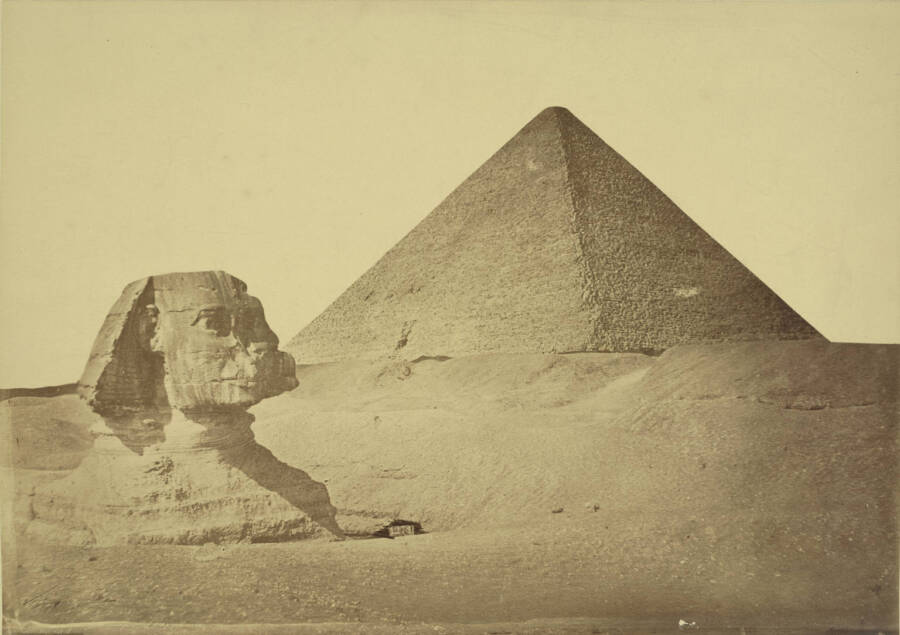
Cornell University LibraryThe Great Pyramid of Giza and the Great Sphinx, pictured here in the late 19th century. New research purports to upend established theories about when the Great Pyramid of Giza was built.

The Great Pyramid of Giza, generally believed to have been built as the tomb of Pharaoh Khufu around 2575 B.C.E., is one of the Seven Wonders of the Ancient World. But what if it’s even older than that?

Alberto Donini, an engineer from the University of Bologna, recently applied a new dating system that he calls the “Relative Erosion Method” (REM) to the pyramid. Now, he’s claiming that his research suggests the famous landmark may have actually been built nearly 25,000 years ago.

When Was The Great Pyramid Of Giza Built? The Origins Of Egypt’s Ancient Wonder

Scientific studies of the pyramids at Giza have been ongoing for centuries, so the current timeline of their construction is widely accepted. As it stands, the Great Pyramid was seemingly built during the reign of Pharaoh Khufu, who ruled over Egypt from roughly 2589 B.C.E. to 2566 B.C.E. The Pyramid of Khafre came shortly thereafter, followed by the Pyramid of Menkaure.

This timeline was determined using both historical records and scientific study. Ancient authors like Herodotus wrote that Khufu had the Great Pyramid constructed as his tomb, noting that he “brought the people to utter misery” by making them transport impossibly heavy limestone blocks from quarries — possibly located hundreds of miles away — in order to erect the 481-foot structure. Exactly how they managed this remains a mystery to this day, though several promising theories have been put forth, such as the use of a ramp system.

Pharaoh Khufu

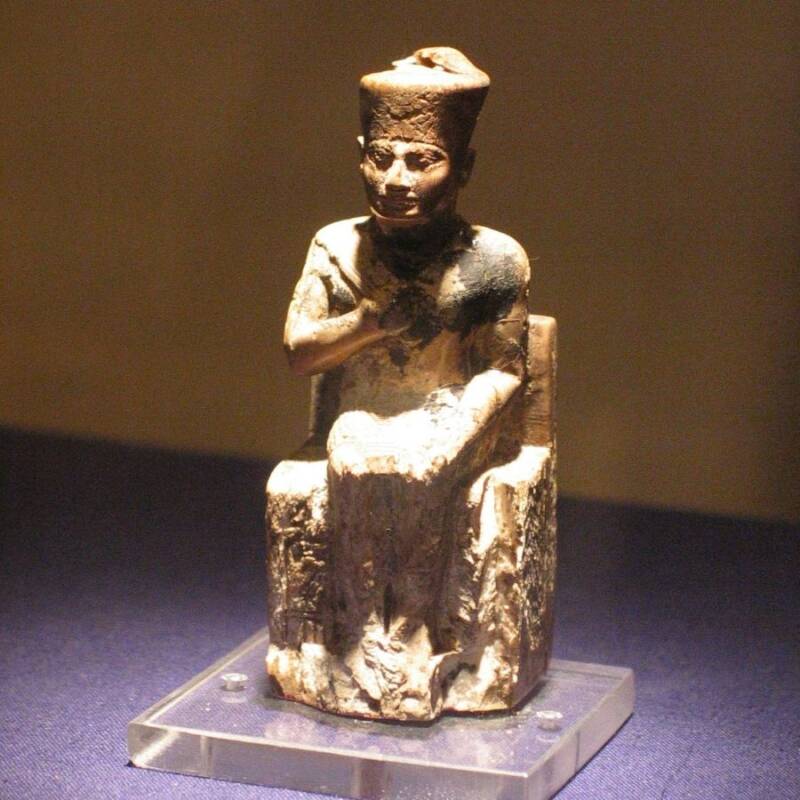
Public DomainA statue of Khufu at Cairo’s Egyptian Museum.

Then, in the 1800s, archaeologists discovered graffiti inside the Great Pyramid that mentioned Khufu by name. It was seemingly scrawled by the workers who built the monument, adding another layer of evidence that the structure was built during that pharaoh’s reign.

Archaeologists later used scientific methods to date the pyramid. They radiocarbon dated the mortar used to secure the stone blocks, which was made using ashes and thus contained organic matter. These results suggested that the mortar was likely mixed between 2620 and 2484 B.C.E., once again aligning with the reign of Khufu.

With so much proof pointing to a construction date of roughly 2575 B.C.E., it seems unlikely that there’s any additional information out there that could significantly change the timeline. However, Alberto Donini claims that his research could completely rewrite this story.

Why The Relative Erosion Method Could Complicate The Story Of How Old The Great Pyramid Of Giza Is

In a preliminary report on his research, Alberto Donini describes his new “Relative Erosion” dating method: “The REM is based on the ratio between two types of erosion affecting the same type of rock in the same location: one with a known date and the other with a date to be determined. The ratio is then used to calculate the age of the stone block under examination.”

When the pyramids of Giza were built, they were covered in a gleaming casing of smooth, polished, white limestone. Then, in 1303, a massive earthquake struck the region, knocking some of these stones to the ground. The fallen material was recycled to build palaces and mosques in Cairo, and in the years that followed, even more of the limestone was removed intentionally to use for decorative purposes. By 1400, much of it was gone.

How Old Is The Great Pyramid Of Giza

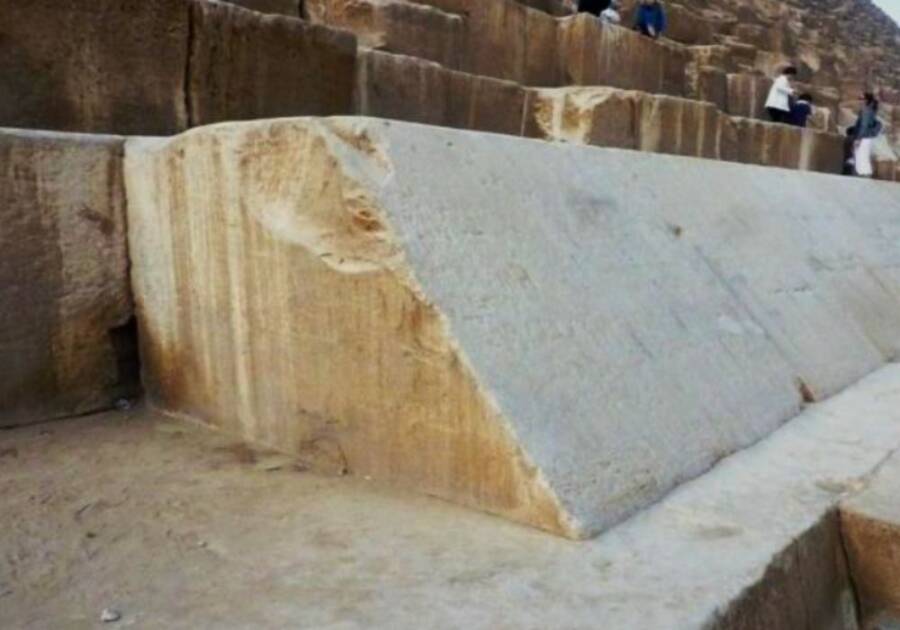
Alberto DominiA small section of the Great Pyramid where the smooth, white limestone cladding still remains.

Donini began his research by comparing the areas of the Great Pyramid that were once covered by limestone with stones at the structure’s base that have always been exposed to the elements. By comparing the amount of erosion that’s taken place in the past seven centuries to the amount of erosion on the blocks that were never covered by limestone, Donini believed he could calculate when those original stones were placed.

Donini noted that erosion occurs by several means. Water is a major source, from runoff dripping onto surfaces to trickles of liquid seeping into small cracks, freezing, and expanding. Wind blowing rough sand from Egypt’s desert also wore down the limestone over time, as did temperature fluctuations, acid rain, and surface wear from humans touching and walking on the surfaces.

There were several factors that Domini took into account while making his calculations. First, he acknowledged that there’s been an increase in foot traffic in the modern era, leading to more surface erosion in recent years than in ancient times. There’s also likely been more acid rain since the Industrial Revolution. These elements could lead to an underestimation of the Great Pyramid’s age.

Alternatively, the climate was wetter in ancient times, so more rain then could have led to faster erosion rates than those seen in the past few centuries. This, in turn, could lead to an overestimation of the monument’s age.


Hardback Edition of From Dot to Cleopatra

 https://www.amazon.co.uk/dp/1919212949 

From Dot to Cleopatra is precisely what it says: a hisstory of ancient Egypt suitable for everyone from the holiday traveller to the more serious student, it contains a wealth of information including tables of Gods, Pharoahs and Pyramide as well as a guide to visiting the ancient sites of modern Egypt.

Publisher's comments:
Alun Buffry's From Dot to Cleopatra takes out the confusion and presents the facts and the mystery in a plain-speaking guide which takes the reader from year dot before the beginning of recorded history to the time of Cleopatra's death. Thousands of years of Egyptian culture, with special reference to the pyramids, are recounted in a manner which does not baffle and assumes no previous knowledge of this history. The author leads us comfortably through a whole field of fact and theory recorded by antiquarians, archaeologists, pre-historians, treasure and fame hunters, even a crank or two! Here are the names, Nomes, Pharaohs, gods, kings, pyramids, obelisks, sphinxes and mummies, dynasty by dynasty: here, too, the legends, discoveries and great questions. At home or visiting Egypt, readers are saved much research as Alun Buffry gets to the core. He's a scientist, so he doesn't accept things as true unless they are proved, but he doesn't dismiss a theory because he doesn't agree with it. He is a fireside fabler and chronicler too, bringing us to our own conclusions as he tells the oldest stories which, with 'From Dot to Cleopatra', anyone can follow. This is an up-to-date reference book which can easily be read in a few days or dipped into for years. It includes a guides to the monuments and, a bonus for serious Egyptologists, the author's list of Pharaohs. You'll find plenty of mystery with the history, enough to share the fascination in Ancient Egypt which has lured explorers and amazed everyone else for centuries. Reader's comments: "I was never very interested in Ancient Egypt until I read "From Dot to Cleopatra", now I am fascinated by it." : Dr Anne Biezanek "Knowing Alun personally I decided to read his book. I am not a great reader but this was easy going. Every time I put it down I had to pick it up again soon, until I finished it. Now I will read it again. Alun writes as he talks, his humour is always there." : Jane Appleton, Housewife "We both thoroughly enjoyed From Dot to Cleopatra": Rev Robin and Rev Adrienne Scott "I can hardly believe how well you managed to include so much information on such a huge subject in such a small book in such a readable and presentable fashion." : John Adam, Web Designer.

TABLE OF CONTENTS
Introduction WHEN WAS DOT? FACT, THEORY AND FICTION THE ANCIENT EGYPTIANS GODS AND GODDESSES DIVINE PLAY TOMBS, PYRAMIDS AND MUMMIES THE GREAT PYRAMID OF CHEOPS : FACTS A MILLENNIUM AND A HALF MOSES, MAGIC AND WRITING THE EIGHTEENTH DYNASTY MORE RAMESSES THE LATE PERIOD AND THE GREEKS THE PTOLEMIES CLEOPATRA, JULIUS AND MARCUS DAILY LIFE IN ANCIENT EGYPT VISITING THE MONUMENTS GLOSSARY

First published in softback by Frontier 2000 Publishing, in 1997, the paperback version was so popular that it has been republished by ABeFree Publishing asa hardcover.


Friday, 3 August 2018

Visualisation from 'Myhat in Egypt: Through the Eyes of a God':by Alun Buffry


 Myhat, Ed and Ana visit the Pyramids 1989 A visualisation of a visit to the Giza site in Egypt to see inside and outside of the Great Pyramid of Cheops (Khufu), taken from 'MyHat in Egypt Through the Eyes of a God' by Alun Buffry ISBN 978 0 9932107 7 8 available through Amazon and good shops.

Thursday, 21 April 2016

This unprecedented historical discovery will rewrite our history!

The archaeological establishment is scrambling to find some reason to reject and pour scorn on the extraordinary consequences of the excavations now taking place at Gunung Padang in Indonesia.
Since its first exploration by archaeologists in 1914 the site was thought to be a natural hill with 2500 year-old megalithic structures on top of it. But in 2010 geologist Dr Danny Hilman Natawidjaja (who earned his doctorate at Cal Tech) recognized this “hill” as a possible man-made pyramid and began to explore it using ground penetrating radar, seismic tomography, resistivity survey and other remote sensing techniques, as well as some direct excavations and deep core drilling.
The results were immediately intriguing producing evidence of deeply buried man-made chambers and yielding carbon dates going back as far as 26,000 years. This was the last Ice Age when our ancestors are supposed (according to the orthodox archaeological model) to be have been nothing more than primitive hunter gatherers incapable of large-scale construction and engineering feats. Was it possible that geologist Natawidjaja was unearthing the proof of a lost advanced civilization of prehistoric antiquity? Such ideas are heresy to mainstream archaeologists and sure enough the archaeological establishment in Indonesia banded together against Dr Natawidjaja and his team, lobbied the political authorities, agitated locally and succeeded in slowing down, though not completely stopping, the further exploration of Gunung Padang.
Dr Natawidjaja fought back, doing some high-level lobbying of his own, taking the matter to the President of Indonesia himself. There were further delays to do with elections in Indonesia but just a couple of months ago, in mid-August 2014, the final obstacles were lifted and Dr Natawidjaja and his team moved back onto the Gunung Padang site with full approval to go ahead with their work, including permission to excavate the concealed chambers.

Archaeologists were furious and immediately began lobbying to get the work stopped – fortunately to no avail as preliminary excavations have produced results that prove beyond doubt that Gunung Padang in indeed a man-made pyramid of great antiquity as Dr Natawidjaja had long ago proposed. Even the relatively young layer so far excavated (the second artificial columnar rock-layer beneath the megalithic site visible on the surface) has yielded dates of 5200 BC (nearly 3000 years older than the orthodox dating for the Pyramids of Giza in Egypt) and there are firm indications from the original remote sensing and core drilling work of much older layers below. In short, it is now evident to all that the site is vastly older than the 2500 years that archaeologists had insisted upon for decades. Even the most hostile amongst them are therefore now reframing their assessment of the site and referring to it as “a gigantic terraced tomb, which was part of the biggest megalithic culture in the archipelago.”
For a flavor of the sour grapes the archaeological establishment feel towards Dr Natawidjaja and his team see this recent article from the Jakarta Post:
I asked Dr Natawidjaja for his response to the Jakarta Post article and he replied as follows:
“The article has got the story all wrong.  All excavations were supervised by archeologists from Agency for Conservation and Management of Archaeological Sites (BPCB) and University of Indonesia.  The excavation sites have also recently been inspected by the Director for Conservation of Archeological Sites (who is the boss of Miss Desril Shanti ), by the head of the BPCB, and by the Minister of Education and Culture himself.  Afterward, they gave a press conference confirming that all excavations are good and proper.  For information, the head of the National Archeological Center, which is the main office above local Archeological Centers including Bandung Archeological Center, is also a member of the National Team for Gunung Padang. The Jakarta Post article is also wrong about the funding.  The Minister of Education and Culture did indeed announce in the press conference that he would allocate about Rp 3 billion for the research but it has not begun to be disbursed yet.  So far, I and my team are still working willingly on our own funding with the help of the soldiers (TNI) who have been working alongside us.  Of course the TNI have their own funding – but not from that Endowment Fund.”
As to the progress of the work at Gunung Padang, Dr Natawidjaja writes as follows:
“The research progress has been being great.  We have excavated three more spots right on top of the megalithic site in the past couple weeks, which give more evidence and details about the buried structures.  We have uncovered lots more stone artifacts from the excavations.  The existence of the pyramid-like structure beneath the megalithic site is now loud and clear; even for non-specialists, it is not too difficult  to understand if they come and see for themselves.    We have found some kind of open hall buried by soil 5-7 meters thick; however we have not yet got into the main chamber.  We are now drilling to the suspected location of the chamber (based on subsurface geophysic) in the middle of the megalithic site.”

 http://fabweb.org/2015/08/13/this-unprecedented-historical-discovery-will-rewrite-our-history/

Tuesday, 4 February 2014

THE GREAT PYRAMID OF CHEOPS : FACTS

“The Pyramid which is the Place of Sunrise and Sunset”
Fourth dynasty; approx. 2575 BC ?

As the reader will know the pyramids at Giza are amongst the greatest and most mysterious structures ever built.  I hesitate before saying “ever built by man”.  We do not know who really built them, when or why!

Although it is generally believed that these massive structures were built over about 70 years, anyone with any knowledge of even the most up-to-date engineering technology available today will know that this would be an impossible task now, let alone thousands of years ago before they had even invented the wheel or the pulley.  Classic Egyptologists tend to rely on their readers ignorance or lack of imagination when they state figures like 100,000 men taking 20 years to build the Great Pyramid.

A quick calculation reveals the impossibility of such a feat, using ropes and rollers and dragging stones up to 70 tons up ramps, placing them in incredibly accurate positions which aligned perfectly with the stars.  They seldom consider how these ancient workers could have dragged and lifted the stones weighing 200 tons used to build the temples and causeways around the pyramids and Sphinx.

Although it is often stated that the Pharaohs Khufu, Khafre and Menkaure ordered the building of these wonders in the fourth dynasty, there is no actual evidence of this.  Quarry marks inside the Great Pyramid may be forgeries; the tiny statue of Khufu found, upside down as if dropped, in a crack in the ground outside the pyramid no more suggests that he was the builder than would the finding of Nelson’s Column in Trafalgar Square suggest that Nelson engineered the Square.

Not only are these impressive structures surrounded by mystery, but it appears that even the Egyptian authorities are keen to suppress any new discoveries and many explorers have in recent days been stopped from continuing their work on the point of possibly momentous discoveries.  This is precisely what happened to the work of scientist Rudolf Gantenbrink who, using a robot, examined the so-called ventilation shafts leading from the so-called Queen’s Chamber in 1993.  Having found evidence of a small door at the end of one shaft and seen (through the robot eye) a piece of wood which could be dated to reveal the true age of the pyramid, his work was halted and he has not been allowed to continue since.  Others, like John West and the geologist Robert Schoch of Boston University, have been ignored, because the results of their work would seriously effect the classic Egyptologists view of the past;  their work on the weathering of the Sphinx would suggest it is much older than Egyptologists want it to be.  It certainly appears that either there is some hidden knowledge which us common folk are not privilege to, or else there is some sort of anti-intelligence conspiracy.

There are hundreds of books written on the Great Pyramid.  Authors approach the monuments from a variety of angles.  For some it is evidence of extra-terrestrial life or of an advanced civilisation from the past.  Others see the Pyramid as a cosmic message, either warning us of some great disaster or promising us the coming of a Messiah.   Measurements, undeniably precise, can be interpreted as magical, astronomical or numerological.  Some claim the Pyramid was a tomb, others an observatory of the stars and yet others believe it was a centre for mysterious initiation ceremonies.  Whatever its true purpose, it is now certain that  a great number of inscriptions, paintings and papyri refer to Giza in terms we are only just beginning to understand.

As the author of this presentation, I would have thought the whole thing was no more than science fantasy, if I had not myself been able to walk around, enter and climb upon the Great Pyramid.

Items found within the Great Pyramid of Giza

Iron Plate 2.6 cms x 8.6 cms, discovered by J.R.Hill (1837) stuck inside joint inside southern shaft from King’s Chamber.  Purpose and origin unknown.  Now in British Museum.
Three items found in northern ‘ventilation’ shaft from Queen’s Chamber: *
1.Piece of cedar wood: may have been a measure
2.Bronze forked hook-like item, believed to have been used for Opening of the Mouth ceremony, with part of wooden handle.
3.Green granite ball, 0.850 kg (1 lb 3 oz)
All discovered by Wayman Dixon and Grant in 1872.
 *NB  : These so-called ‘ventilation’ shafts where these objects were found do not appear to have run as far as the outside of the pyramid.
Size and comparison of size
Height 418.9 feet (146.0 m)
North side755 feet 4.9818 inches
West side755 feet 9.1551 inches
East side755 feet 10.4937 inches
South side756 feet 0.09739 inches
Corner Angles :  SE 89o 56’27”;   NE 90o 3’ 2”;  SW 90o 0’ 33”;  NW 89o 59’ 58”
Area  53,000 square metres
Estimated number of rocks = 2,500,000; average weight 2.6 tons
91,000,000 cubic feet
Estimate of tonnage of rock = 6,300,000 tons

The following size comparisons have been made:
The pyramid contains more solid masonry than all the cathedrals, churches and chapels built in Britain since the time of Christ.
The Great Pyramid could contain the cathedrals of Florence, Milan, St. Peter’s, Westminster Abbey and St. Paul’s.
The base of the pyramid occupies 13 acres, equivalent to 7 New York city blocks!
The casing blocks were removed by Arabs to build the mosques of Cairo; the mosques contain less material than than the outer casing of the pyramids..

Early entries:
It seems likely that the Great Pyramid was open through most of the New Kingdom and then sealed up, maybe due to local superstitions that it housed powerful magic or a powerful and frightening magician.
Within the period of fairly ‘modern’ history there was a report by the historian Strabo in 24 BC, that the entrance to the Great Pyramid was through a hinged stone door, which, once replaced, was indistinguishable from the rest of the outside of the pyramid.  There is no evidence of this, although one of the pyramids at Dahshur does have such a doorway.  At this time it must have been an even more magnificent building since the outer layer of polished limestone was still intact.  Remember that the pyramid was, to Strabo, as ancient as Strabo is to us today.

The first major attempt to re-find or create an entrance after the original entrance was lost, was in 820 AD by the young caliph Abdullah Al Mamun.  Convinced that the pyramid contained much treasure the caliph used the services of many men to try to burrow in through the side.  Hammers and chisels failing they then tried cracking the stones by throwing cold vinegar onto the stones heated by red hot fires, knocking out the pieces.  This process enabled them to tunnel in one hundred feet.   They met up with a passageway 3_ feet wide by nearly  4 feet high, sloping at an angle of 26o.   They discovered a large stone on the floor, which seemed to have been dislodged from the roof.  They then discovered the original secret entrance ninety feet to the North and some forty-nine feet above the base of the pyramid.  Following this tunnel, the ‘Descending Passage’ as it became known later, they came upon the empty ‘pit’.  Returning to the fallen stone they attempted to dislodge further stones from the ceiling but were unable to do so.

They decided to dig in along side this huge ‘plug’.  After six feet they found another plug, then a third.  Eventually they came to limestone so hard that they could go no further so they forced there way into the ‘Ascending Passage’, again 4 feet high, at a slope of 26o again.  They crawled 150 feet along this slippery passageway, reaching a horizontal passage which itself led to a rectangular limestone chamber with a gabled limestone ceiling, which later became known as the ‘Queen’s Chamber’, although there was no evidence that it related to any ancient queen; in fact it was the Arabs who buried their women in tombs with gabled ceilings.  There was an empty niche in one of the walls, which attracted Mamun’s attention further, which could have once housed a statue or hidden another passage or chamber.  Mamun decided to get his men to burrow into this niche, but they gave up after 3 feet.

Returning to the Ascending Passage they discovered they were in a narrow gallery, some 28 feet high, stretching up at a slope of 28o.  This became known as the ‘Grand Gallery’. With great difficulty they climbed 150 feet to find a huge stone which they had to climb over.  Beyond this stone the passage levelled out, the ceiling now only 41 inches high.  The explorers found another chamber (the ‘Antechamber’) and a larger chamber made from massive polished granite blocks, 34 feet long, 17 feet wide and 19 feet high.  Notice the ratio of the length to breadth of this chamber  is  2 : 1.  The roof here was level and the chamber became known as the ‘King’s Chamber’ because that was the type of ceiling used in Arab tombs for the men.  Unfortunately this chamber was empty except for a sarcophagus without a lid, although this in itself became fascinating to later explorers because it is slightly too big to pass through the chamber door.  There were reports that a stone statue had been found in the sarcophagus although there is no other evidence of this.  Mamun and his men had become so frustrated with the lack of treasure that they attacked the floor!

Years later, after an earthquake had destroyed much of the Arab city El Kaherah, the Arabs removed 22 acres of outside covering from the pyramid, to rebuild the city, as well as two bridges!  In 1356 AD Sultan Hassan removed stone to build his mosque which still stands in modern Cairo.  There was much rubble left piled up and this eventually covered Al Mamun’s entrance  Although the removal of the outer layer had uncovered another two possible entrances, there were now rumours of black magic and nobody wanted to enter the pyramid.

The next entry of interest was made by John Greaves, a mathematician and astronomer.  He climbed the rubble and followed Mamun’s route to the Queen’s Chamber which now stank so bad he had to abandon it.  He visited the King’s Chamber and collected much data and measurements.  Greaves also discovered the ‘Well’ in the Grand Gallery.  He descended 60 feet into this well (there was no water in it) finding that it widened into a rough chamber later called the ‘Grotto’.  Unfortunately the stench and the large volume of bat dung forced his retreat.  He then climbed the outside of the pyramid counting the courses and estimating the height to be 481 feet without the missing top layers.

The Well was entered again in 1765 by Nathaniel Davison, an explorer, only to find the bottom blocked in.  Davison also made another remarkable discovery, the area above the roof of the King’s Chamber, by climbing the Grand Gallery and crawling down a hole only 2 foot wide.  The chamber he found had been  made from rough granite slabs, weighing each some 70 tons.  How these slabs could ever have been lifted and placed so perfectly is yet another mystery.  The chamber is now known as ‘Davison’s Chamber’.  The ceiling of this low crawl space is also made from 70 ton slabs.

In 1798 Napoleon arrived in Egypt and visited the Pyramid with a unique group of scientists and soldiers, to search for knowledge of the ancient past.  Napoleon was a man convinced of supernatural powers and fascinated by magic, but they found nothing more except even more bat dung.  On August 12 1799 Napoleon himself entered the King’s Chamber and asked to be left alone.  Upon exiting he was asked what he had found as he looked shocked and pale.  He answered nothing and never spoke about his experience, until his dying day when he started to speak but then said “What’s the use, you’d never believe me” (in French, of course).

The next discovery was made by an Italian, Caviglia, who cleared the bat dung from Davison’s Chamber and dug a tunnel off it, finding nothing.  Then Caviglia descended the Well and tried to clear the rubble that had collected  since Mamun’s men had burrowed up into the ceiling.  He struggled 150 feet down a stifling passage, the Ascending Passage and, despite sickness from heat and smell, he pressed on another 50 feet, finding a low doorway leading into a hole.  Digging into this they emerged into the bottom of the Well.

About  this time an Englishman, Colonel Howard-Hyse, arrived on the scene at Giza.  His team dug up the floor of the Queen’s Chamber but found nothing there, so thoughtfully refilled the holes!  Discovering a crack in the roof of Davison’s Chamber they tried to dig into the roof, but were unable to do and so blasted their way up.  Here Hyse discovered another chamber, the floor of which was the roof of Davison’s Chamber.  The ceiling was made of 50 ton blocks.  Continuing upwards they found another similar chamber made of 8 granite blocks.  Over the next four moths they found three more chambers, all empty, except for a fine black dust originating from decayed insects.  Howard-Hyse named these chambers after Nelson, Lady Ann Arbuthnot and Colonel Campbell.  They are now seen to be a means of relieving the immense pressure that would otherwise be directly on the roof of the King’s Chamber; the topmost chamber also had a gabled roof.  Red painted cartouches (upside down so probably quarry marks rather that decoration), were found on some of the stones up here and proved to be of a fourth dynasty Pharaoh called Khufu.  Khufu was believed to be the Cheops whom the historian Herodotus had heard of and reported.  It was therefore concluded that Khufu built the Great Pyramid, although there is very little direct evidence to support this conclusion.  Howard- Hyse also found two shafts running from the King’s Chamber through 200 feet of solid masonry to the outside of the pyramid; there is no knowing whether they ever went through the original outer layer, although it is now widely accepted that these were ventilation shafts - air poured through when they were unblocked.  Incidentally Howard-Hyse also took the sarcophagus from the third pyramid at Giza, that of Menkaure, but this was lost off the coast of Spain in a shipwreck and now lies deep in Davy Jones’ Locker.

The Subterranean Chamber
A passage only 3 feet 6 inches (1.1 m) wide and 3 feet 11 inches (1.2 m) high,  at an angle of 26o, descends 345 feet (105 m) from the true entrance, into the bedrock.  It ends in a roughly hewn  pit measuring 46’ x 27’1” x 11’ 6” (14 m x 8.3 m x 3.5 m), 600 feet (183 m) below the apex of the pyramid.  There is a hole sunk into the floor, leading nowhere.  In the western side there is a squared, polished, passage, cut horizontally, 100 feet (30 m) long, leading nowhere. In 1992 Professor Jean Kerisel used radar to examine the walls and floor of the subterranean chamber and reported that he found evidence of an undiscovered system of corridors within the Great Pyramid.  Unfortunately the Egyptian Government has not allowed this to be further investigated.  Strangely Herodotus had reported being told of an underground chamber at Giza.

The Ascending Passage
This passage leads up into the pyramid, at an angle of 26o, matching the Descending Passage.  It is 129 feet (39 m) long, but too low to stand up in.  Where the passage levels out, it forks, one way to the Queen’s Chamber, the other down steps to the Grand Gallery.

The Grand Gallery
Height   28 feet  (8.52 metres)
Length 157 feet (48 m)
Angle of ascent 26o
Seven courses of limestone, each course corbelled in 3 inches over the lower course..  The gallery is 62” wide (1.6 m) at the bottom but only 41” (1 m) at the top.  In present times the gallery is fitted with a wooden ramp.

The King’s Chamber
Size :  34’4”  (10.45 m) E-W;  17’2” (5.23 m) N-S;  height  19’1” (5.81 m)
 = 20 x 10 Egyptian Cubits
Reached by a passageway from the top of the Grand Gallery, it is empty, apart from a broken sarcophagus which is too wide to have been carried through the passageway.  The passage leads to an antechamber with three deeply cut grooves, which may have been to house a portcullis. A pair of granite leaves are set above the portcullis entrance, with a small protuberance or seal on the granite face, on the lower leaf.  The meaning of this is unknown, it is not hieroglyphic.  The antechamber becomes a restricted passage for a few feet, then opens up to the King’s Chamber.
The floor is made from 15 massive granite paving stones.  The floor plan of the chamber is the ratio 2:1; the height is in the ratio of the diagonal of the floor, representing the Golden Section, or Phi, the formula _(1+˚5) .

The walls are formed from 5 courses of stone containing exactly 100 blocks, each about 70 tons.  The ceiling is formed from nine immense red granite stones, some of which weigh over 50 tons.
The sarcophagus is still inside the King’s Chamber.  As mentioned already it is bigger than the doorway so it could not be moved out.  The sarcophagus has inside measurements of 6 foot 6.6 inches  long, 2 foot 2.81 inches wide and 2 foot 10.42 inches deep, whilst its outside measurements are 7 foot 5.63 inches long, 3 foot 2.5 inches wide and 3 foot 5.31 inches deep.  This makes it about an inch wider than the doorway, so it could not have been carried through the lower entrance (now plugged).  The sarcophagus is made of chocolate coloured granite with hard granules of feldspar, quartz and mica.  It is wondrous how such a piece could ever have been cut in the Stone Age.  It would require saws 8 feet long, made of some material such as bronze and jewels - diamond was extremely rare in those days.  How on earth such a block could be hollowed out remains a mystery, as no saws or drills have ever been found.
There are small ‘ventilation holes’ on the North and South walls, although these may have been wrongly named.

The Queen’s Chamber
A horizontal passage, 127 feet (39 m) long,  from the Grand gallery leads to the Queen’s Chamber; the floor of this passage drops two feet towards its end.  There is a stepped niche cut into the chamber’s southern wall.  The floor of the chamber has been left rough.  Two ‘ventilation shafts’, left sealed at the outer extremity, run from the walls.

Davison’s Chamber
Above the roofing slabs of the King’s Chamber, closed to the public, a series of rough hewn blocks set in 4 layers, rise to a roofed compartment.  This causes an echo in the King’s Chamber.  It was discovered by Davison in the eighteenth century and it is believed to be a device for relieving the pressure on the roof of the King’s Chamber.  On one of the upper levels were found quarry marks containing the cartouche of Cheops - Khufu.

The Well or Grotto
At the junction of the Ascending Passage and the passage to the Queen’s Chamber is a sealed entrance to a narrow, roughly hewn, shaft, running partly perpendicular, partly obliquely, to the Descending Passage, near its lowest point in the bedrock.

How Did They Build It?
Bearing in mind the huge size of the pyramids, classical Egyptologists have kindly calculated that it must have taken something like twenty years and 100, 000 men to build the Great Pyramid of Giza.  I think this statement must require some quantitative analysis.

Firstly we must not, of course, forget that this building was achieved (we think) in the Stone Age, before (we think) the invention of the pulley or the wheel.  However the work was done it would involve (as far as we know) only the power of human and animal muscles, along with basic rollers, ramps and levers.  We do not know whether such human muscle would have been provided by reluctant slaves or devoted servants, but one thing is sure, it would take several highly experienced generals of the calibre of Napoleon or Caesar to organise such a work-force in one place.  Then there is the question of the number of highly trained engineers needed constantly on site, supervisors for lifting and dragging the stones weighing from 1 to 25 tons each.  We must not, of course, forget the huge task force required to feed the workers.

Next consider how the stones were actually lifted and moved.  “Dragged up ramps”, the Egyptologists explain.  But here we are considering dragging huge stones along rollers, probably wooden and constantly in need of replacement, up a ramp from river level to an eventual height of hundreds of feet, to be then placed perfectly.  Such a ramp would in fact involve something like three times the material involved in the pyramid itself  - some 8 million cubic metres - and would need to be something like 4800 feet long.   This material would need to be very strong and hard and would itself require a huge task force to transport it ( and, presumably move it away afterwards, since it doesn’t seem to be around any more).   Now for a little mathematics.  It is estimated that the Great Pyramid contains some 2,5000,000 stones, a total weight of about 6,300,000 tons ( an average of about 2.6 tons each).  The 23rd course alone consists of several hundred 5 ton limestone blocks.  Now we are told that the workers built only during the time of the annual inundation, when they were not required on the land.  But let’s be generous and assume that the work force worked 365 days a year for the twenty years and each day they worked 16 hours.  This gives us a total of about 116,800 hours.  So they had to cut, transport, drag, lift and place some two and a half million 2.6 ton (average - a lot weighed over 20 tons) stones in 116,800 hours.  That is one stone every 3 minutes!   Quite a feat trying to imagine the large numbers of men crowded into the available places, pulling and pushing to the shouts of their supervisors  “Left a bit, up a bit, back a bit, down - no, up and forward a bit - now down again -  oh sand, we’ll have to move that one again!”.  I very much doubt that any construction company in the world today, with all the technology and power available, would take on the task.  54 tons of solid stones moved each hour, 16 hours a day, 365 days a year, for 20 years.   Obviously, we cannot sensibly accept these figures based on what we know today, let alone in Stone Age times.  

Now here we have a problem.  How can we cook the books?  How can we adjust the figures to make this construction more feasible.  To increase the work force would be difficult, since only so many men can occupy the space.  We do not know any way of making the stones smaller or lighter.  We cannot increase the hours worked per day, or the number of days in a year, so the number of years must be changed.  So far we calculated the time taken to lift and place a stone to be 3 minutes.  This in itself cannot be possible given our technological knowledge.  Safely lifting huge stones takes a lot longer.  But if we estimate 30 minutes the overall time factor is increased tenfold, that is it will take 200 years.  This is all being on the generous side; it would, of course, have taken longer still.  This means workers and bosses alike dying off, as well as the Pharaoh himself.  Then there would be the Second Pyramid of Giza, as huge as Cheop’s,  to build - another few hundred years.  We are now faced with the prospect of a huge organisation spanning over several hundreds or a thousand years and many successive Pharaohs (many of whose names we seem  to have lost).  Do you believe it?

Personally I can only conclude that such as feat as the building of three pyramids at Giza is physically impossible given our technological knowledge ( hardly considering the other 70 odd pyramids in Egypt).  The problem is that the pyramids are not science fiction, but real, I have been inside them, like millions of tourists over the last few hundred years.  Sure, there must be some explanation, it was done.  But how?  Alien technology, lost magic, the will of the gods?  I’ll leave you to think about that one!

The Valley Temple
Almost as fascinating as the pyramid is the nearby so-called Valley Temple, composed of hundreds of limestone blocks as large as 30 feet by 12  feet by 10 feet and weighing up to 200 tons each (yes 200!).   How could these blocks be lifted 40 feet into the air and placed so precisely.  In 1997 AD there are only two cranes in the world capable of lifting such a massive stone and these require 6 weeks preparation by a team of 20 specialised men, as well as a huge counter-weight.  Egyptologists seem to ignore these questions.

The Ground Plan of Giza

There are a remarkable number of coincidences in the way in which the three main pyramids at Giza are laid out.  As well as the representation of mathematical concepts such as PI (22/7) and the alignment of the pyramids with the poles, it has now been suggested that the ground plan may be a representation of part of the sky at night.  Certainly an aerial photograph of the pyramid plateau reveals a great similarity with the shape of the stars in the belt of the constellation of Orion, with the third pyramid slightly out of line with the other two.  Recently, with the aid of computer generated images of the sky thousand of years ago, it seems that at least one of the so-called ventilation shafts pointed directly at Orion.  What is even more incredible is that if you look at the situation of the other pyramids in that part of Egypt, they represent even more stars of Orion, with the Nile representing the Milky Way.  Maybe there is some significance in this, because we know the Ancient Egyptians were fascinated by the night sky.  Why Orion?  Could it have been the home of Osiris?

 http://www.amazon.co.uk/From-Dot-Cleopatra-Alun-Buffry-ebook/dp/B007I5N0I4