Showing posts with label Saqqara. Show all posts

Wednesday, 29 April 2026

Egypt discovers 4,300-year-old body wrapped in pure gold inside limestone coffin

 Egypt discovers 4,300-year-old body wrapped in pure gold inside limestone coffin 

Archaeologists in Egypt have uncovered a 4,300-year-old mummy wrapped in gold inside a sealed limestone coffin at the Saqqara necropolis, south of Cairo, in a discovery that highlights the enduring link between gold, power and belief in one of Africa’s most historically influential civilisations.

According to Earth.com, the mummy was found at the bottom of a 15-metre shaft inside a rectangular limestone sarcophagus that had remained sealed with ancient mortar for more than four millennia.

Egyptian archaeologist Zahi Hawass, working with the Supreme Council of Antiquities, identified the deceased as Heka-shepes based on inscriptions within the burial chamber.

The tomb dates back to Egypt’s Fifth and Sixth Dynasties during the Old Kingdom period.

Earth.com reported that the body was wrapped in sheets of gold leaf that had remained undisturbed since burial. In ancient Egypt, gold symbolised the flesh of the gods and eternal life.

Artisans hammered the metal into thin sheets and pressed it onto the wrappings using resin, a process reserved for a small elite.

The use of gold in burial rites signalled both immense wealth and spiritual aspiration. Most Old Kingdom tombs were looted over time, making intact discoveries of this scale rare.

For modern Egypt, gold remains economically strategic. The country is among Africa’s notable gold producers, with mining exports contributing to foreign exchange earnings.

The ancient association with gold continues to shape Egypt’s global brand as a cradle of wealth, craftsmanship and civilisation.

The discovery comes as Egypt expands its tourism offering with the opening of the Grand Egyptian Museum, a landmark project near the Giza Pyramids that is now welcoming visitors.

The museum, one of the largest archaeological museums in the world, houses more than 100,000 artefacts and is expected to significantly boost visitor numbers.

Tourism remains a key foreign currency earner for Africa’s second-largest economy, and high-profile discoveries often fuel renewed global interest in Egypt’s heritage.

Saqqara, located near the Step Pyramid of Djoser, has produced a series of major finds in recent years. Each announcement reinforces Egypt’s soft power and its status as a global centre of ancient civilisation.

Officials say conservation teams are now working to stabilise the mummy and associated artefacts. Preserving fragile materials such as wood, textiles and pigment requires controlled conditions and detailed scanning before items are moved or displayed.

For Egypt, the gold-wrapped mummy is more than an archaeological milestone.

It is a reminder that gold has long been intertwined with the country’s wealth, belief systems and global standing, from the pharaohs of the Old Kingdom to modern export markets across Africa and beyond.

Wednesday, 12 April 2023

Archeologists find ancient tomb of temple guard near Giza Pyramids

 Archeologists find ancient tomb of temple guard near Giza Pyramids

Archeologists find ancient tomb of temple guard near Giza Pyramids

A 3,200-year-old tomb belonging to Panehsy, the guard of the temple of Egyptian deity Amun, has been uncovered in Saqqara necropolis, south of the Egyptian capital Cairo, the tourism ministry said on Wednesday.

The temple-shaped tomb, dating back to ancient Egypt's 19th dynasty (1292-1189 BC), was discovered by a team of Dutch and Italian archeologists.

Saqqara, one of the most important burial sites of ancient Egypt, has seen a series of archaeological discoveries in recent years.

Egypt aims to show off newly discovered artifacts as it seeks to revive its vital tourism industry, a key source of foreign currency and jobs for the struggling economy. The country attracted 11.7 million visitors in 2022.

"The new find sheds light on the development of Saqqara necropolis during the Ramesside era, and lifts the curtain on new individuals not yet known in historical sources," said Mostafa Waziri, Secretary General of the Supreme Council of Antiquities.

The tomb resembles a freestanding temple with an entrance, an inner courtyard of columned porticoes, a shaft leading to underground burial chambers, and three chapels. It borders the tomb of Maya, a high-ranking official during the reign of ancient Egypt's boy-king Tutankhamun.

Inside the tomb, archeologists found a stela picturing Panehsy and his wife Baia, who was the singer of Amun, in front of an offering table, as well as several other drawings of priests and religious offerings.

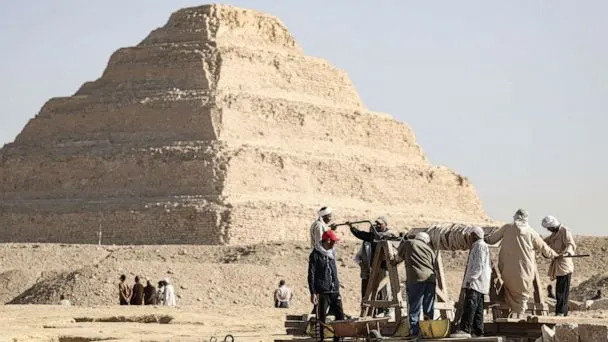
PHOTO: Egyptian antiquities workers dig at the site of the Step Pyramid of Djoser, Jan. 26, 2023. (Omar Zoheiry/picture-alliance/AP, FILE)

The team also unearthed four small chapels during excavation work in the area, two of which bear well-preserved reliefs of funeral scenes and drawings of the resurrection of a mummy to live in the afterlife, officials said.

The team includes archeologists from the National Museum of Antiquities in Leiden (RMO), whose mission has been excavating the area since 1975, and the Egyptian Museum in Turin (Museo Egizio), which joined the excavation project as a main partner in 2015.