Showing posts with label Great Pyramid. Show all posts

Wednesday, 22 July 2026

I asked chatGPT what evidence is there to say that the Great Pyramid was built in the reign of Khufu

I asked chatGPT what evidence is there to say that the Great Pyramid was built in the reign of Khufu?


it said:

There isn't one single inscription saying, "Khufu built the Great Pyramid in year X." Instead, the case comes from several independent lines of evidence that fit together.

 1. Khufu's name appears inside the pyramid

In the small, inaccessible relieving chambers above the King's Chamber, 19th-century explorers found red ochre quarry marks and graffiti left by the construction crews. Some contain cartouches with the name Khufu.

These marks appear to be work-gang markings, rather than a formal dedication. One famous example refers to a crew associated with Khufu. Because the chambers were sealed and inaccessible after construction, the markings are strong evidence connecting the monument's construction to Khufu's reign.

2. Ancient Egyptian records connect Khufu with the pyramid

The Inventory Stela, discovered at Giza in the 19th century, mentions Khufu and the Great Sphinx area. However, it is much later than Khufu's reign and is not considered reliable evidence that Khufu himself built the Great Pyramid. It is better viewed as evidence of a later Egyptian tradition associating Khufu with Giza.

3. The pyramid fits the chronology of Khufu's dynasty

The Great Pyramid's architectural style, surrounding temples, boat pits, and the development of the Giza pyramid complex all fit the Fourth Dynasty, specifically the period around Khufu's reign (c. 26th century BCE).

The pyramids of Khufu's successors, Djedefre and Khafre, provide a broader chronological sequence. The Great Pyramid is the earliest and largest of the major Giza pyramids, consistent with Khufu's position in the royal succession.

4. Radiocarbon dating supports the period

Radiocarbon dating of organic material associated with the pyramid and its construction has generally produced dates consistent with the Old Kingdom and the Fourth Dynasty. The results have some variation and are not precise enough to say "this was built in Khufu's Year 17," but they broadly support the accepted chronology.

5. The Diary of Merer provides a remarkable contemporary connection

One of the most important discoveries is the Diary of Merer, a roughly 4,500-year-old administrative papyrus found at Wadi al-Jarf. Merer was an official who supervised a team transporting limestone from Tura to Giza.

The diary mentions work

 question: what evidence to argue that the Great Pyramid was not built by Khufu?

 There are arguments used by some alternative-history writers to claim the Great Pyramid was not built during Khufu's reign, but it's important to distinguish between legitimate uncertainties and evidence that actually contradicts the mainstream chronology.

Here are the main arguments and how archaeologists generally assess them:

1. The Khufu inscriptions could be later additions

The most famous evidence linking Khufu to the Great Pyramid is the red ochre quarry marks in the relieving chambers above the King's Chamber, including markings containing Khufu's name.

Critics argue that:

  • The marks were discovered by Howard Vyse in 1837.
  • Vyse was accused by some contemporaries of questionable archaeological practices.
  • Therefore, the markings might have been forged.

Problem with this argument: There is no convincing evidence that they were forged. The markings are consistent with construction graffiti found elsewhere in ancient Egyptian monuments, and the use of Khufu's cartouche fits the archaeological context. The forgery theory remains highly speculative.

2. The Great Pyramid has no formal inscription naming Khufu as its builder

Unlike some Egyptian monuments, the Great Pyramid doesn't contain a prominent inscription saying, essentially, "Khufu built this pyramid."

This is true. But it isn't particularly unusual. Egyptian pyramids were primarily royal funerary monuments, and the absence of a dedicatory inscription isn't evidence that Khufu didn't build it.

The argument is therefore better described as an absence of direct evidence, rather than evidence against Khufu.3. The pyramid's dating is partly based on conventional chronology

Some critics argue that the dating of the Great Pyramid depends on the established Egyptian chronology, which itself has uncertainties.

There is some truth here: ancient chronology is not precise to the exact year, and different dating methods have margins of error.

However, the chronology is supported by multiple independent sources, including:

 Egyptian king lists and historical records

  • Archaeological sequences
  • Radiocarbon dating
  • Stratigraphy
  • Architectural development
  • Contemporary administrative documents

So there is uncertainty about the exact date, but not strong evidence that the pyramid belongs to a completely different period.

4. The Great Pyramid appears to have been built on a much older site

The Giza Plateau contains evidence of earlier activity, and the bedrock itself is obviously much older than the pyramid.

Some researchers have argued that the site—or even parts of the complex—could have been constructed much earlier and later modified by Khufu.

This is sometimes connected to claims about water erosion on the Sphinx and a proposed much older age for the Sphinx.

 The difficulty is that there is no comparable archaeological evidence showing that the Great Pyramid itself existed thousands of years before Khufu. The geological and archaeological evidence for the pyramid is consistent with Fourth Dynasty construction.

5. The pyramid's precision is argued to be beyond Fourth Dynasty capabilities

Another argument is that the Great Pyramid is so precisely aligned and engineered that ancient Egyptians supposedly could not have built it around 2600 BCE.

Examples cited include:

  • Its extremely accurate cardinal alignment
  • The precision of its stonework
  • Its enormous scale
  • The sophisticated internal architecture

This is an interesting question about how it was built, but it isn't evidence that it wasn't built by Egyptians of Khufu's era. Archaeology shows that Fourth Dynasty Egypt had:

  • Large organized labor forces
  • Copper tools
  • Stone-working techniques
  • Surveying methods
  • Extensive quarrying infrastructure
  • Highly centralized administration

The precise methods used are still debated in some details, but the overall engineering is within the demonstrated capabilities of the period.

6. The Great Pyramid may have had a purpose other than a tomb

There is no mummy of Khufu in the Great Pyramid, and the King's Chamber contains only an empty granite sarcophagus.

This has led some people to argue that it wasn't a tomb at all.

The counterargument is that the pyramid was probably looted in antiquity. The absence of a surviving burial isn't surprising given the enormous amount of time that has passed. Other Egyptian royal pyramids were also found empty.

The pyramid's architecture and its relationship to the surrounding temples, causeway, and funerary complex are strongly consistent with a royal tomb complex.

 7. The Great Pyramid may have been built by an earlier civilization

This is the most radical alternative hypothesis. Proponents sometimes suggest that:

  • An unknown advanced civilization built it.
  • The Egyptians inherited or modified it.
  • It dates to the end of the last Ice Age or earlier.

The main evidence cited includes astronomical interpretations, geological arguments, and the pyramid's engineering sophistication.

The major problem is lack of archaeological evidence. There is no demonstrated earlier civilization at Giza that left behind the enormous industrial footprint that such a project would require. By contrast, there is extensive evidence of Fourth Dynasty Egyptian activity at the site.

 At present, no.

There are legitimate questions about the exact construction date, the construction techniques, and the precise role of the pyramid in Egyptian religious practice. But the evidence that the Great Pyramid was constructed during Khufu's reign is considerably stronger than the evidence for an alternative date.

The most reasonable conclusion is:

The evidence doesn't prove beyond every conceivable doubt that Khufu personally "built" the Great Pyramid—he almost certainly didn't lay the stones himself—but it strongly supports the conclusion that the monument was commissioned and constructed as part of his royal funerary complex during his reign.

One important nuance is that "built by Khufu" can mean two different things. If you mean "Khufu personally designed and supervised the construction," the evidence is weak. If you mean "the Egyptian state under Khufu commissioned and constructed it," the archaeological evidence is strong.

END ... BUT ...
 

Scientists may have finally cracked how the Egyptians built the pyramids


Thursday, 2 July 2026

Introducing MyHat in Egypt, Through The Eyes of a God, a book on Amazon by Alun Buffry

My second book about Ancient Egypt "Myhat in Egypt, Through the Eyes of a God", is available on Amazon as a paperback and on Kindle and also as a free mp3 for those that cannot or don't want to read. This one is the true account of Ed and Ana's visits to Egypt as tourists in 1989, 1990 and later. They went to Cairo, saw and entered the pyramids of Khufu and Kharfe, Saqqara and other sites. In Luxor they saw the great temples of Karnak and Luxor, that of Hatshepsut on the West bank, The Valley of the Kings and much more, before exploring a hidden tomb and finding themselves 4000 years in the past, where they met people who spoke English and the boy Ameny who was about to become King. As they travelled up the Nile with Ameny they realised that they were not the first people to visit from the future. They solved the mystery of a missing boy and witnessed the murder of their travelling companion, Professor Bertie, lucky to escape with their own lives. The story is told by the strange "MyHat". I hope that you enjoy reading it as much as I enjoyed writing i!.

Links for Books, Kindles and MP3s

Monday, 29 June 2026

Visualisation from 'Myhat in Egypt: Through the Eyes of a God' by Alun Buffry

This is a short visualisation of a few pages of the book that tells of the visits and adventures of Ed, Ana and Myhat, to Cairo and Luxor in 1989, 1990 and 2013, including an unexpected journey over 4000 years back in time where they met the boy Ameny, who was to become a Pharoah and were lucky, maybe, to escape with their lives after a companion was murdered on the Nile. A book of travel, adventure, a love story and a murder mystery! I hope you enjoy this video and the book itself.

ON AMAZON AND KINDLE HERE

ALSO AVAILABLE AS FREE A VOICE-READER MP3, FOR THOSE UANABLE OR NOT WANTING TO READ

Wednesday, 25 February 2026

Origins of Egypt's Great Pyramid upended as clues point to lost civilization from 20,000 years ago

Origins of Egypt's Great Pyramid upended as clues point to lost civilization from 20,000 years ago.

 by Stacy Liberatore, MSN, February 25, 2026

 For more than a century, Egyptologists have dated the Great Pyramid to around 2580 BC, about 4,600 years ago.

A controversial new study now claims the monument could be tens of thousands of years older.

Italian engineer Alberto Donini from the University of Bologna said erosion patterns at the pyramid's base suggest it may have been built between 20,000 and 40,000 years ago, far earlier than the conventional timeline.

Donini's Relative Erosion Method (REM) estimated the pyramid's age by comparing how much erosion occurred on stones exposed since construction with nearby stones whose exposure time is known.

By measuring the difference in wear, he calculated how long the older stones have been exposed, producing dates that far exceed traditional estimates.

The study, which has not yet been peer-reviewed, examined twelve points around the pyramid's base.  Some measurements suggested tens of thousands of years of erosion, with the average pointing to roughly 25,000 years.

Donini also proposed that Pharaoh Khufu may have renovated the pyramid rather than built it, potentially revising assumptions about its original authorship.

If the dates proposed by Donini are accurate, the Great Pyramid could predate not only the reign of Khufu but also the rise of any known advanced civilizations, raising fundamental questions about human history and architectural knowledge in the distant past. 

The Great Pyramid of Giza, the largest of the three pyramids on the Giza Plateau, was built by Pharaoh Khufu during Egypt's Fourth Dynasty. 

It sits alongside the Pyramid of Khafre, the Pyramid of Menkaure and the Great Sphinx, all shrouded in mystery due to their precise alignment, unusual construction methods, and debated purpose. 


The new study measured erosion at twelve points around the base of the Great Pyramid of Khufu. 

At each point, Donini compared limestone surfaces that had been exposed since the pyramid's construction with adjacent surfaces that were only exposed after the outer casing blocks were removed about 675 years ago. 

He measured the volume of eroded material on both surfaces and calculated a ratio, which allowed him to estimate how long the older stones had been exposed.

Each point produced a different age, ranging from about 5,700 to over 54,000 years.

However, the average suggested a 68 percent probability that the pyramid was built between roughly 11,000 and 39,000 years ago, with an overall average of about 24,900 years.

Donini emphasized that REM does not provide a precise construction date, but rather an estimate of the structure's age range with an associated probability. 

Although the resulting date ranges are wide, the conclusions indicate a low probability for the official archaeological dating of 2,560 BC,' he said.

The study challenges long-held assumptions about ancient Egypt and has ignited debate among archaeologists, historians and engineers. 

Some scholars have pointed out that evidence for the pyramid’s construction has always relied heavily on textual sources, like the later inscriptions found inside the monument, which may not reflect the original building period.

Donini’s approach differs from traditional archaeological dating, which often relies on historical records, carbon dating of organic material, or stylistic comparisons with other monuments. 

By focusing on the physical erosion of the stone itself, REM offers a method that is independent of historical accounts, providing an entirely new perspective on the pyramid’s age.

The study also acknowledges that many factors, including climate variation, acid rain, foot traffic, and partial burial under sand, introduce uncertainty into the calculations. Despite these variables, the consistent results across twelve measurement points strengthen the claim that the pyramid’s base has endured tens of thousands of years of exposure.

Whether the findings will overturn centuries of Egyptological consensus remains to be seen, but the research has already reopened one of archaeology’s most enduring mysteries.


Friday, 6 February 2026

From Dot to Cleopatra book reached Nigeria

 I am pleased that through Books2Africa some of the last copies of my book "From Dot to Cleopatra" original paperback edition have reached happy readers in Nigeria.

This has encouraged me to release a new paperback edition and a hardcover edition both available on Amazon along with the Kindle edition


Wednesday, 4 February 2026

New Analysis Suggests That The Great Pyramid Of Giza Is Potentially 20,000 Years Older Than Experts Thought

 https://allthatsinteresting.com/when-was-the-great-pyramid-of-giza-built

New Analysis Suggests That The Great Pyramid Of Giza Is Potentially 20,000 Years Older Than Experts Thought 

A new method that compares points of erosion on the Great Pyramid of Giza suggests that this iconic monument could have been constructed as early as 23000 B.C.E. — 20,000 years earlier than previously believed.

When Was The Great Pyramid Of Giza Built

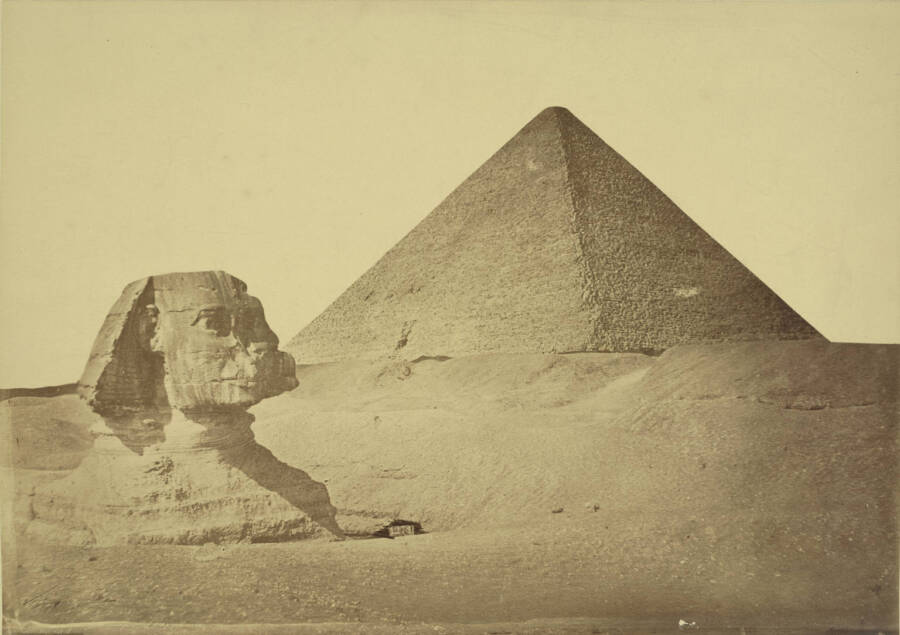
Cornell University LibraryThe Great Pyramid of Giza and the Great Sphinx, pictured here in the late 19th century. New research purports to upend established theories about when the Great Pyramid of Giza was built.

The Great Pyramid of Giza, generally believed to have been built as the tomb of Pharaoh Khufu around 2575 B.C.E., is one of the Seven Wonders of the Ancient World. But what if it’s even older than that?

Alberto Donini, an engineer from the University of Bologna, recently applied a new dating system that he calls the “Relative Erosion Method” (REM) to the pyramid. Now, he’s claiming that his research suggests the famous landmark may have actually been built nearly 25,000 years ago.

When Was The Great Pyramid Of Giza Built? The Origins Of Egypt’s Ancient Wonder

Scientific studies of the pyramids at Giza have been ongoing for centuries, so the current timeline of their construction is widely accepted. As it stands, the Great Pyramid was seemingly built during the reign of Pharaoh Khufu, who ruled over Egypt from roughly 2589 B.C.E. to 2566 B.C.E. The Pyramid of Khafre came shortly thereafter, followed by the Pyramid of Menkaure.

This timeline was determined using both historical records and scientific study. Ancient authors like Herodotus wrote that Khufu had the Great Pyramid constructed as his tomb, noting that he “brought the people to utter misery” by making them transport impossibly heavy limestone blocks from quarries — possibly located hundreds of miles away — in order to erect the 481-foot structure. Exactly how they managed this remains a mystery to this day, though several promising theories have been put forth, such as the use of a ramp system.

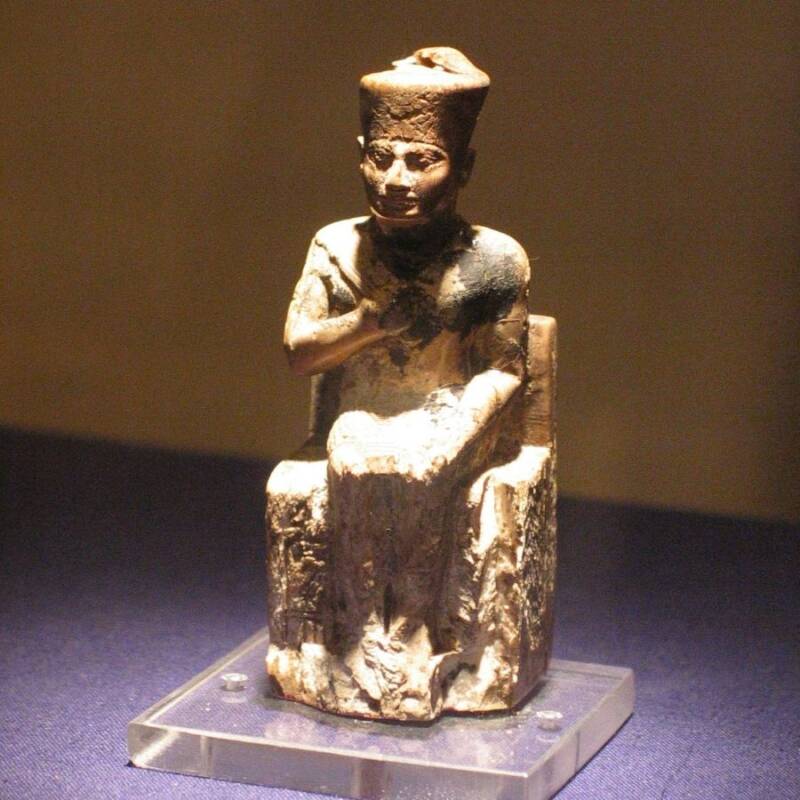
Pharaoh Khufu

Public DomainA statue of Khufu at Cairo’s Egyptian Museum.

Then, in the 1800s, archaeologists discovered graffiti inside the Great Pyramid that mentioned Khufu by name. It was seemingly scrawled by the workers who built the monument, adding another layer of evidence that the structure was built during that pharaoh’s reign.

Archaeologists later used scientific methods to date the pyramid. They radiocarbon dated the mortar used to secure the stone blocks, which was made using ashes and thus contained organic matter. These results suggested that the mortar was likely mixed between 2620 and 2484 B.C.E., once again aligning with the reign of Khufu.

With so much proof pointing to a construction date of roughly 2575 B.C.E., it seems unlikely that there’s any additional information out there that could significantly change the timeline. However, Alberto Donini claims that his research could completely rewrite this story.

Why The Relative Erosion Method Could Complicate The Story Of How Old The Great Pyramid Of Giza Is

In a preliminary report on his research, Alberto Donini describes his new “Relative Erosion” dating method: “The REM is based on the ratio between two types of erosion affecting the same type of rock in the same location: one with a known date and the other with a date to be determined. The ratio is then used to calculate the age of the stone block under examination.”

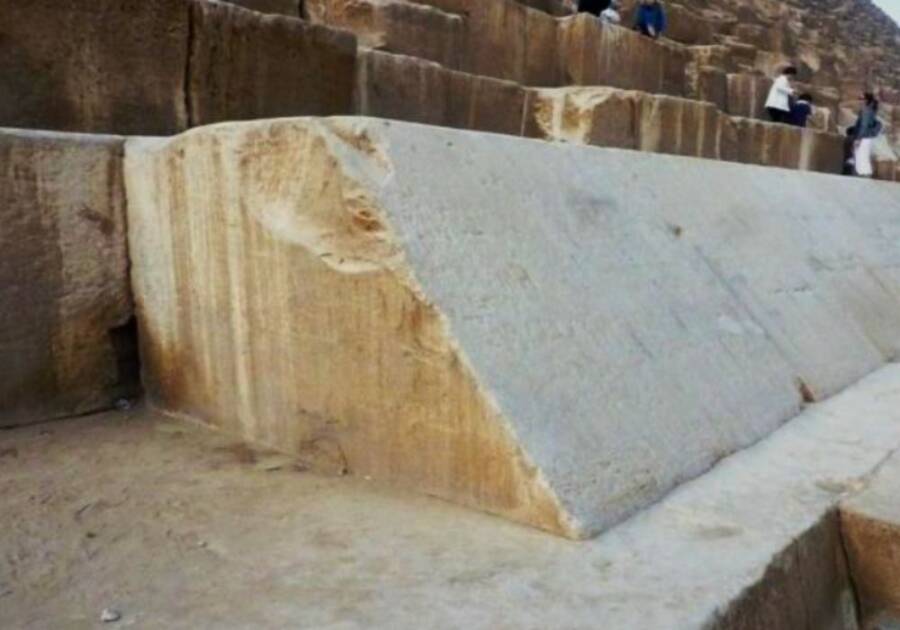
When the pyramids of Giza were built, they were covered in a gleaming casing of smooth, polished, white limestone. Then, in 1303, a massive earthquake struck the region, knocking some of these stones to the ground. The fallen material was recycled to build palaces and mosques in Cairo, and in the years that followed, even more of the limestone was removed intentionally to use for decorative purposes. By 1400, much of it was gone.

How Old Is The Great Pyramid Of Giza

Alberto DominiA small section of the Great Pyramid where the smooth, white limestone cladding still remains.

Donini began his research by comparing the areas of the Great Pyramid that were once covered by limestone with stones at the structure’s base that have always been exposed to the elements. By comparing the amount of erosion that’s taken place in the past seven centuries to the amount of erosion on the blocks that were never covered by limestone, Donini believed he could calculate when those original stones were placed.

Donini noted that erosion occurs by several means. Water is a major source, from runoff dripping onto surfaces to trickles of liquid seeping into small cracks, freezing, and expanding. Wind blowing rough sand from Egypt’s desert also wore down the limestone over time, as did temperature fluctuations, acid rain, and surface wear from humans touching and walking on the surfaces.

There were several factors that Domini took into account while making his calculations. First, he acknowledged that there’s been an increase in foot traffic in the modern era, leading to more surface erosion in recent years than in ancient times. There’s also likely been more acid rain since the Industrial Revolution. These elements could lead to an underestimation of the Great Pyramid’s age.

Alternatively, the climate was wetter in ancient times, so more rain then could have led to faster erosion rates than those seen in the past few centuries. This, in turn, could lead to an overestimation of the monument’s age.


Wednesday, 12 April 2023

Egypt unveils hidden tunnel inside Great Pyramid of Giza

 Egypt unveils hidden tunnel inside Great Pyramid of Giza

 Scanning work will continue to uncover more secrets.”

By Ayat Al-TawyMarch 2, 2023
 
The latest discovery comes two months after five ancient tombs were found nearby.

CAIRO, Egypt -- A nine-meter long hidden passageway was discovered inside the Great Pyramid of Giza, Egypt’s tourism minister Ahmed Issa announced on Thursday.

The function of the corridor near the main entrance of the Pyramid of Khufu, located right behind the chevron zone on the north side, was not immediately known but officials said it could lead to further discoveries.

The finding was made by researchers from the Scan Pyramid project, an international mission that since 2015 has been using modern methods -- including radiographic muons, infrared thermography and 3D reconstruction techniques to probe the internal structure of the pyramid.

The gabled ceiling of the secret tunnel suggests it was built to lighten the load on the structure, Mostafa Waziri, head of Egypt’s Supreme Council of Antiquities told reporters at the pyramid site.

“But a big question mark hangs over whether this corridor was created to relieve the weight on the [main] entrance or lighten the load on a space yet to be discovered,” he added. "Scanning work will continue to uncover more secrets of this structure.”

The Great Pyramid, the largest of the Great Pyramids of Giza, is the last surviving wonder of the ancient world. It was built as a royal tomb some 4,500 years ago during the reign of Pharaoh Khufu.

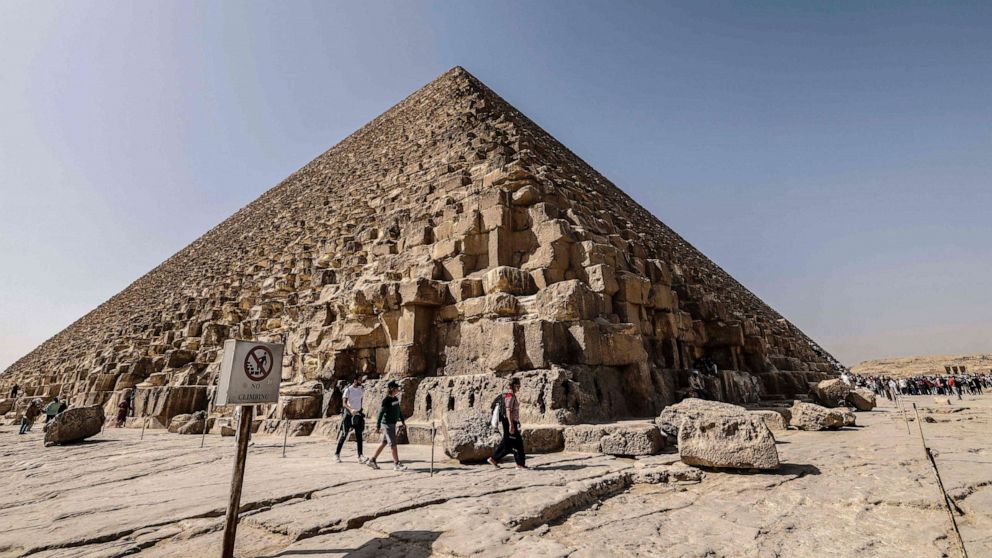
PHOTO: Tourists visit the Great Pyramid of Khufu (Cheops) at the Giza Pyramids necropolis on the southwestern outskirts of Cairo, on February 2, 2023.
Tourists visit the Great Pyramid of Khufu (Cheops) at the Giza Pyramids necropolis on the southwestern outskirts of Cairo, on February 2, 2023.

A chevron technique was used in building the pyramid to cover internal structures and prevent them from collapsing. Scientists say the detection of any previously unknown internal structures could lead to a better understanding of the construction process of the ancient monument.

In 2017, the same team of scientists discovered a large void through cosmic-ray muon radiography, which they said was the first major inner structure found in the Great Pyramid since the 19th century. They found another unknown cavity on the north eastern edge of the Pyramid the year before.

Egypt aims to tap into new ancient discoveries to draw in tourists, a major source of foreign currency and jobs that has been hard hit by the COVID-19 pandemic as well as political instability following the 2011 revolution.

Friday, 3 August 2018

Visualisation from 'Myhat in Egypt: Through the Eyes of a God':by Alun Buffry


 Myhat, Ed and Ana visit the Pyramids 1989 A visualisation of a visit to the Giza site in Egypt to see inside and outside of the Great Pyramid of Cheops (Khufu), taken from 'MyHat in Egypt Through the Eyes of a God' by Alun Buffry ISBN 978 0 9932107 7 8 available through Amazon and good shops.