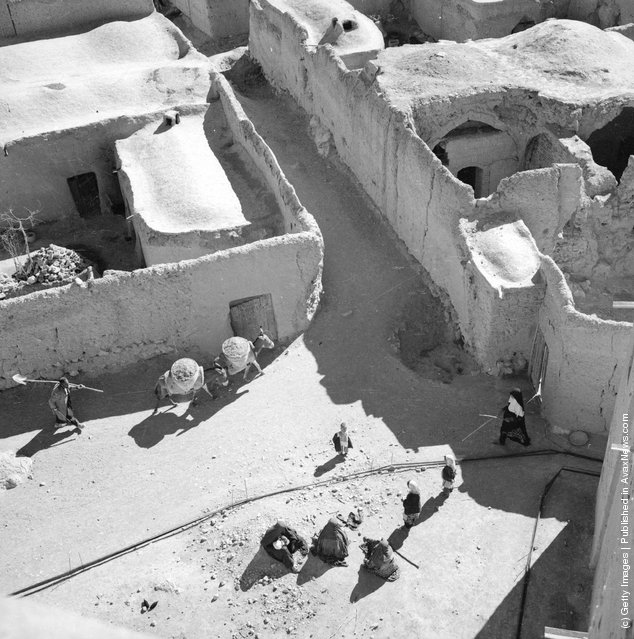
Taken From All About My Hat The Hippy Trail 1972
So
it was decided, that is what they would do, and the next morning we
made an early start with out bags and walked into the city. It was
more like a Western than Asian city, with streets full of people,
cars, trucks and buses. There were no donkey carts and few bicycles.
Many of the men were dressed in western styles, either jeans or
suits, and the women wore colourful cloths and showed their faces.
Al
was surprised that the Embassy was easy to find and the queue to
apply for a visa to cross Afghanistan was short. The visa was for up
to four weeks. But they had to buy them in Mashhad.
They
very quickly found a cheap bus to the city outskirts and the road
heading east – they would aim for another large town, called
Mashhad, much closer to the Afghan border, if they could get a lift.
It was 625 miles by road from Tehran to Mashhad.
Al
was wondering what sort of adventure lay in front of them,
hitch-hiking with so little money in a country where they knew not
one word of the language and was probably going to be very different
from Tehran.
It
was!
As
it turned out a car with two young men wearing jeans and shirts
stopped within minutes. They spoke English. They were not going all
the way to Mashhad and said they planned to sleep that night on the
edge of the Caspian Sea and carry on next day to their village.
“You
can stay few days in our house”, said one man, “we have
morphine.”
“We
don't take morphine,” said Al.
“Well
stay with us any way,” the man said.
Later
we learned that these two new hosts-to-be were called Atash and Nouri
and were brothers.
The
car was driven by Atash into the night so by the time they reached
the home it was dark.
By
that time Al and Keith had chatted to their new friends and learned
that the lads’ father was in fact the village and area policeman
and that he had a license to grow poppies to make opium. It was
opium that the brothers had offered, not morphine itself – morphine
was the name they gave to it though. Al asked if opium was legal in
Iran.
“Oh
no no,” said Nouri.
“It
is not permitted without special permission to grow and my father has
that and anyway he is the police. If you like you can smoke some
opium tomorrow. My father will give
some for you but only if you want.”
“I've
smoked opium before, man, it's cool” said Keith; “I really dug
it, made me feel relaxed and dreamy. I'd like to smoke some tomorrow.
How about you Al?”
I
felt that Al was both enthusiastic to try something new and reluctant
to take any risk with it. I knew that Al had taken an interest in
experimentation whilst at University studying chemistry, after all,
that was what science was about and Al was a scientist. Al wondered
whether Mike and John whom he had left in Turkey would also try a
smoke and thought they probably would – they were chemistry
students too.
Al's
interest in chemistry had started when he was about 13 and had been
given a “chemistry set” by his father, Jim. From the first time
Al had mixed two chemicals (sodium bicarbonate and citric acid) and
watched them effervesce, Al's imagination and interest in chemicals
had been awakened. Al had thought it was like the two substances had
become aware of each other in a “chemical way” and that
awareness, he thought, was a form of life.
It
was about that age when Al lost interest and belief in any form of
god.
So
chemistry had come along and Al thought that maybe there was some
answers in science as to what the universe was, what life is and why
he was here at all.
To
tell you the truth those thoughts, not part of Al's memories but also
his behaviour pattern. His need to search and explore, try new
experiences and experiment. It was that burning that had taken Al
onwards to study chemistry and science at university, but also what
had first led him to want to try cannabis – and now he was thinking
of trying opium.
Keith,
Al knew, was very different in that respect. He had told Al that he
did not believe in any gods or any secrets to life and for him, life
was just to enjoy and that was why Keith took drugs. He enjoyed
them.
The
car pulled into what looked like a large courtyard.
“We
eat now”, said Nouri, “then we sleep and tomorrow you meet father
and maybe smoke – for you my friends, no charge.”
The
next morning Al awoke to find Keith studying the map in his guide
book.
“We
can get from here to Mashhad easy I think,” he said “and from
there we can get a visa stamp and go to Afghanistan. I 'll send a
letter home and ask Marion to send us some money to Kabul – maybe
you can get some sent out too.”
There
was a knock on the door and Atash came into the room. “First
little food and tea, then to smoke."
“After
smoking pipe only little black tea, no food as it will upset stomach
and make sick”, he said.
Breakfast
was short and sweet. Sweet black tea, eggs and bread and sweet
breads, and fruit.
Soon
enough Atash led Al and Keith into a large room full of cushions and
some of the cushions had men laying on them. Al, Keith and Atash
went to one side and sat on some cushions. There was no conversation
at all in the room.
In
the centre of the room was a man putting a light to the end of what
looked like a very long pipe and on the other end was a man laying on
his side and sucking on the pipe. Al could see that the man at the
lit end seemed to be prodding what looked like a small black ball –
and knew that must be the opium.
Atash
pointed at the man lighting the opium. “Father.” he said, “He
speaks no English but good man. He will make pipe for you.
Remember, no drinking or eating, only little tea.”
It
was not long before it was Keith's turn to try the pipe. Keith
smoked three pipes as did everyone else in the room and then went
back to his cushions.
Then
it was Al's turn.
Al
noticed how the pipe was smoked through small wooden mouth-pieces and
each smoker had their own so that lips did not have to touch the
pipe. The room was clean and Al was pleased to see that and the
mouth-pieces. It was nothing like the dark and dirty opium dens Al
had read about.
Father,
policeman, opium farmer, called Mohammed, took up a small piece of
the black opium on a small metal rod which he them placed on the end
of the long wooden pipe. Father lit the opium whilst Al sucked
gently but consistently until his lungs were full. Mohammed seemed
to know exactly how much Al needed, for it ran out of smoke just as
Al's lungs were full. Al sucked on three pipes and went back to his
cushions to relax.
It
carried on like that well into the late afternoon. Al was feeling
pretty good, in a dreamy state, not asleep but euphoric. Al did not
feel that opium, when used in situations like this, was a bad thing –
none of the other smokers seemed anything like the poor decrepit
addicts he had read about in the press in his home country. But he
was aware that opium was very different to manufactured heroin or
morphine. And taking it for a day may be very different to taking it
day after day.
Al
was feeling very warm and cosy, laying down on the cushions and
drifting into pleasant dream-like chains of thoughts. He had smoked
about nine pipes!

Mohammed
the father had left the room as had most of the other men, when Al
opened his eyes and looked around. It was then that he realised that
Keith was missing, so he scrambled to his feet and went outside into
the courtyard first, to see where his travelling companion was.
To
his surprise Al found Keith in a corner by a tree, being sick into a
bucket! He asked Keith: “You OK,? Doesn't sound too good.”
After
getting his breath back, Keith stood up: “Aw man, I drank some
fucking 7-Up and had some bread and cheeses, it must have been that.”
“Well
they did tell us not to eat or drink between smoking,” laughed Al.
“Yeh,
that too, man” said Keith.
Al
and Keith went indoors and Al took me off his head, a rare
occurrence, and I knew nothing until the next morning.
Keith Marshall
Whilst
Al was eating breakfast, he told his hosts that Keith had been sick
all night and was still asleep, asking if they could stay another
day.
“But,”
he said, “We won't be smoking today.”
“No
problem my friend,” said Nouri, “We are hoping you will stay and
it is our honour to have you and Mr Keith in our house. No smoking,
no problem.
It
was late afternoon before Keith arose; Al had been spending the
afternoon in a shady spot in the courtyard, reading, drinking tea and
making notes. He had been looking through Keith's travel guide book,
reading a little about Afghanistan, the next country they would
visit. They would need to go first to Mashhad and buy a visa, then
go by bus to the border. He was thinking just how different
everywhere was compared to his home country, Wales, and England where
he had been living whilst at University. He was thinking how
different University life had been to his younger years at home in
his parents' house with his sister and Aunt.
Al's
last school as a teenager had been boys only. It had been like that
since he was eleven. When he was eighteen, he went to University in
a city called Norwich, a day's travel from his parents in Wales. As
a University student Al suddenly had complete control over his life,
having to pay his rent and buy his food, books and beer out of his
money from a government grant. And there were women at the
University too.
Here
in Iran, Al thought, he had hardly ever seen a woman except western
or American travellers.
What
women there were, were covered head-to-toe in black clothing. In the
village there did not appear to be any at all. It seemed unlikely
that many girls or women had much of an academic education. He
wondered if there were any at Iranian Universities – were there
qualified female doctors or teachers or lawyers? He did not remember
seeing any women working in shops or offices, except maybe a few in
Tehran. Al thought just how isolated in their lives those women
were, probably hardly going outside of their homes or the nearest
market. He wondered how much even the men knew about his country and
how different it was, especially from this village-come-opium den.
Towards
the end of the afternoon, Al spotted Nouri and Atash and asked them
if he could take their picture, and they agreed. They stood on a
porch outside of a door and put their arms round each hoer’s
shoulders and Al took one shot. He had only one film with just about
eight shots left.
Nouri
asked if he could take one of his brother Atash with Al and it was
done.
(Now
I can tell you that a while later, when the film was developed and
printed, to Al's big surprise, whilst his back was to the door and he
was facing the camera, and couple of quite young looking women had
opened the doorway, and stood in the background with some small
children, one in arms. So there had been women in the village after
all? But sadly I was not on Al’s head for that photo.

The
following day, Atash took Al and Keith by car to a bus stop where
they boarded a bus to Mashhad. It seemed like a journey that would
never end, a long hot and dusty road in a bus crowded with women in
black, men in a variety of garments, and a few live chickens.
Mashhad
was well over seven hundred miles from Tehran the way we had
travelled – but just one hundred and twenty miles from Afghanistan.