Amazon Link
Showing posts with label Iraq. Show all posts
Showing posts with label Iraq. Show all posts
Friday, 10 July 2026

Sunday, 13 August 2023
Life on the Brim: The Autobiography of a Hat: 3 books in one
Three stories in one book - my journey to India in 1972, several visits to Egypt and a fictional time travel murder mystery set in Ancient Egypt - all written through the eyes of my hat!

Saturday, 16 April 2022
April 11, 12, 13 1972: Al Qa'im, Iraq
Taken From All About My Hat The Hippy Trail 1972
It was April 12, 13 1972.
At that time Iraq was governed by President Ahmed Hassan and the al-Bakr Ba'ath Party.
“Another walk through no-man's land,” said Al. “I wonder how far that's going to be. The last one looked like people lived there and they go back and forth freely to markets and things – if they're in no-man's land they may not even have passports. “We'll take some extra water this time, as it's gonna to be hot walking if it's a long way.”
Al and Keith took out their sleeping bags and lay down on the wooden balcony outside the custom's post; the guard brought them some strong and sweet coffee. As they relaxed drinking the coffee, all they could hear were crickets and flying bugs.
The bugs were massive. Neither Al nor I had ever seen anything like them before. They flew around madly targeting the bright lights that were on at all four corners of the custom's building, often crashing into a wall or post. Then they fell to the ground, often landing on their backs and started trying to flip themselves over with their wings. Few seemed to manage that.
As the numbers of bugs increased, the noise grew louder and louder and sleep was retreating. The guard came out with a broom and brushed away the bugs – some took off again and presumably ended up crash landing again, because numbers did not decrease. The guard said “Flippers!” and laughed. This carried on throughout the long sleepless night, every time the guard shouting with glee “Flippers.”
The next morning Keith and Al rose quite early, left the border post and walked several miles across no-man's land, where they spotted several small houses and people working in the fields. Keith told Al that they were neither Iraqi nor Syrian people and I figured out they must be no-men and no-women if they lived and worked in no-man's land. Or maybe he meant Norman's land – I had met somebody called Norman once but I did not know if this was where he was from or not.
After an hour or so we arrived in Iraq, presented their visas, changed their money again, this time the money was called Dinars and walked on into a small village.
“I wonder what this place is called,” said Al, “the only sign I saw was in Arabic.”
As we arrived in the village we were greeted by several smiling young men dressed in what I realised was typical desert costume of djellaba and sandals.
To say that the village was dry would be an under-statement. It was parched! There was very little vegetation in sight, lots of dust and sand and many of the buildings seemed to be made of dust and sand too. The main road which led eventually to Baghdad went straight through the village and as we arrived along that road, we saw a tea-house. We headed straight for it, accompanied by some of the young men.
The men were all very friendly and smiling and kept offering Keith and Al cigarettes and black tea. They would not take no for an answer. They wanted to talk and talk in English – as they were all studying English at school.
Al asked one of the men what the village was called.
“Al Qa'im,” he said proudly.
Al asked whether there was a way to get to Baghdad cheaply. He knew that it was about 330 miles from Deir el Zur to Baghdad and they were not half way yet.
One of the young men, called Mohammed, a very common-place name and not just in this village apparently, said that the bus was in the early morning and had already left that day, but maybe a truck would pass by. “But,” he said, “you have to pay driver same as bus fare – we all pay for lifts in Iraq.”
He offered to show Keith and Al around the small village before sharing some food. I sensed some reluctance in Al. He said to Keith: “What about our bags, I don't want to be carrying a rucksack round the village. I am a bit worried if we leave the bags here and one gets nicked, what chance would we have of getting it back?”
Mohammed immediately said “No problem my friends, there are no thieves here. In Iraq we cut off a hand of a thief. You can leave bags here, nobody touch.”
“I guess so, man”, said Keith.
When Al opened his bag and took out his camera, immediately there was a small crowd eager to get their photos taken. Mohammed organised them in one line and led Al over to join them, whilst Keith took the photo. It must have looked odd with about 15 local lads dressed in djellaba and sandals, some with head-scarves, lined up with Al wearing a donkey jacket and jeans and ME perched on his head! There was a lot of movement until suddenly Mohammed shouted “Cheese”. They all shouted “Cheese” and froze perfectly still. Keith took the photo. It would be along time before that film was developed.


Mohammed and a couple of his friends or brothers walked Keith and Al around the village and took them to their little school. There were few people about, those that were had donkeys and one or two carts laden with figs or dates. Some children, some dogs, a few cars, not a woman in sight!
It was not a large village so the tour took just about half an hour and they returned to the tea house where they were immediately served with couscous and spicy beans with vegetables, dried and fresh figs, goats cheese and unleavened bread, yoghurt and black tea, followed by more black tea, coca cola and endless cigarettes.
Mohammed had asked questions about where we were from, where were we going, why, what we did at home, did we have wives and children and why not? They wanted to know what life in the UK was like and did we have televisions and telephones. “Have you been on aeroplane?” asked Mohammed.
Suddenly Mohammed turned to Al. “Do you like the Zionists?”
I felt some hesitation in Al before he answered. “There's good and bad in everyone,” he said.
“Very good answer,” said
Mohammed beaming. “You are right, but here in our village, only
good!”
Later in the afternoon, Al asked if there was a small hotel or lodge to stay the night. Mohammed said “You both stay at my father's house. I take you now?” So this time with their bags, the duo followed Mohammed down a few narrow dusty streets, around a few corners, and eventually stopped at a small one-level house with a few chickens, goats and dogs roaming around outside. Mohammed's father was called Mohammed!
Mohammed senior asked many of the questions that Mohammed Junior had asked and Mohammed Junior translated both ways. It wasn't long before more food arrived. Couscous with spicy beans and vegetables, bread, goats cheese and yoghurt, dried figs and this time olives. There was also chicken that Keith tucked into. As much as Keith and Al ate, more arrived. Nobody else was eating.
Eventually both Keith and Al said they could not eat any more.
Then the others at the table started eating most of what was left.
At this, Al said to Mohammed junior “I hope we have not eaten your dinner.”
“No, no,” said Mohammed, “you eat first and we eat after, that is our tradition for guests. What is left is for women.”
That night as the sun set they went to bed. Fine embroidered quilts and cushions were provided.
The toilet was a small shack down near a tiny stream about fifty yards from the house. One had to take a candle and a bottle of water at night. It was a crouch down toilet, a hole in the ground with a run-off to who-knows where and would not cope with toilet paper. The idea was to use one's left hand to wash oneself with water from the bottle, then wash one's hands afterwards, of course. It was a tradition that everyone kept, to wash or do dirty stuff with the left hand but to eat or shake hands with the right hand. To offer the left hand to shake is a powerful insult and to eat with the left hand is considered dirty, almost obscene. That makes having one's right hand cut-off for thieving even worse .. There are probably few with only one hand in Iraq.
In the morning after a breakfast of bread, yoghurt and figs, Mohammed junior led us to the place where we could catch a bus to Baghdad. It was to take almost all day and we passed through the desert. They carried several bottles of drinking water each and some bread, goats cheese, figs and olives for lunch.
“Great people there,” Al said to Keith, “this is the first time I've ever been across a desert.”
“Yes but it's very hot man and not much to see except sand. Fucking hot,” said Keith.
He was right; it was hot, and I spent several hours on Al's lap instead of his head.
Saturday, 16 July 2016
Readers photo competition - help by giving some pics a LIKE on Facebook: All About My Hat - The Hippy Trail 1972
Reader's Pic Competition - top scores so far - please share the link on your page and generate more votes:
VOTES SO FAR ( 16/7/16 )
Paul FourTwenty Kelly 52
Melissa Dawdaughter 41
Sy Dignam 35
Giuseppe Albero 34
Frank Kirk 27
Lesley James 21
Emilio Napoli 20
Elizabeth Clarke 18
Nol van Shaik 17
Jackie Woodchild 16
Chris Philbin 15
Phil Norwich 13
Sharna van-Damme 13
Kate Midlane 13
Winston Matthews 13
Jacqui Maklin 13
Kevin Traylen 13
Rocky van de Benderskum 13
Give your friend's picture a like at:
https://www.facebook.com/allaboutmyhat/photos/?tab=album&album_id=1553921764890883
ISBN 978 0 9932107 1 6
http://www.buffry.org.uk/allaboutmyhat.html
watch and listen here:
watch and listen here:
Tuesday, 17 November 2015
Peace is more than the absence of war
So who looks at any possible solutions to the eye for an eye
philosophy? is there a solution? is war a natural part of the animal
called (wo)man?
Is the world too big to change?
My
personal belief is that to put an end to war we need to spread peace.
Not just the idea of peace but the experience, the feeling, the knowing
how to get that feeling, and it would
need to be a feeling available practically to every human being
irrespective of health, wealth, education, religion or no religion, in
all parts of the world, given freely and not through challenging
indoctrination or preaching religion. It would have to be universally
acceptable and beneficial, like air or water, like breath itself. But I
know that in order for that to happen, there is a massive amount of
concept, misunderstanding, fear and opposition to overcome.
The process starts with me, the process starts with you.
I
can only tell you about my personal experiences of how and when I was
shown how to find that peace within inside me in 1972: it cost me
nothing but a little effort and some acceptance of a gift.
Once peace is found within inside oneself, it spreads, it helps overcome fear, anger, hatred, greed and it leads to contentment.
I am so happy to know that in this day that experience is on offer, for free.
http://www.wopg.org/
Friday, 9 January 2015
"All About My Hat - The Hippy Trail 1972" by Alun Buffry NOW ON KINDLE AT AMAZON
An incredible journey in 1972, of a young man and his hat, "Myhat", from
Thessalonki in Greece, through Turkey, Syria, Iraq, Iran, Afghanistan,
Pakistan and India - and back to the UK, through poverty and illness, a
journey not forgotten. Passing through Istanbul, Izmir, Ephesus (Efes),
Antalya, Antakya, Aleppo, Deir el Zur, Qa'im, Baghdad, Tehran, Mashad,
Herat, Kandahar, Kabul, Khyber Pass, Peshawar, Rawalpindi, Lahore,
Amritsar, Delhi, Agra, Haridwar and Rishikesh - known now as "The Hippy
Trail".
READERS' COMMENTS
Ann C, Norwich: "This is a fascinatng book packed with stories about adventures on the "Hippy Trail" in all its reality.It was harsh with extreme discomfort.heat and dust and sometimes illness. It took strength and endurance .but then. the rewards were a rich awareness of other cultures and beliefs. I recommend it warmly.and did I mention, it is so funny!"
Roger W E, Swansea: "My Hat is becoming an independent friend, as I read on - he/she/it is competing with you! Roger WE"
Chris P, Essex: "Awesome read fella, most enjoyable."
Ian L, Norfolk: "Read it before Christmas, liked it, very entertaining, definitely a good read, well done Alun."
Frank K, W Sussex: "Loved the book Alun and have shown friends, also travellers with a Hippie hat. Great days to remember for you I bet. I like the way you laid out the text too, great read."
Mark S, Norfolk: "Loving the book."
Melissa D, Italy "I really enjoyed this book..... but I have to admit I skipped some of the travel book descriptions. My favourite part is..... No, I won't spoil it for you!
Simon B, Norwich: "You were lucky to survive. Loved the book."
INTRODUCTION
Let me introduce myself, I am called Myhat.
I am quite an old hat. I was made decades ago. I had been passed many times to a few heads, yet had seldom found one that I felt really comfortable on.
About 40 years ago, everything changed. I found myself upon a head that I had a close affinity with and I found myself seeing, hearing, smelling much through this young man, Al - and even picking up on his emotions and thoughts.
I was lost then for several years, stored in a cupboard until, once again, I found myself on Al's head and now I can tell my tales.
Al and I spent some nine months together on our first trip, visiting many big cities and several small villages, in eight countries, all different, all new to myself and my new head – an adventure of a lifetime.
I had sat on Al's head and witnessed all sorts of strange places and events until we had travelled to India and then to the UK.
When Al arrived back in the UK, he was quite ill, having suffered from a problem called Hepatitis and also dysentery. Al went to his parent's house in Wales and then to hospital. But whilst he was in that hospital, I was never on his head after he had arrived, and ended up in a box in a storage cupboard.
I didn't know what was happening. Why was Al leaving me? How long was I to be here? What would become of me now? Would I get a new head? Would I get more adventures? Would I be treasured or neglected?
Then one day, Al took me out of my box and put me back on his head.
That is how it came that I found myself back on Al's head. I have been on and off Al's head for about forty years and now I can tell my tales. Al had done a lot of travelling over those forty years.
I had always been able to understand any language spoken and understood by whatever head I was placed on - but never been able to utter anything myself – until now! I have discovered that I can help Al remember the places we had experienced together and I somehow I managed to place the idea of writing my tale for me. Anyway, that idea came upon Al and here he is, writing this for me!
As well as understanding the thoughts, memories and feelings of my head – I felt as he felt - I have been able to see through the eyes, hear through the ears and even taste through the mouth and tongue of my head – Al – and over the days developed a strange connection so that so long as Al was nearby, I could watch what was going on around him – even when not on his head!
I watched, I listened and I remembered – and that is how I come to write this story through a head called Al.
A DIP IN THE GANGES
After a pleasant afternoon with Ashok and his family, they drove back to Haridwar and Al was dropped off back near the railway station where, once again, he slept on the wooden bench.
The following morning after a breakfast of fruit, yoghurt and bread, Al took a stroll around the town. It seemed very old. The streets were crowded with people going about their days amidst the cows.
After a while he found a bridge over the river Ganges. It looked greener on the other side, with trees to sit beneath and watch the powerful currents pass. So he crossed the bridge and turned right to follow a rough path running besides the River.
He spotted an orange-robed elderly and bearded man sitting cross-legged beneath a tree, a semi-circle of younger people sitting facing him.
Al knew that they were called Baba’s, as he himself had been called a few times.
“Maybe he’s one of those guru teachers,” Al thought.
Back in England Al had read about the pop group The Beatles who had taken up with a Guru called Maharishi Mahesh Yogi who had taught them how to meditate and himself gained great publicity and popularity – maybe it was something to do with that.
The orange-robbed ‘teacher’ shouted something and motioned to Al to go over and join them and sit down. Al complied. The elderly teacher smiled and asked Al where he was from and why he was in Haridwar, in a broken English with an almost German accent.
Al explained that he had travelled overland from the UK, simply on an adventure and that he was here because he had met a Spanish man in Delhi who had recommended it as a good place to stay for a while. The teacher laughed and from under his robes produced a chillum. The chillum was prepared, wrapped in a safi – a small piece of cloth that served as a sort of filter – the tobacco hash mixture poured in and the lit chillum passed around so that everyone including Al had a good puff.
The teacher-come-chillum-maker – the Baba – asked Al if he had a few rupees for another chillum. Al handed over a small note. A young boy suddenly appeared from amongst the nearby thickness of trees, took the note, ran off into the trees to return seconds later with a small lump of black hash which he passed on and which was instantly made into another chillum and smoked.
Al stayed a short while and as nothing was being said and he was quite high on the hash, he said his goodbyes and left, carrying on in the same direction as before. Within minutes he was sitting with another group under another tree, smoking again.
“This is the good life!” thought Al, so high that he was beginning to feel like he was in a Holy city in India. “By the Ganges!”
He left the second group and walked some hundred yards before he had the idea that immersing oneself in the Ganges was supposed to purify the soul.
“Well,” he mumbled under his breath so only he (and I) could hear, “Why not, it’s hot and I’ll soon dry off.”
Across the river he could see a long walled building complex with steps going down to the River. As he got closer he could see steps going down on this side too. A few steps, “I should be OK."
The water was moving very fast. Al thought maybe he would not immerse himself, just splash himself all over.
“After all, I can’t swim.” So he put down his bag, took me off his head and put me on his bag, took off his sandals, and stepped down and in to the water.
With some hesitation, one step, second step, third step – then his feet were swept from under him. He felt himself falling backwards into the water which he knew would sweep him away. Too high to feel real fear, he envisioned the situation if he was to be swept down the Ganges – he would have to try to float. He had to hope he would be saved, but who would swim in this? How many bodies had ended up like this. Was this really Holy Water?
As he fell he reached out and somehow managed to grab a chain that was attached to the land, maybe for mooring a boat. He grabbed the chain but the force of the water was now tugging at his body like a hungry monster and now splashing his whole body with his head about to go under.
As his head went under he felt a wrenching on his arm but he pulled stronger, now his head was out, now his body, now he was clambering up the steps, drenched and coughing up Holy Water. He made it to the grassy bank and collapsed on the floor.
I felt so many emotions and thoughts and images flooding Al’s brain.
“So fucking stupid! I could have died.”
“Am I cleansed? Am I saved? Don’t feel any different.”
“God I’m stoned! I shouldn’t have done that. What would have happened if that chain wasn’t there?”
“Glad I took Myhat off!"
So was I.
Had I been in that water I would surely have been swept away for ever.
But it wasn’t long before Al was dried out and sitting with yet another group smoking another chillum.
After a while, that particular teacher said that they had seen Al go into the River and now his soul was clean. That was about all he said, except he asked Al if he wanted some chai and said that “Mahatma is coming, he will take you for chai.” Al liked the spicy milky tea drinks.
Al wondered if this was the Maharishi Mahesh Yogi or maybe some local lord or lord’s son, a rich man probably. Everything was so strange that Al did not know what to expect next. I was wondering about who this ‘Mahatma’ was - maybe he made hats?
After a while a man in orange robes accompanied by a small group of Indian-looking people approached. Apparently he was the Mahatma. He exchanged words with the teacher under the tree and said to Al: “OK, you come now for chai and this evening we will do our ‘Arti’ parade through town and then you join us and come to Ashram maybe?” They walked a while, crossed a bridge and entered a small chai shop where the Mahatma said something to the owner or waiter – who did not look too pleased – pointing at Al who, seemingly somewhat disgruntled, delivered to his table with “No charge, Sir” and the Mahatma and his entourage left, saying “Join us for Arti parade.”
There were still a few hours before evening so Al decided to go and wait on his bench back at the railway station.
That was when everything changed.
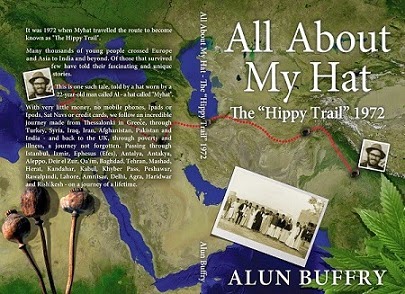
NOW AVAILABLE ON KINDLE AT AMAZON

READERS' COMMENTS
Ann C, Norwich: "This is a fascinatng book packed with stories about adventures on the "Hippy Trail" in all its reality.It was harsh with extreme discomfort.heat and dust and sometimes illness. It took strength and endurance .but then. the rewards were a rich awareness of other cultures and beliefs. I recommend it warmly.and did I mention, it is so funny!"
Roger W E, Swansea: "My Hat is becoming an independent friend, as I read on - he/she/it is competing with you! Roger WE"
Chris P, Essex: "Awesome read fella, most enjoyable."
Ian L, Norfolk: "Read it before Christmas, liked it, very entertaining, definitely a good read, well done Alun."
Frank K, W Sussex: "Loved the book Alun and have shown friends, also travellers with a Hippie hat. Great days to remember for you I bet. I like the way you laid out the text too, great read."
Mark S, Norfolk: "Loving the book."
Melissa D, Italy "I really enjoyed this book..... but I have to admit I skipped some of the travel book descriptions. My favourite part is..... No, I won't spoil it for you!
Simon B, Norwich: "You were lucky to survive. Loved the book."
TASTERS
INTRODUCTION
Let me introduce myself, I am called Myhat.
I am quite an old hat. I was made decades ago. I had been passed many times to a few heads, yet had seldom found one that I felt really comfortable on.
About 40 years ago, everything changed. I found myself upon a head that I had a close affinity with and I found myself seeing, hearing, smelling much through this young man, Al - and even picking up on his emotions and thoughts.
I was lost then for several years, stored in a cupboard until, once again, I found myself on Al's head and now I can tell my tales.
Al and I spent some nine months together on our first trip, visiting many big cities and several small villages, in eight countries, all different, all new to myself and my new head – an adventure of a lifetime.
I had sat on Al's head and witnessed all sorts of strange places and events until we had travelled to India and then to the UK.
When Al arrived back in the UK, he was quite ill, having suffered from a problem called Hepatitis and also dysentery. Al went to his parent's house in Wales and then to hospital. But whilst he was in that hospital, I was never on his head after he had arrived, and ended up in a box in a storage cupboard.
I didn't know what was happening. Why was Al leaving me? How long was I to be here? What would become of me now? Would I get a new head? Would I get more adventures? Would I be treasured or neglected?
Then one day, Al took me out of my box and put me back on his head.
That is how it came that I found myself back on Al's head. I have been on and off Al's head for about forty years and now I can tell my tales. Al had done a lot of travelling over those forty years.
I had always been able to understand any language spoken and understood by whatever head I was placed on - but never been able to utter anything myself – until now! I have discovered that I can help Al remember the places we had experienced together and I somehow I managed to place the idea of writing my tale for me. Anyway, that idea came upon Al and here he is, writing this for me!
As well as understanding the thoughts, memories and feelings of my head – I felt as he felt - I have been able to see through the eyes, hear through the ears and even taste through the mouth and tongue of my head – Al – and over the days developed a strange connection so that so long as Al was nearby, I could watch what was going on around him – even when not on his head!
I watched, I listened and I remembered – and that is how I come to write this story through a head called Al.
A DIP IN THE GANGES
After a pleasant afternoon with Ashok and his family, they drove back to Haridwar and Al was dropped off back near the railway station where, once again, he slept on the wooden bench.
The following morning after a breakfast of fruit, yoghurt and bread, Al took a stroll around the town. It seemed very old. The streets were crowded with people going about their days amidst the cows.
After a while he found a bridge over the river Ganges. It looked greener on the other side, with trees to sit beneath and watch the powerful currents pass. So he crossed the bridge and turned right to follow a rough path running besides the River.
He spotted an orange-robed elderly and bearded man sitting cross-legged beneath a tree, a semi-circle of younger people sitting facing him.
Al knew that they were called Baba’s, as he himself had been called a few times.
“Maybe he’s one of those guru teachers,” Al thought.
Back in England Al had read about the pop group The Beatles who had taken up with a Guru called Maharishi Mahesh Yogi who had taught them how to meditate and himself gained great publicity and popularity – maybe it was something to do with that.
The orange-robbed ‘teacher’ shouted something and motioned to Al to go over and join them and sit down. Al complied. The elderly teacher smiled and asked Al where he was from and why he was in Haridwar, in a broken English with an almost German accent.
Al explained that he had travelled overland from the UK, simply on an adventure and that he was here because he had met a Spanish man in Delhi who had recommended it as a good place to stay for a while. The teacher laughed and from under his robes produced a chillum. The chillum was prepared, wrapped in a safi – a small piece of cloth that served as a sort of filter – the tobacco hash mixture poured in and the lit chillum passed around so that everyone including Al had a good puff.
The teacher-come-chillum-maker – the Baba – asked Al if he had a few rupees for another chillum. Al handed over a small note. A young boy suddenly appeared from amongst the nearby thickness of trees, took the note, ran off into the trees to return seconds later with a small lump of black hash which he passed on and which was instantly made into another chillum and smoked.
Al stayed a short while and as nothing was being said and he was quite high on the hash, he said his goodbyes and left, carrying on in the same direction as before. Within minutes he was sitting with another group under another tree, smoking again.
“This is the good life!” thought Al, so high that he was beginning to feel like he was in a Holy city in India. “By the Ganges!”
He left the second group and walked some hundred yards before he had the idea that immersing oneself in the Ganges was supposed to purify the soul.
“Well,” he mumbled under his breath so only he (and I) could hear, “Why not, it’s hot and I’ll soon dry off.”
Across the river he could see a long walled building complex with steps going down to the River. As he got closer he could see steps going down on this side too. A few steps, “I should be OK."
The water was moving very fast. Al thought maybe he would not immerse himself, just splash himself all over.
“After all, I can’t swim.” So he put down his bag, took me off his head and put me on his bag, took off his sandals, and stepped down and in to the water.
With some hesitation, one step, second step, third step – then his feet were swept from under him. He felt himself falling backwards into the water which he knew would sweep him away. Too high to feel real fear, he envisioned the situation if he was to be swept down the Ganges – he would have to try to float. He had to hope he would be saved, but who would swim in this? How many bodies had ended up like this. Was this really Holy Water?
As he fell he reached out and somehow managed to grab a chain that was attached to the land, maybe for mooring a boat. He grabbed the chain but the force of the water was now tugging at his body like a hungry monster and now splashing his whole body with his head about to go under.
As his head went under he felt a wrenching on his arm but he pulled stronger, now his head was out, now his body, now he was clambering up the steps, drenched and coughing up Holy Water. He made it to the grassy bank and collapsed on the floor.
I felt so many emotions and thoughts and images flooding Al’s brain.
“So fucking stupid! I could have died.”
“Am I cleansed? Am I saved? Don’t feel any different.”
“God I’m stoned! I shouldn’t have done that. What would have happened if that chain wasn’t there?”
“Glad I took Myhat off!"
So was I.
Had I been in that water I would surely have been swept away for ever.
But it wasn’t long before Al was dried out and sitting with yet another group smoking another chillum.
After a while, that particular teacher said that they had seen Al go into the River and now his soul was clean. That was about all he said, except he asked Al if he wanted some chai and said that “Mahatma is coming, he will take you for chai.” Al liked the spicy milky tea drinks.
Al wondered if this was the Maharishi Mahesh Yogi or maybe some local lord or lord’s son, a rich man probably. Everything was so strange that Al did not know what to expect next. I was wondering about who this ‘Mahatma’ was - maybe he made hats?
After a while a man in orange robes accompanied by a small group of Indian-looking people approached. Apparently he was the Mahatma. He exchanged words with the teacher under the tree and said to Al: “OK, you come now for chai and this evening we will do our ‘Arti’ parade through town and then you join us and come to Ashram maybe?” They walked a while, crossed a bridge and entered a small chai shop where the Mahatma said something to the owner or waiter – who did not look too pleased – pointing at Al who, seemingly somewhat disgruntled, delivered to his table with “No charge, Sir” and the Mahatma and his entourage left, saying “Join us for Arti parade.”
There were still a few hours before evening so Al decided to go and wait on his bench back at the railway station.
That was when everything changed.
AVAILABLE AT http://www.buffry.org.uk/allaboutmyhat.html
NOW AVAILABLE ON KINDLE AT AMAZON
Subscribe to:
Posts (Atom)