Showing posts with label Baghdad. Show all posts

Monday, 18 April 2022

April 13 - 18, 1972: Baghdad and Journey to Iranian Border

 Taken From All About My Hat The Hippy Trail 1972

They reached Baghdad as it was getting dark and soon found a cheap dormitory near the bus station where they could spend the night. It was cheap enough, even for Keith and Al neither of whom had much money left. It was upstairs above a small eating house where we were told we could eat for free.

The dormitory consisted of two rows of about twelve beds and a few tables and chairs. At one end of the room were gathered about 8 elderly men

They look like Ali Baba and the thieves,” said Al.

Hey man, I don't think they're thieves,” said Keith; “they've all got two hands.”

Maybe they're clever thieves,” said Al, “I am going to tie my rucksack to the bed.”

Al kept me on his head all night. Sometimes, tossing and turning, I would slip off, but Al would stir and pull me back on to his head. It seemed like a long night.

When Al finally decided to get out of bed, I sensed his relief, for not only was there no bad incident, no attempt at stealing his rucksack, but when he looked around, I too could see that those men were not the 40 thieves after all. It was a small group of smiling men that soon offered Al and Keith some black tea to drink and some bread and cheese to eat for breakfast. There was no conversation between Al and those men, as it seemed they did not understand Al's language, English, and he did not understand theirs. Yet somehow I felt a great sense of friendship between them.

After breakfast, Al and Keith decided to go out into Baghdad and do some exploring.


 They strolled down a dusty road filled with people that mostly ignored them. There were men dressed either Arab-style or Western-style, women in black, some with faces completely covered and just a criss-cross pattern to look through, others showing their eyes, scruffy children, donkeys, cars, buses and trucks.

Look!”said Al, “There's a sign saying 'Youth Hostel’. Shall we take a look?”

It was a short way up a side street, even more dusty than the main street, but, surrounded by a wire fence,; it looked spacious and clean.

I'll nip in and see if they've got rooms and how much,” said Keith. “Might be cheap, man”.

Within minutes Keith was back out with big grin on his face: “It’s even cheaper than the dorm, “he said, “a twin room with a toilet and shower and we can use the kitchen and it's clean too and they sell food and have table tennis and darts and games.”

Keith was really excited so Al went in to take a look and sooner said than done they had booked a room for three nights and moved their bags in.

Let's not hang about”, said Al, “It could be a good day, let's go explore!”

Al and Keith started walking up a wide but dusty street. Al felt very hot. The men he saw were dressed in various ways, some in jeans and T-shirts like Al and Keith, others in flowing robes of various colours and some with cloth wrapped around their heads; others wore suits with or without ties. Then there were what Al assumed were the women underneath what looked like heavy black bundles from head to ankle. He thought they must have been very hot and wondered why they dressed like that. Was it out of choice or was it forced upon them.

We passed shops and stalls selling food and clothing, bits and pieces, a butcher's shop with meat hanging from hooks, shops selling books, tools, kitchen items. And there was a barber or two. There were lots of small Tea Houses and small eateries and plenty of stalls selling tobacco and newspapers.

It wasn't exactly clean, with a lot of litter and animal droppings, and the dust was made worse by many trucks and buses, and as we progressed up the street there was more and more crowds of people and suddenly we found ourselves in a fruit market.

Wow!”, said Al, “Look at that! Fruits! I'm parched, I want some blackcurrant juice!”


Al and Keith spent the next hour or so wandering up and down the first section of this long street market, trying all sorts of fruit juices and then milkshakes: I remember there were so many different tastes; fruits called raspberry, strawberry, apple, pear, orange, mango, melon and a juice made from carrots. Many of the juices were offered with ice and Al was a bit doubtful as he had been told not to drink tap water, but since the locals were drinking the juices with ice, the lads did too.

We also bought some bread, dates, cheese and olives for later, and some soft cakes.

As it was now even hotter, we headed back to the hostel.

The following day Al and Keith spent many hours alternating between sitting outside in the sun and laying on their beds inside, drinking copious amounts of black tea, water and cheap soft drinks loaded up with ice.

Baghdad is a really old city”, said Keith.

Listen to this, man, it's cool stuff” he said, reading from his travel guide book:

Baghdad is the largest city in Iraq and the second largest city in Western Asia after Tehran”.

That's where we're going next!”, interrupted Al.

Keith read on: “Located along the Tigris River, the city was founded in the 8th century and became the capital of the Abbasid Caliphate. Throughout the High Middle Ages, Baghdad was considered to be the largest city in the world with an estimated population of one million two hundred thousand people. According to some archaeologists it was the first city to reach a population over one million inhabitants. The city was largely destroyed at the hands of the Mongol Empire in 1258.

With the recognition of Iraq as an independent state, in 1938, Baghdad gradually regained some of its former prominence as a significant centre of Arab culture.

The name Baghdad is pre-Islamic and its origins are under some dispute. The site where the city of Baghdad came to stand has been populated for millennia and by the 8th century AD several Aramaic Christian villages had developed there, one of which was called Baghdad, the name which would come to be used for the Abbasid metropolis.

The name has been used as Baghdadu on Assyrian cuneiform and Babylonian records going back to at least 2000 BC. An inscription by Nebuchadnezzar in 600 BC describes how he rebuilt the old Babylonian town of Bagh-dadu. There used to be another Babylonian settlement called Baghdad, in upper Mesopotamia, near the ancient city of Edessa. The name has not been attested outside of Mesopotamia.

In its early years, the city was known as a deliberate reminder of an expression in the Koran, when it refers to Paradise. It took four years to build.

Mansur assembled engineers, surveyors, and art constructionists from around the world to come together and draw up plans for the city. Over 100,000 construction workers came to survey the plans; many were distributed salaries to start the building of the city. July was chosen as the starting time because two Astrologers, Naubakht Ahvazi and Mashallah, believed that the city should be built under the sign of the lion, Leo. Leo is associated with fire and symbolises productivity, pride, and expansion.

The bricks used to make the city were eighteen inches on all four sides. Marble was also used to make buildings throughout the city, and marble steps led down to the river's edge.

The basic framework of the city consists of two large semicircles. The city was designed as a circle leading it to be known as the "Round City". The original design shows as single ring of residential and commercial structures along the inside of the city walls, but the final construction added another ring inside the first. Within the city there were many parks, gardens, villas, and promenades. In the centre of the city lay the mosque, as well as headquarters for guards. The purpose or use of the remaining space in the centre is unknown. The circular design of the city was a direct reflection of the traditional Persian Sasanian urban design. The Sasanian city of Gur in Fars, built five hundred years before Baghdad, is nearly identical in its general circular design, radiating avenues, and the government buildings and temples at the centre of the city. This style of urban planning contrasted with Ancient Greek and Roman urban planning, in which cities are designed as squares or rectangles with streets intersecting each other at right angles.

The Surrounding walls.

The four surrounding walls of Baghdad were named Kufa, Basra, Khurasan, and Damascus; named because their gates pointed in the directions of these destinations. Each gate had double doors that were made of iron; the doors were so heavy it took several men to open and close them. The wall itself was about a hundred and forty-four feet thick at the base and about forty thick at the top. Also, the wall was 100 feet high, which included merlons, a solid part of an embattled parapet usually pierced by embrasures. This wall was surrounded by another wall with a thickness of 160 feet. The second wall had towers and rounded merlons, which surrounded the towers. This outer wall was protected by solid glacis, which is made out of bricks and quicklime. Beyond the outer wall was a water-filled moat.

The Golden Gate Palace.

In the middle of Baghdad, in the central square was the Golden Gate Palace. The Palace was the residence of the caliph and his family. In the central part of the building was a green dome that was one hundred and thirty feet high. Surrounding the palace was an esplanade, a waterside building, in which only the caliph could come riding on horseback. In addition, the palace was near other mansions and officer's residences. Near the Gate of Syria a building served as the home for the guards. It was made of brick and marble. The palace governor lived in the latter part of the building and the commander of the guards in the front. In 813, after the death of caliph Al-Amin the palace was no longer used as the home for the caliph and his family. The roundness points to the fact that it was based on Arabic script. 


And the Hanging Gardens of Babylon are not far from here,” said Al, “maybe we can get a bus and go there.”

But I know that trip never happened for one of the other men in the hostel told them it was not worth seeing, just ruins. I also know that Al regretted not going to see it for himself, ever since.

After a few days in Baghdad that both Al and Keith seemed to enjoy, a couple of visits to the market and an afternoon spent in a museum, we planned an early morning bus to the Iraq-Iran border. That had meant a visit to the Embassy to buy a visa and another change of money.

Iraq and Iran were fighting at some sections along their border but we were told by an information officer at the Tourist office that it was OK where we were going. Iran did not want Iraq money so the plan was to change it at the border.

We were heading for Tehran, about five hundred and sixty miles away.

The bus took ages and was crammed to capacity with people wearing all sorts of clothing from complete head-to-toe burkas to T-shirt and jeans. There were just another two Europeans on the bus. When we reached the border town it was almost dark, most places were closed and there was nowhere to stay. Al felt very uncomfortable as soon as they alighted from the bus and people scattered. The streets looked empty and shadowy.

Trying to cope with a strong feeling of impending disaster, Al and Keith entered a saloon-like eating house that had lights on and an open door. Inside sat a small group of older men watching football on a tiny black and white TV. Near the counter sat a small group of young men drinking Fanta and smoking cigarettes. The place was indeed smoky and run-down. Although everyone seemed to turn to look at us as we went in, nobody said a word or even made a gesture.

We went up to the counter and the aged man sat behind it seemed to look straight through us.

Hello, we would like something to eat please, and some tea”, said Keith.

Nothing. It was as if he had not spoken.

Al tried gesturing that he wanted to eat and drink.

The man shrugged and pointed towards the door. I felt Al's strong feeling that we needed to leave.

 Maybe they don't like that we are leaving Iraq,” said Keith quietly.

Well Iraq and Iran are at war in the South if you remember – we're lucky they're not shooting at each other here. Let's go”, said Al.

So we left the building and turned left heading again towards the border crossing point that was just a few miles away, Al knew from a sign post with Arab writing and the number 2 pointing that way.

About 15 minutes later they passed another café.

As we approached, a young man in jeans came out and ran towards us.

Welcome, welcome, my friends, you are most welcomed here. The border closed now, you go tomorrow.”

Hello,” said Al, "is there something to eat here?”

Yes, yes, please come, we have food and we have room to sleep and for you my friends no money.”

So with thoughts on whether he was once again risking his safety Al followed as Keith headed towards the low door and into a shadowy interior.

There was low music playing and what could have been an extended family with young children crawling or running around. They were almost all dressed like westerners, although the women were mostly covered they did show their faces.

Several people at once gestured to empty chairs and Keith and Al sat down. Everyone was looking at them – and smiling. Immediately glasses of black tea were served up, with biscuits.

Al was sat next to a young man on one side and an elderly man on the other. The young man pointed to the older man and said “My fadda!”

Al turned his head and was met with a massive toothless grin and outstretched hand. “Very pleased you are here now”, he said, “You are our guests this night.”

Whilst they sipped tea Al and the old man chatted and Al learned that this was indeed a guest house but they had few guests as they were a big family already and because they were Christians many people passed by. But they were also farmers and were able to grow food for the markets and, said the man “God gives what we need.”

The man said his name was Abdullah and he had come to Iraq with his father and mother many years ago, from Turkey. Then they did farming.

Suddenly a steaming hot bowl of soup was put in front of them, with bread, olives, figs, beans and green vegetables.

Eat, eat, my friends, this is for you”, said Abdullah.

As it turned out few of the family spoke English and over the next hour or so many left. Al was keen to avoid talking politics and anyway he did not know the politics of the area. Abdullah was keen to learn about the places Al had been, asking a lot of questions about his home too.

Close to midnight now, Abdullah showed Al and Keith to two straw mattresses at the one end of the room, where they could sleep. 


Keith was reading his travel guide. He said: “Listen to this man. There's two types of Islam, I've been reading about the religion.” He read quietly:

Islam is a monotheistic and Abrahamic religion articulated by the Koran, a book considered by its adherents to be the verbatim word of God.

Muslims believe that God is one and incomparable and the purpose of existence is to worship God. Muslims also believe that Islam is the complete and universal version of a primordial faith that was revealed before many times throughout the world, including notably through Adam, Noah, Abraham, Moses, and Jesus, whom they consider prophets. They maintain that the previous messages and revelations have been partially misinterpreted or altered over time, but consider the Arabic Koran, to be both the unaltered and the final revelation of God. Religious concepts and practices include the five pillars of Islam, which are basic concepts and obligatory acts of worship, and following Islamic law, which touches on virtually every aspect of life and society, providing guidance on multifarious topics from banking and welfare, to family life and the environment.

Most Muslims are of two denominations: Sunni 75–90% or Shia 10–20%.

Muslims believe that the creation of everything in the universe was brought into being by God’s sheer command, “‘Be’ and so it is,” and that the purpose of existence is to worship God. He is viewed as a personal god who responds whenever a person in need or distress calls him.

Allah is the term with no plural or gender used by Muslims and Arabic-speaking Christians and Jews to reference God.

Muslims identify the prophets of Islam as those humans chosen by God to be his messengers. According to the Koran, the prophets were instructed by God to bring the "will of God" to the peoples of the nations.

"Muslims believe that prophets are human and not divine, though some are able to perform miracles to prove their claim. Islamic theology says that all of God's messengers preached the message of Islam—submission to the will of God. The Koran mentions the names of numerous figures considered prophets in Islam, including Adam, Noah, Abraham, Moses and Jesus, among others.

Muslims believe that God finally sent Muhammad as the last prophet, the Seal of the Prophets to convey the divine message to the whole world.

Belief in the "Day of Resurrection" is also crucial for Muslims.

The Pillars of Islam - "pillars of religion" - are five basic acts in Islam, considered obligatory for all believers. The Koran presents them as a framework for worship and a sign of commitment to the faith. They are: 1. the creed; 2. daily prayers; 3. alms giving; 4. fasting during Ramadan and 5 the pilgrimage to Mecca at least once in a lifetime. Both Shia and Sunni sects agree on the essential details for the performance of these acts.

The Shahadah, which is the basic creed of Islam that must be recited under oath with the specific statement: "I testify that there are no deities other than Allah alone and I testify that Muhammad is his Messenger." This testament is a foundation for all other beliefs and practices in Islam. Muslims must repeat the shahadah in prayer, and non-Muslims wishing to convert to Islam are required to recite the creed.

The prayers are recited in the Arabic language, and consist of verses from the Koran. The prayers are done with the chest in direction of the kaaba though in the early days of Islam, they were done in direction of Jerusalem.

"A mosque is a place of worship for Muslims. The word mosque in English refers to all types of buildings dedicated to Islamic worship, although there is a distinction in Arabic between the smaller, privately owned mosque and the larger, "collective" mosque. Although the primary purpose of the mosque is to serve as a place of prayer, it is also important to the Muslim community as a place to meet and study."

There's loads more!” said Keith, “about family and what they can and cannot do or eat. They are not supposed to eat pigs or shellfish or become intoxicated. And they're all supposed to do prayers and fast and try to get to Mecca on a pilgrimage once in their lives – I think that's in Saudi Arabia.”

Saturday, 16 July 2016

Readers photo competition - help by giving some pics a LIKE on Facebook: All About My Hat - The Hippy Trail 1972


Reader's Pic Competition - top scores so far - please share the link on your page and generate more votes:
VOTES SO FAR  ( 16/7/16  )
    
Paul FourTwenty Kelly 52 
Melissa Dawdaughter 41 
Sy Dignam 35 
Giuseppe Albero 34 
Frank Kirk 27 
Lesley James 21 
Emilio Napoli 20 
Elizabeth Clarke 18 
Nol van Shaik 17 
Jackie Woodchild 16 
Chris Philbin 15 
Phil Norwich 13 
Sharna van-Damme 13 
Kate Midlane 13 
Winston Matthews 13 
Jacqui Maklin 13 
Kevin Traylen 13 
Rocky van de Benderskum 13 
Give your friend's picture a like at:
https://www.facebook.com/allaboutmyhat/photos/?tab=album&album_id=1553921764890883

ISBN 978 0 9932107 1 6
http://www.buffry.org.uk/allaboutmyhat.html

watch and listen here:

Saturday, 28 March 2015

ALUN BUFFRY - 2 news books now in paperback

"ALL ABOUT MY HAT - THE HIPPY TRAIL 1972"  PAPARBACK
isbn   9780-0-9932107  ON AMAZON
isbn    978-0-9932107-0-9 THROUGH BOOKSHOPS AND LIBRARIES

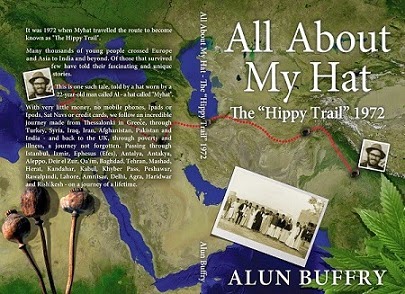
An incredible journey in 1972, of a young man and his hat, "Myhat", from Thessalonki in Greece, through Turkey, Syria, Iraq, Iran, Afghanistan, Pakistan and India - and back to the UK, through poverty and illness, a journey not forgotten. Passing through Istanbul, Izmir, Ephesus (Efes), Antalya, Antakya, Aleppo, Deir el Zur, Qa'im, Baghdad, Tehran, Mashad, Herat, Kandahar, Kabul, Khyber Pass, Peshawar, Rawalpindi, Lahore, Amritsar, Delhi, Agra, Haridwar and Rishikesh - known now as "The Hippy Trail".


READERS' COMMENTS
Joan Bello?, US: "I am quite sure that I have just finished reading what should be recognized as an all time classic. Alun Buffry is a master storyteller. All About My Hat kept me spellbound from the first page. This is a precise recounting of true adventure that every hippy-minded person will be in awe of regardless of age. Thankfully, Buffry has found a delightfully unique literary vehicle that completely disposes of the usual ego distraction of so many biographical accounts. It is effortless reading, nothing superfluous, no fillers, with an ease of language and a precision that is admirable. My Hat is a constant reminder of the camaraderie shared among all cannabis supporters around the world. Bravo!!"
Winston M, Surrey: "Great read and so much interesting found it hard to put down."
Kevin T, Norfolk: "A Brilliant book once i started it i could NOT put it down i would recommend others to read it."
Roger H, Suffolk: "Good Grief!"
Ann C, Norwich: "This is a fascinatng book packed with stories about adventures on the "Hippy Trail" in all its reality. It was harsh with extreme discomfort, heat and dust and sometimes illness. It took strength and endurance ...but then... the rewards were a rich awareness of other cultures and beliefs. "I recommend it warmly.and did I mention, it is so funny!"
Roger W E, Swansea: "My Hat is becoming an independent friend, as I read on - he/she/it is competing with you! Roger WE"
Chris P, Essex: "Awesome read fella, most enjoyable."
Ian L, Norfolk: "Liked it a lot, very entertaining, definitely a good read, well done Alun."
Frank K, W Sussex: "Loved the book Alun and have shown friends, also travellers with a Hippie hat. Great days to remember for you I bet. I like the way you laid out the text too, great read."
Mark S, Norfolk: "Loving the book."
Melissa D, Italy "I really enjoyed this book..... but I have to admit I skipped some of the travel book descriptions. My favourite part is..... No, I won't spoil it for you!
Simon B, Norwich: "You were lucky to survive - loved the book."
Marion G, Suffolk: "Marion Gaze An easy enjoyable read. It took me right back to those times of footloose carefree travel and spontaneous adventure....usually ending in illness or loss of ones money! Though i was part of the start of the journey, Alun's Hat remembers a lot more than me, which is why there will not be a book about my overland trip to India a year or so later..." 
 
INTRODUCTION
Let me introduce myself, I am called Myhat.
I am quite an old hat. I was made decades ago. I had been passed many times to a few heads, yet had seldom found one that I felt really comfortable on.
About 40 years ago, everything changed. I found myself upon a head that I had a close affinity with and I found myself seeing, hearing, smelling much through this young man, Al - and even picking up on his emotions and thoughts.
I was lost then for several years, stored in a cupboard until, once again, I found myself on Al's head and now I can tell my tales.
Al and I spent some nine months together on our first trip, visiting many big cities and several small villages, in eight countries, all different, all new to myself and my new head – an adventure of a lifetime.
I had sat on Al's head and witnessed all sorts of strange places and events until we had travelled to India and then to the UK.
When Al arrived back in the UK, he was quite ill, having suffered from a problem called Hepatitis and also dysentery. Al went to his parent's house in Wales and then to hospital. But whilst he was in that hospital, I was never on his head after he had arrived, and ended up in a box in a storage cupboard.
I didn't know what was happening. Why was Al leaving me? How long was I to be here? What would become of me now? Would I get a new head? Would I get more adventures? Would I be treasured or neglected?
Then one day, Al took me out of my box and put me back on his head.
That is how it came that I found myself back on Al's head. I have been on and off Al's head for about forty years and now I can tell my tales. Al had done a lot of travelling over those forty years.
I had always been able to understand any language spoken and understood by whatever head I was placed on - but never been able to utter anything myself – until now! I have discovered that I can help Al remember the places we had experienced together and I somehow I managed to place the idea of writing my tale for me. Anyway, that idea came upon Al and here he is, writing this for me!
As well as understanding the thoughts, memories and feelings of my head – I felt as he felt - I have been able to see through the eyes, hear through the ears and even taste through the mouth and tongue of my head – Al – and over the days developed a strange connection so that so long as Al was nearby, I could watch what was going on around him – even when not on his head!
I watched, I listened and I remembered – and that is how I come to write this story through a head called Al.

A DIP IN THE GANGES
After a pleasant afternoon with Ashok and his family, they drove back to Haridwar and Al was dropped off back near the railway station where, once again, he slept on the wooden bench.
The following morning after a breakfast of fruit, yoghurt and bread, Al took a stroll around the town. It seemed very old. The streets were crowded with people going about their days amidst the cows.
After a while he found a bridge over the river Ganges. It looked greener on the other side, with trees to sit beneath and watch the powerful currents pass. So he crossed the bridge and turned right to follow a rough path running besides the River.
He spotted an orange-robed elderly and bearded man sitting cross-legged beneath a tree, a semi-circle of younger people sitting facing him.
Al knew that they were called Baba’s, as he himself had been called a few times.
“Maybe he’s one of those guru teachers,” Al thought.
Back in England Al had read about the pop group The Beatles who had taken up with a Guru called Maharishi Mahesh Yogi who had taught them how to meditate and himself gained great publicity and popularity – maybe it was something to do with that.
The orange-robbed ‘teacher’ shouted something and motioned to Al to go over and join them and sit down. Al complied. The elderly teacher smiled and asked Al where he was from and why he was in Haridwar, in a broken English with an almost German accent.
Al explained that he had travelled overland from the UK, simply on an adventure and that he was here because he had met a Spanish man in Delhi who had recommended it as a good place to stay for a while. The teacher laughed and from under his robes produced a chillum. The chillum was prepared, wrapped in a safi – a small piece of cloth that served as a sort of filter – the tobacco hash mixture poured in and the lit chillum passed around so that everyone including Al had a good puff.
The teacher-come-chillum-maker – the Baba – asked Al if he had a few rupees for another chillum. Al handed over a small note. A young boy suddenly appeared from amongst the nearby thickness of trees, took the note, ran off into the trees to return seconds later with a small lump of black hash which he passed on and which was instantly made into another chillum and smoked.
Al stayed a short while and as nothing was being said and he was quite high on the hash, he said his goodbyes and left, carrying on in the same direction as before. Within minutes he was sitting with another group under another tree, smoking again.
“This is the good life!” thought Al, so high that he was beginning to feel like he was in a Holy city in India. “By the Ganges!”
He left the second group and walked some hundred yards before he had the idea that immersing oneself in the Ganges was supposed to purify the soul.
“Well,” he mumbled under his breath so only he (and I) could hear, “Why not, it’s hot and I’ll soon dry off.”
Across the river he could see a long walled building complex with steps going down to the River. As he got closer he could see steps going down on this side too. A few steps, “I should be OK."
The water was moving very fast. Al thought maybe he would not immerse himself, just splash himself all over.
“After all, I can’t swim.” So he put down his bag, took me off his head and put me on his bag, took off his sandals, and stepped down and in to the water.
With some hesitation, one step, second step, third step – then his feet were swept from under him. He felt himself falling backwards into the water which he knew would sweep him away. Too high to feel real fear, he envisioned the situation if he was to be swept down the Ganges – he would have to try to float. He had to hope he would be saved, but who would swim in this? How many bodies had ended up like this. Was this really Holy Water?
As he fell he reached out and somehow managed to grab a chain that was attached to the land, maybe for mooring a boat. He grabbed the chain but the force of the water was now tugging at his body like a hungry monster and now splashing his whole body with his head about to go under.
As his head went under he felt a wrenching on his arm but he pulled stronger, now his head was out, now his body, now he was clambering up the steps, drenched and coughing up Holy Water. He made it to the grassy bank and collapsed on the floor.
I felt so many emotions and thoughts and images flooding Al’s brain.
“So fucking stupid! I could have died.”
“Am I cleansed? Am I saved? Don’t feel any different.”
“God I’m stoned! I shouldn’t have done that. What would have happened if that chain wasn’t there?”
“Glad I took Myhat off!"
So was I.
Had I been in that water I would surely have been swept away for ever.
But it wasn’t long before Al was dried out and sitting with yet another group smoking another chillum.
After a while, that particular teacher said that they had seen Al go into the River and now his soul was clean. That was about all he said, except he asked Al if he wanted some chai and said that “Mahatma is coming, he will take you for chai.” Al liked the spicy milky tea drinks.
Al wondered if this was the Maharishi Mahesh Yogi or maybe some local lord or lord’s son, a rich man probably. Everything was so strange that Al did not know what to expect next. I was wondering about who this ‘Mahatma’ was - maybe he made hats?
After a while a man in orange robes accompanied by a small group of Indian-looking people approached. Apparently he was the Mahatma. He exchanged words with the teacher under the tree and said to Al: “OK, you come now for chai and this evening we will do our ‘Arti’ parade through town and then you join us and come to Ashram maybe?” They walked a while, crossed a bridge and entered a small chai shop where the Mahatma said something to the owner or waiter – who did not look too pleased – pointing at Al who, seemingly somewhat disgruntled, delivered to his table with “No charge, Sir” and the Mahatma and his entourage left, saying “Join us for Arti parade.”
There were still a few hours before evening so Al decided to go and wait on his bench back at the railway station.
That was when everything changed.

"OUT OF JOINT -  20 YEARS OF CAMPAIGNING FOR CANNABIS"  isbn  978-1-5084202-1-7


It was in Norwich prison whilst on remand in 1991 that Alun Buffry was approached by Jack Girling during a prison visit, and invited to help him and others form the Campaign to Legalise Cannabis International Association (CLCIA).In 1992, whilst on bail, the CLCIA was formed but it would not be until after Alun Buffry was released on parole in 1995, having served four-and-a-half years, that he started to dedicate himself to the cause of legalising the possession, cultivation and trade of cannabis in the UK. In the General Election of 1997, Howard Marks contested four seats on the single issue of cannabis. In 1999, the campaign registered as a political party in the UK under the name Legalise Cannabis Alliance (LCA).The LCA fought in over 80 elections including Parliamentary, local council and county councils, did numerous talks and interviews, gave oral evidence to the Home Affairs Committee and the Basque Government in Spain, debated at The Oxford Union and at universities, attended marches and rallies protests and picnics and produced the first and only Party Political Broadcast by a cannabis party, shown on TV in Wales in 2005. This is Alun Buffry's no-holds-barred story, from his prospective, detailing his own activities and those of others, over the period 1991 to 2011.


Friday, 9 January 2015

"All About My Hat - The Hippy Trail 1972" by Alun Buffry NOW ON KINDLE AT AMAZON

An incredible journey in 1972, of a young man and his hat, "Myhat", from Thessalonki in Greece, through Turkey, Syria, Iraq, Iran, Afghanistan, Pakistan and India - and back to the UK, through poverty and illness, a journey not forgotten. Passing through Istanbul, Izmir, Ephesus (Efes), Antalya, Antakya, Aleppo, Deir el Zur, Qa'im, Baghdad, Tehran, Mashad, Herat, Kandahar, Kabul, Khyber Pass, Peshawar, Rawalpindi, Lahore, Amritsar, Delhi, Agra, Haridwar and Rishikesh - known now as "The Hippy Trail".

READERS' COMMENTS

Ann C, Norwich: "This is a fascinatng book packed with stories about adventures on the "Hippy Trail" in all its reality.It was harsh with extreme discomfort.heat and dust and sometimes illness. It took strength and endurance .but then. the rewards were a rich awareness of other cultures and beliefs. I recommend it warmly.and did I mention, it is so funny!"

Roger W E, Swansea: "My Hat is becoming an independent friend, as I read on - he/she/it is competing with you! Roger WE"

Chris P, Essex: "Awesome read fella, most enjoyable."

Ian L, Norfolk: "Read it before Christmas, liked it, very entertaining, definitely a good read, well done Alun."

Frank K, W Sussex: "Loved the book Alun and have shown friends, also travellers with a Hippie hat. Great days to remember for you I bet. I like the way you laid out the text too, great read."

Mark S, Norfolk: "Loving the book."

Melissa D, Italy "I really enjoyed this book..... but I have to admit I skipped some of the travel book descriptions. My favourite part is..... No, I won't spoil it for you!

Simon B, Norwich: "You were lucky to survive.  Loved the book."

TASTERS

INTRODUCTION

Let me introduce myself, I am called Myhat.
I am quite an old hat. I was made decades ago. I had been passed many times to a few heads, yet had seldom found one that I felt really comfortable on.
About 40 years ago, everything changed. I found myself upon a head that I had a close affinity with and I found myself seeing, hearing, smelling much through this young man, Al - and even picking up on his emotions and thoughts.
I was lost then for several years, stored in a cupboard until, once again, I found myself on Al's head and now I can tell my tales.
Al and I spent some nine months together on our first trip, visiting many big cities and several small villages, in eight countries, all different, all new to myself and my new head – an adventure of a lifetime.
I had sat on Al's head and witnessed all sorts of strange places and events until we had travelled to India and then to the UK.
When Al arrived back in the UK, he was quite ill, having suffered from a problem called Hepatitis and also dysentery. Al went to his parent's house in Wales and then to hospital. But whilst he was in that hospital, I was never on his head after he had arrived, and ended up in a box in a storage cupboard.
I didn't know what was happening. Why was Al leaving me? How long was I to be here? What would become of me now? Would I get a new head? Would I get more adventures? Would I be treasured or neglected?
Then one day, Al took me out of my box and put me back on his head.
That is how it came that I found myself back on Al's head. I have been on and off Al's head for about forty years and now I can tell my tales. Al had done a lot of travelling over those forty years.
I had always been able to understand any language spoken and understood by whatever head I was placed on - but never been able to utter anything myself – until now! I have discovered that I can help Al remember the places we had experienced together and I somehow I managed to place the idea of writing my tale for me. Anyway, that idea came upon Al and here he is, writing this for me!
As well as understanding the thoughts, memories and feelings of my head – I felt as he felt - I have been able to see through the eyes, hear through the ears and even taste through the mouth and tongue of my head – Al – and over the days developed a strange connection so that so long as Al was nearby, I could watch what was going on around him – even when not on his head!
I watched, I listened and I remembered – and that is how I come to write this story through a head called Al.

A DIP IN THE GANGES

After a pleasant afternoon with Ashok and his family, they drove back to Haridwar and Al was dropped off back near the railway station where, once again, he slept on the wooden bench.
The following morning after a breakfast of fruit, yoghurt and bread, Al took a stroll around the town. It seemed very old. The streets were crowded with people going about their days amidst the cows.
After a while he found a bridge over the river Ganges. It looked greener on the other side, with trees to sit beneath and watch the powerful currents pass. So he crossed the bridge and turned right to follow a rough path running besides the River.
He spotted an orange-robed elderly and bearded man sitting cross-legged beneath a tree, a semi-circle of younger people sitting facing him.
Al knew that they were called Baba’s, as he himself had been called a few times.
“Maybe he’s one of those guru teachers,” Al thought.
Back in England Al had read about the pop group The Beatles who had taken up with a Guru called Maharishi Mahesh Yogi who had taught them how to meditate and himself gained great publicity and popularity – maybe it was something to do with that.
The orange-robbed ‘teacher’ shouted something and motioned to Al to go over and join them and sit down. Al complied. The elderly teacher smiled and asked Al where he was from and why he was in Haridwar, in a broken English with an almost German accent.
Al explained that he had travelled overland from the UK, simply on an adventure and that he was here because he had met a Spanish man in Delhi who had recommended it as a good place to stay for a while. The teacher laughed and from under his robes produced a chillum. The chillum was prepared, wrapped in a safi – a small piece of cloth that served as a sort of filter – the tobacco hash mixture poured in and the lit chillum passed around so that everyone including Al had a good puff.
The teacher-come-chillum-maker – the Baba – asked Al if he had a few rupees for another chillum. Al handed over a small note. A young boy suddenly appeared from amongst the nearby thickness of trees, took the note, ran off into the trees to return seconds later with a small lump of black hash which he passed on and which was instantly made into another chillum and smoked.
Al stayed a short while and as nothing was being said and he was quite high on the hash, he said his goodbyes and left, carrying on in the same direction as before. Within minutes he was sitting with another group under another tree, smoking again.
“This is the good life!” thought Al, so high that he was beginning to feel like he was in a Holy city in India. “By the Ganges!”
He left the second group and walked some hundred yards before he had the idea that immersing oneself in the Ganges was supposed to purify the soul.
“Well,” he mumbled under his breath so only he (and I) could hear, “Why not, it’s hot and I’ll soon dry off.”
Across the river he could see a long walled building complex with steps going down to the River. As he got closer he could see steps going down on this side too. A few steps, “I should be OK."
The water was moving very fast. Al thought maybe he would not immerse himself, just splash himself all over.
“After all, I can’t swim.” So he put down his bag, took me off his head and put me on his bag, took off his sandals, and stepped down and in to the water.
With some hesitation, one step, second step, third step – then his feet were swept from under him. He felt himself falling backwards into the water which he knew would sweep him away. Too high to feel real fear, he envisioned the situation if he was to be swept down the Ganges – he would have to try to float. He had to hope he would be saved, but who would swim in this? How many bodies had ended up like this. Was this really Holy Water?
As he fell he reached out and somehow managed to grab a chain that was attached to the land, maybe for mooring a boat. He grabbed the chain but the force of the water was now tugging at his body like a hungry monster and now splashing his whole body with his head about to go under.
As his head went under he felt a wrenching on his arm but he pulled stronger, now his head was out, now his body, now he was clambering up the steps, drenched and coughing up Holy Water. He made it to the grassy bank and collapsed on the floor.
I felt so many emotions and thoughts and images flooding Al’s brain.
“So fucking stupid! I could have died.”
“Am I cleansed? Am I saved? Don’t feel any different.”
“God I’m stoned! I shouldn’t have done that. What would have happened if that chain wasn’t there?”
“Glad I took Myhat off!"
So was I.
Had I been in that water I would surely have been swept away for ever.
But it wasn’t long before Al was dried out and sitting with yet another group smoking another chillum.
After a while, that particular teacher said that they had seen Al go into the River and now his soul was clean. That was about all he said, except he asked Al if he wanted some chai and said that “Mahatma is coming, he will take you for chai.” Al liked the spicy milky tea drinks.
Al wondered if this was the Maharishi Mahesh Yogi or maybe some local lord or lord’s son, a rich man probably. Everything was so strange that Al did not know what to expect next. I was wondering about who this ‘Mahatma’ was - maybe he made hats?
After a while a man in orange robes accompanied by a small group of Indian-looking people approached. Apparently he was the Mahatma. He exchanged words with the teacher under the tree and said to Al: “OK, you come now for chai and this evening we will do our ‘Arti’ parade through town and then you join us and come to Ashram maybe?” They walked a while, crossed a bridge and entered a small chai shop where the Mahatma said something to the owner or waiter – who did not look too pleased – pointing at Al who, seemingly somewhat disgruntled, delivered to his table with “No charge, Sir” and the Mahatma and his entourage left, saying “Join us for Arti parade.”
There were still a few hours before evening so Al decided to go and wait on his bench back at the railway station.
That was when everything changed.


NOW AVAILABLE ON KINDLE AT AMAZON