Saturday, 14 February 2026

Friday, 29 April 2022
April 1972: Herat, Khandihar and Kabul
Taken From All About My Hat The Hippy Trail 1972
(images found on line)
Next morning Al was out of bed and quickly down to the dining room for breakfast, hoping to see Miriam there; but she wasn't there.
Breakfast was a big surprise, there was masses. Porridge, eggs, boiled, scrambled, fried, pancakes, sausages and pieces of lamb, which Al did not eat, toast and jams, bowls of massive fruit and even cold pizza, with tea and coffee and fruit juices.
After breakfast, Al and Keith went outside to see what the place was like in daylight. Al was secretly hoping he would see Miriam.
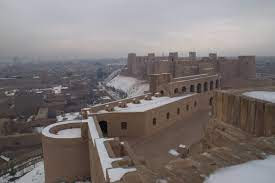
The city was dominated by a fifth century citadel known as Herat Fort. Very impressive but it did not draw Al and Keith to it - neither did they visit the mosque. Instead they amazed themselves simply by walking the street - it was like going back in time a couple of thousand years.
Stalls were set up along one side of the road, offering mostly fruit and vegetables, meat, bread, clothing and kitchen utensils. What traffic there was had to drive past this market on the other side of the road.
There was also quite a large number of elderly men dressed in long robes and turbans, holding out hands or gesturing to eat. Al did not have money to spare for them if he had wanted to give. Many seemed to be given food from the stalls.
Strangely, although it was dusty and hot and looked like something out of Biblical times, obviously not wealthy but mostly unchanged for probably centuries, the place felt really calm and in a way idyllic. Only thing was, no Miriam!

They spotted a sign in English which read “Bus Tikkets Here” (sic).
Luckily the man selling the tickets from a small booth spoke English and they were able to make sure that their two tickets would take them all the way all to Kabul..
“Yes yes, ” said the man, “but you must pay five Afghani extra to reserve seats, five each, You go first Kandahar and then the bus stops for night – you can sleep on bus or get hotel, or stay one day and get another bus to Kabul. But you say now so we keep you seats.”
It was two hundred and eighty miles from Herat to Kandahar and another two hundred and ninety to Kabul.
Al and Keith quickly agreed that they would stay two nights in the city – the night they arrived and one full day.
“May as well stay, man, if it's where the weed grows,” whispered Keith.
So that is what they did. Soon enough they were out of their hostel and it was 3 PM and the bus was leaving on time! Apparently the road to Kandahar, once out of the city of Herat, was in good condition until they entered the city of Kandahar itself.
Miriam was not on the bus and Al felt the journey was disappointing despite the views across the desert to the distant hills and the small groups of Bedouin tents. It went on and on. They arrived in Kandahar when it was dark. The driver pointed them to walk up the street they had just driven down and said “Sleeping there.”

Sure enough, there were several hostels and Al and Keith soon found a cheap room with two beds. But there was no food and it was a very different atmosphere to when in Herat. So they dropped their bags and went into a small restaurant near the hotel. It was maybe that they had never heard of vegetarians – Al tried saying “No meat, carne no, nicht Flesh!” wondering if that was Spanish and German at all. The guy with a long black beard, black headdress and grey gown, just shook his head.
Al signalled 'two' and said “Kabul rice no meat' and “two tea.” Everyone else seemed to be eating kebabs. Al spotted what looked like omelette; he pointed and said “two”
The food came almost instantly.
It was pretty dreadful. The omelet was cold and oily and quite stale; it came with hard crusted bread.
The rice was yellow with specks of black and warm. Al wondered if it was black rice or burnt bits. He could see there were nuts and raisins in it.
But before Al could even taste the rice, Keith spurted out quite loudly “Man it's fucking horrible, cold and soggy and fuck me look at that – it looks like bits of some animal. It's lamb. You said no meat man, that's no good, I can't eat it.”
That put Al off as he pushed the plate of rice aside. He struggled through the omelette.
The waiter brought the tea, black with boiled sweets. He looked at the uneaten food and said something in his language. Keith and Al shrugged and said “I don't understand.”
With that the restaurant seemed to come alive. All the other customers seemed to want to take part in a debate. Some quite loud, waving their arms and gesturing at their own plates and at Keith and Al.
“What the fucks going on now, man,”said Keith, “Sounds like they're gonna lynch us!”
But no, suddenly the place went quiet and one man stood up and said “Excuse me mister, you are speaking English?”
“Yes we speak English,” said Al, wondering if it would have been had better if he had just said no.
“Very good Sirs, he say to you ask if food no good. You no want?”
“No we don't like the rice,” said Al, “Because it's cold and has meat in it and we said no meat – we don't eat meat.”
The man appeared to translate that into a local language and once again the restaurant erupted as everyone wanted their say.

“That is very kind but we can pay for the eggs and tea,” said Al. “It's because we do not eat animals, no lamb or beef or chickens.”
The man translated again and half the restaurant started laughing, smiling and nodding at us.
That done, they went back to their hostel wondering if they had made the right decision to stay a day in Kandahar.
That night was quiet; Al wrote letters ready to post the next morning, to some of his friends back in England, asking them to send him some money. Keith had told him to ask people to send it through American Express and to write to “Poste Restante”and the name of any town, and that Al could pick up mail using that at the main post offices. So Al asked for some to be sent to Kabul and some to be sent to Delhi in India.
The next morning they ate bread and curd cheese with fruit for breakfast in a small café next to the bus station, and were soon on the bus on the way to Kabul. They never saw fields of cannabis, as they had hoped for, in Kandahar.
The bus journey was again, unfortunately, not inspiring Al despite the distant mountains. He was glad when they pulled into the bus station in Kabul, a journey of another 280 miles.
Getting out of the bus, Al and Keith were immediately set upon by a group of men offering cheap hotels. Suddenly a man appeared with their rucksacks, asking for money as he had independently climbed to the roof of the bus to get them down. One of the other men said “Take your bags and come, I take you to good cheap hotel Mustafa – do not give money, he not official porter.."
So that is what they did.
They walked for about ten minutes and arrived at Hotel Mustafa. It looked clean and was convenient to get to the bus station and the city itself. Inside on reception there were two young men with big gleaming smiles and bright shining eyes beneath their pitch black hair. They were both wearing jeans and shirts.
Al had noticed that there was a greater range of style of clothing – and hats – than elsewhere so far since reaching Afghanistan. Many men wore long coats over trousers. Some even wore suits and shirts but open-necked.
They booked a room with two beds for twenty Afghani per night. Al knew that was very cheap - he had been working forty hours for twenty pounds in England, and twenty Afghanis was worth just a few pence - and that was for two beds.
They paid for seven days in advance. That was almost all of Al's money so he was going to have to depend on Keith.
When he told that to Keith, his friend replied: “No problem man, I have an idea with the travellers cheques. We should be able to sell them on the street and get more than from the banks.
Inside the room, Keith rolled a joint. There was a small shared balcony but nobody there. So they sat on some chairs at a rickety old table and lit the joint.
Almost immediately one of the guys from reception appeared asking if they wanted tea.
“Yes please,” said Al, “With milk!”
Minutes later the man appeared again with a large metal pot full of tea, a jug of milk, some sugar and three cups. He pulled up another chair and sat down.

“Where you from my friends?”
“England,” said Keith.
“Wales,” said Al.
“Welcome to Kabul,” he said, “my name is Abdul. My brother is Rafi. We are here for our father's hotel and you are welcome. You want to smoke some good hasheesh. I have chillum.”
Al and Keith both knew that a chillum was a clay pipe through which cannabis mixed with tobacco could be smoked and inhaled deeply. They had both, in fact, smoked chillums in England..
So they heartily agreed to share the pipe.
Abdul took a cigarette from his pocket and emptied the tobacco on to his hand. He took a small piece of black hash from his pocket and warmed one end with a lit match before rubbing it into the tobacco and pouring the mix into the chillum. As if by magic a young teenage boy appeared with three cups and another pot of tea.
Chillums are usually smoked through clasped hands so that the lips do not touch the mouthpiece. As he waited for his turn, he remembered the occasion of his first smoke. He had been in Norwich with his friend John, whom he had left along with Mike and the van in Turkey now some weeks ago. Al wondered briefly where John and Mike were. He wondered if there would be news in a letter at the Post Office.


Al was thinking of that one fine day when he and John had been walking into Norwich city centre. They had been smoking some fine Lebanese hash the night before – it was a sort of green brown colour but when rolled between fingers it turned reddish and dark – a good sign.
As they walked close to Chapelfield Gardens, walking towards them was a large clean-cut chap with a smile on his face. Both Al and John wore their hair long, which is probably why they were stopped.
The guy said “Hi, I'm Paul, just moved here from Australia. They call me Australian Paul, but back there they called me English Paul.”
Paul had chatted a couple of minutes about who he was and then asked if Al and John wanted to “score some dope.”
They said no. Then Paul had reached over and dropped something into Al’s coat pocket, saying “Smoke that later.”. Al had felt it and realised it may have been a small lump of cannabis. He remembered now how he had expected plain cloths “drugs squad” to appear and search and arrest him, but nothing like that had happened.
Instead, Australian Paul said “Tell you what man, let's go have a smoke in the park.”
So Al and John, with Al wondering what they were about to get involved with, had gone with Paul to the nearby Chapelfield Gardens where they had sat, whilst Paul rolled a joint – they had smoked it, then another.
By then Al had looked at the piece that Australian Paul had put in his pocket and it had looked just like the Lebanese hash they had smoked the previous evening.
Paul had said: “Tell you what man, give me back that piece and we'll smoke it now. I live in Mill Hill Road, maybe you two can pop round this evening about 8 and we'll have a good smoke.”
They had smoked a third joint and Paul had left, telling the lads the number of his house.
As it had happened, Paul lived in the very next street to where Al and John had shared a small flat whilst saving up for their trip. One could almost have seen Paul's place from theirs.
So at about 8 PM they had gingerly knocked on the door, been invited in and met Lorraine, Paul's Australian wife.
Tea had been made and then Paul had produced a chillum. He had warmed up some hash and had rubbed it into some tobacco in his hand, poured it into the chillum and had said “Give me a light man.”
Paul had held the chillum between his two clasped hands and inhaled through his hands.
“You know how to smoke this?” he had asked.
Neither Al nor John had ever smoked a chillum before, so Paul showed them how, first passing his clasped hands so each lad could suck on a hole he had made with his hands.
“Suck deep, man, from your guts, get a good hit.”
Almost as soon as Al sucked he had felt a rush to his head – the tobacco had increased the effects of the cannabis and he had become stoned quite quickly.
Then John had sucked on Paul's clasped hands.
Then they drank tea and chatted whilst Paul prepared another chillum.
This time Paul had shown them exactly how he had clasped his hands around the stem of the chillum, so they could smoke it through their own. It was not difficult.
Over what seemed like the next couple of hours they had smoked several more chillums and drank more tea.
At one point Paul had asked Al to make a pot of tea.
The place was a small bedsit and across the room from where they had been sitting, was a stove, sink and shelves.
Al had put the kettle on the stove but the tea caddy was empty. He spotted a packet of tea, put three spoons of it into the tea pot, poured the rest of the packet into the caddy and added the then boiling water to the pot.
Or at least, he had thought that he had.
Al had gone back and sat on the bed. He had been looking across the room and had seen the lid of the tea pot seemingly rising from the pot! He had thought he was hallucinating!
But when he had risen and gone over to the pot, he had discovered he had actually put three spoons of tea into the caddy and emptied the rest into the pot! The tea had swollen up.
Al, John and Paul had rolled around laughing.
After a while, Al had started feeling hungry and as they had been there at least 3 hours, had suggested to John that they leave and get some chips. John had agreed.
So they left and walked down to the fish and chip shop that was not too far away, discussing the evening and how strange they had found Paul to be.
They had reached the chip shop but it was closed. Al had wondered what the time was. The streets were very quiet for 11 PM. He spotted a man walking towards them and asked the time – neither Al nor John wore a watch.
“Quarter to three,” said the stranger.
It had been quarter to three in the morning – they had been in Paul's place almost six hours!
With that realisation, both Al and John were laughing – in fact they could not stop laughing.
They had laughed so much, they had ended up literally rolling round on the pavement clutching their sides!
But after a while the laughter subsided and the two lads went home. That night Al slept “like a log”.
Al smoked many chillums after that and that included smoking with Keith as well as Paul and John.
That had been Al's introduction to a chillum and that was how he knew Keith could smoke them too.
Now in Kabul, he was about to smoke a chillum of unknown strength, with Keith and Abdul. He was looking forward to it, and soon enough they were puffing away and feeling very good. Abdul told them that if they wanted more hash, he would buy for them, or they could buy from “boy in street with cigarettes”.
Al enjoyed the smoke – he and Keith laughed at nothing once they were back in their room. Al lay on his bed and was soon asleep.
He awoke some hours later. Keith was snoring, but awoke soon after Al started moving. Al went to reception to get some tea and when he returned, Keith was making another chillum.
They smoked the chillum and drank the tea, joked and laughed for a while, then fell asleep again.
When they woke up it was the next morning. They left the hotel and went to a small eating house where they ate fried eggs and bread. Nearby was a small shop selling what seemed like almost everything. They bought bread and cheeses, brownie cakes, dry bread rusks, jam, strawberries and yoghurt out of Keith's money.
I noticed a type of hat I had never seen before. Al knew it was called a Jinnah Cap, made from the fur of a breed of sheep, often from the fur of aborted lamb foetuses. The triangular hat is part of the costume of the native people of Kabul which has been worn by generations dating back in Afghanistan. The hat is peaked, and folds flat when taken off of the wearer's head.

They went back to the hotel, smoked, laughed, slept and woke up a couple of hours later.
Keith read from his travel guide:
“Kabul is the capital and largest city of Afghanistan. Kabul is over three thousand five hundred years old and many empires have controlled the city which is at a strategic location along the trade routes of South and Central Asia. It has been ruled by the Median Empire, Achaemenid Empire, Seleucid Empire, Maurya Empire, Kushan Empire, the Saffarids, Ghaznavids, and Ghurids. Later it was controlled by the Mughal Empire, Afsharid dynasty, Durrani Empire and British Empire.
“In the early twentieth century King Amanullah Khan rose to power. His reforms included electricity for the city and schooling for girls. He drove a Rolls-Royce, and lived in the famous Darul Aman Palace. In 1919, after the Third Anglo-Afghan War, Amanullah announced Afghanistan's independence from foreign affairs at Eidgah Mosque.
"In 1929 King Ammanullah left Kabul due to a local uprising orchestrated by Habibullah Kalakani. After nine months rule, Kalakani was imprisoned and executed by King Nader Khan. Three years later, in 1933, the new king was assassinated by a Hazara student Abdul Khaliq during an award ceremony inside a school in Kabul. The throne was left to his nineteen-year-old son, Zahir Shah, who became the last King of Afghanistan.
“During the inter-war period France and Germany worked to help develop the country and maintained high schools in the capital, providing education for the children of the city's elite families. Kabul University opened in 1932 and by the 1960s western educated Afghans made up the majority of teachers. By the 1960s the majority of instructors at the university had degrees from Western universities.
“When Zahir Shah took power in 1933 Kabul had the only six miles of rail in the country and the country had few internal telegraphs, phone lines or roads. Zahir turned to the Japanese, Germans and Italians for help developing a modern transportation and communication network. A radio tower built by the Germans in 1937 in Kabul allowing instant communication with outlying villages A national bank and state cartels were organized to allow for economic modernization. Textile mills, power plants, carpet and furniture factories were also built in Kabul, providing much needed manufacturing and infrastructure.
“In 1955, the Soviet Union forwarded one hundred million dollars in credit to Afghanistan, which financed public transportation, airports, a cement factory, mechanized bakery, a five-lane highway from Kabul to the Soviet border and dams.
“In the 1960s the first Marks & Spencer store in Central Asia was built in the city. Kabul Zoo was inaugurated in 1967, which was maintained with the help of visiting German zoologists. Many foreigners began flocking to Kabul and the nation's tourism industry was starting to pick up speed. Kabul experimented with liberalization, dropping laws requiring women to wear burkas, restrictions on speech and assembly were loosened which led to student politics in the capital Socialist, Maoist and liberal factions demonstrated daily in Kabul while more traditional Islamic leaders spoke out against the failure to aid the Afghan countryside."
They
ate some snacks that they had bought and decided to go out for a
walk. Outside the hotel they saw a boy of maybe 14 years in the
street near the hotel. He was selling cigarettes – one could buy a
packet or just a few. Keith bought a few and the boy offered a small
piece of hash, which Keith also bought. The boy said “Mister, be
careful, only buy hasheesh from me – it is very good – others
selling bad hasheesh and maybe big problem for you.”
Al and Keith went walking down the street and soon reached the river. Looking back at the town behind them it seemed like a building site – pills of rubble, holes in the road, buildings tumbling down.. On the other side of the river there were many houses built on the hill.

The streets this side were busy with people, many carrying baskets and some of them on heads – why put a basket on a head, I thought, when they could have had hats. But the baskets contained their wares. Others were carrying massive bundles on their backs.
As we had strolled down this busy street we also saw men sitting on carpets laid out in the street; presumably selling carpets! Others had piles of fruit for sale. Oranges and melons were everywhere. Some stalls were offering slices of melon, with the vendor constantly fanning off the many flies.
Tiny stalls were selling a range of food cooked on small fires or stoves on the ground. Al had no idea what they were selling, but sitting and cooking on the ground like that did not appeal to his sense of hygiene – the place was also littered with trash and animal droppings.
We spotted a man sitting on a wooden chair in the street; behind him was a man who was cutting his hair – a barber. The cut hair fell to the ground and was blown away by the breeze, Next to them was another man giving his customer a shave with a long cut-throat razor.
There were low, covered stalls with rows of meat hanging from the roof – live chickens for sale outside.
Other stalls offered cooked lamb kebabs or pieces of chicken, baked potatoes, eggs, breads. Most of them were busy with customers.
There were small stalls selling flowers, shoe-shiner boys, knife-sharpening and stalls with piles of crates of cheap fizzy drinks.
The women were all covered head to toe in their long burkas, as they were called, even their eyes were covered with a cross-lattice. Some wore blue, some wore brown and some wore black. Al assumed they were women. Al saw two women walking together dressed in blue burkas; later he saw another two – or were they the same two? He wondered how they would recognise each other in a crowd.
That was of course the local women - the Western women wore either jeans or knee-length dresses showing their legs.
There was a whole range of styles of clothing that the men wore. Some wore long robes and turbans whilst others wore rough-looking jackets or waistcoats over cotton shirts with dark cotton trousers below. Others wore dark suits, and some even wore jeans similar to Al's. There were more Westerners than Al had seen for months. Al wondered briefly if he would see Miriam, but he didn't.
There was also a variety of hats - flat hats, hats made from scarves of white or grey, as well as many different styles of turban, Almost all the older men sported beards.
Most of the male children seen on the streets were either dressed in rags and bare-footed, or like smaller versions of the men; the girls, however, wore dresses, not burkas.
There were many brightly-coloured trucks, buses, cars, bicycles, heavily laden donkeys and even robed men driving sheep or leading a few camels.. There were low-backed trucks filled to overflowing with men, and many buses seemingly filled to capacity too, sometimes with men hanging on at the doorway.
Men were pushing large laden or empty barrows. It was hot, dusty and, in places, smoky or smelly.

Occasionally we saw a couple of police or military dressed in khaki, just strolling round like everyone else, but with batons. A couple of times they were shouting at someone.
There were plenty of men and children whose clothes could only be described as dirty rags.
But the view of the mountain was better. There was what looked like a fort on the top.
Beyond the river they could see the beautiful hills. It was a great view and they found a place to sit away from people, and Keith rolled a joint. As they looked down to the brown water of the river, they could see women washing clothing and children playing in it.
Friday, 14 February 2020
Books by Alun Buffry


Tuesday, 26 December 2017

Wednesday, 15 March 2017

Monday, 18 July 2016
The photo competition is heating up
Saturday, 16 July 2016
Readers photo competition - help by giving some pics a LIKE on Facebook: All About My Hat - The Hippy Trail 1972

watch and listen here:
Sunday, 7 February 2016
Saturday, 28 March 2015
ALUN BUFFRY - 2 news books now in paperback
 "ALL ABOUT MY HAT - THE HIPPY TRAIL 1972" PAPARBACK
isbn 9780-0-9932107 ON AMAZON
isbn 978-0-9932107-0-9 THROUGH BOOKSHOPS AND LIBRARIES
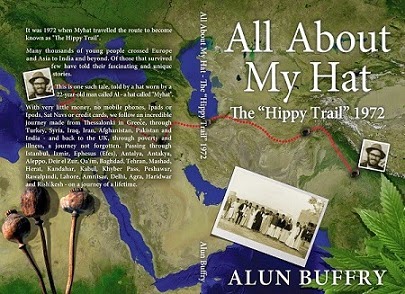
An incredible journey in 1972, of a young man and his hat, "Myhat", from Thessalonki in Greece, through Turkey, Syria, Iraq, Iran, Afghanistan, Pakistan and India - and back to the UK, through poverty and illness, a journey not forgotten. Passing through Istanbul, Izmir, Ephesus (Efes), Antalya, Antakya, Aleppo, Deir el Zur, Qa'im, Baghdad, Tehran, Mashad, Herat, Kandahar, Kabul, Khyber Pass, Peshawar, Rawalpindi, Lahore, Amritsar, Delhi, Agra, Haridwar and Rishikesh - known now as "The Hippy Trail".
READERS' COMMENTS
Joan Bello?, US: "I am quite sure that I have just finished reading what should be recognized as an all time classic. Alun Buffry is a master storyteller. All About My Hat kept me spellbound from the first page. This is a precise recounting of true adventure that every hippy-minded person will be in awe of regardless of age. Thankfully, Buffry has found a delightfully unique literary vehicle that completely disposes of the usual ego distraction of so many biographical accounts. It is effortless reading, nothing superfluous, no fillers, with an ease of language and a precision that is admirable. My Hat is a constant reminder of the camaraderie shared among all cannabis supporters around the world. Bravo!!"
Winston M, Surrey: "Great read and so much interesting found it hard to put down."
Kevin T, Norfolk: "A Brilliant book once i started it i could NOT put it down i would recommend others to read it."
Roger H, Suffolk: "Good Grief!"
Ann C, Norwich: "This is a fascinatng book packed with stories about adventures on the "Hippy Trail" in all its reality. It was harsh with extreme discomfort, heat and dust and sometimes illness. It took strength and endurance ...but then... the rewards were a rich awareness of other cultures and beliefs. "I recommend it warmly.and did I mention, it is so funny!"
Roger W E, Swansea: "My Hat is becoming an independent friend, as I read on - he/she/it is competing with you! Roger WE"
Chris P, Essex: "Awesome read fella, most enjoyable."
Ian L, Norfolk: "Liked it a lot, very entertaining, definitely a good read, well done Alun."
Frank K, W Sussex: "Loved the book Alun and have shown friends, also travellers with a Hippie hat. Great days to remember for you I bet. I like the way you laid out the text too, great read."
Mark S, Norfolk: "Loving the book."
Melissa D, Italy "I really enjoyed this book..... but I have to admit I skipped some of the travel book descriptions. My favourite part is..... No, I won't spoil it for you!
Simon B, Norwich: "You were lucky to survive - loved the book."
Marion G, Suffolk: "Marion Gaze An easy enjoyable read. It took me right back to those times of footloose carefree travel and spontaneous adventure....usually ending in illness or loss of ones money! Though i was part of the start of the journey, Alun's Hat remembers a lot more than me, which is why there will not be a book about my overland trip to India a year or so later..."
INTRODUCTION
Let me introduce myself, I am called Myhat.
I am quite an old hat. I was made decades ago. I had been passed many times to a few heads, yet had seldom found one that I felt really comfortable on.
About 40 years ago, everything changed. I found myself upon a head that I had a close affinity with and I found myself seeing, hearing, smelling much through this young man, Al - and even picking up on his emotions and thoughts.
I was lost then for several years, stored in a cupboard until, once again, I found myself on Al's head and now I can tell my tales.
Al and I spent some nine months together on our first trip, visiting many big cities and several small villages, in eight countries, all different, all new to myself and my new head – an adventure of a lifetime.
I had sat on Al's head and witnessed all sorts of strange places and events until we had travelled to India and then to the UK.
When Al arrived back in the UK, he was quite ill, having suffered from a problem called Hepatitis and also dysentery. Al went to his parent's house in Wales and then to hospital. But whilst he was in that hospital, I was never on his head after he had arrived, and ended up in a box in a storage cupboard.
I didn't know what was happening. Why was Al leaving me? How long was I to be here? What would become of me now? Would I get a new head? Would I get more adventures? Would I be treasured or neglected?
Then one day, Al took me out of my box and put me back on his head.
That is how it came that I found myself back on Al's head. I have been on and off Al's head for about forty years and now I can tell my tales. Al had done a lot of travelling over those forty years.
I had always been able to understand any language spoken and understood by whatever head I was placed on - but never been able to utter anything myself – until now! I have discovered that I can help Al remember the places we had experienced together and I somehow I managed to place the idea of writing my tale for me. Anyway, that idea came upon Al and here he is, writing this for me!
As well as understanding the thoughts, memories and feelings of my head – I felt as he felt - I have been able to see through the eyes, hear through the ears and even taste through the mouth and tongue of my head – Al – and over the days developed a strange connection so that so long as Al was nearby, I could watch what was going on around him – even when not on his head!
I watched, I listened and I remembered – and that is how I come to write this story through a head called Al.
A DIP IN THE GANGES
After a pleasant afternoon with Ashok and his family, they drove back to Haridwar and Al was dropped off back near the railway station where, once again, he slept on the wooden bench.
The following morning after a breakfast of fruit, yoghurt and bread, Al took a stroll around the town. It seemed very old. The streets were crowded with people going about their days amidst the cows.
After a while he found a bridge over the river Ganges. It looked greener on the other side, with trees to sit beneath and watch the powerful currents pass. So he crossed the bridge and turned right to follow a rough path running besides the River.
He spotted an orange-robed elderly and bearded man sitting cross-legged beneath a tree, a semi-circle of younger people sitting facing him.
Al knew that they were called Baba’s, as he himself had been called a few times.
“Maybe he’s one of those guru teachers,” Al thought.
Back in England Al had read about the pop group The Beatles who had taken up with a Guru called Maharishi Mahesh Yogi who had taught them how to meditate and himself gained great publicity and popularity – maybe it was something to do with that.
The orange-robbed ‘teacher’ shouted something and motioned to Al to go over and join them and sit down. Al complied. The elderly teacher smiled and asked Al where he was from and why he was in Haridwar, in a broken English with an almost German accent.
Al explained that he had travelled overland from the UK, simply on an adventure and that he was here because he had met a Spanish man in Delhi who had recommended it as a good place to stay for a while. The teacher laughed and from under his robes produced a chillum. The chillum was prepared, wrapped in a safi – a small piece of cloth that served as a sort of filter – the tobacco hash mixture poured in and the lit chillum passed around so that everyone including Al had a good puff.
The teacher-come-chillum-maker – the Baba – asked Al if he had a few rupees for another chillum. Al handed over a small note. A young boy suddenly appeared from amongst the nearby thickness of trees, took the note, ran off into the trees to return seconds later with a small lump of black hash which he passed on and which was instantly made into another chillum and smoked.
Al stayed a short while and as nothing was being said and he was quite high on the hash, he said his goodbyes and left, carrying on in the same direction as before. Within minutes he was sitting with another group under another tree, smoking again.
“This is the good life!” thought Al, so high that he was beginning to feel like he was in a Holy city in India. “By the Ganges!”
He left the second group and walked some hundred yards before he had the idea that immersing oneself in the Ganges was supposed to purify the soul.
“Well,” he mumbled under his breath so only he (and I) could hear, “Why not, it’s hot and I’ll soon dry off.”
Across the river he could see a long walled building complex with steps going down to the River. As he got closer he could see steps going down on this side too. A few steps, “I should be OK."
The water was moving very fast. Al thought maybe he would not immerse himself, just splash himself all over.
“After all, I can’t swim.” So he put down his bag, took me off his head and put me on his bag, took off his sandals, and stepped down and in to the water.
With some hesitation, one step, second step, third step – then his feet were swept from under him. He felt himself falling backwards into the water which he knew would sweep him away. Too high to feel real fear, he envisioned the situation if he was to be swept down the Ganges – he would have to try to float. He had to hope he would be saved, but who would swim in this? How many bodies had ended up like this. Was this really Holy Water?
As he fell he reached out and somehow managed to grab a chain that was attached to the land, maybe for mooring a boat. He grabbed the chain but the force of the water was now tugging at his body like a hungry monster and now splashing his whole body with his head about to go under.
As his head went under he felt a wrenching on his arm but he pulled stronger, now his head was out, now his body, now he was clambering up the steps, drenched and coughing up Holy Water. He made it to the grassy bank and collapsed on the floor.
I felt so many emotions and thoughts and images flooding Al’s brain.
“So fucking stupid! I could have died.”
“Am I cleansed? Am I saved? Don’t feel any different.”
“God I’m stoned! I shouldn’t have done that. What would have happened if that chain wasn’t there?”
“Glad I took Myhat off!"
So was I.
Had I been in that water I would surely have been swept away for ever.
But it wasn’t long before Al was dried out and sitting with yet another group smoking another chillum.
After a while, that particular teacher said that they had seen Al go into the River and now his soul was clean. That was about all he said, except he asked Al if he wanted some chai and said that “Mahatma is coming, he will take you for chai.” Al liked the spicy milky tea drinks.
Al wondered if this was the Maharishi Mahesh Yogi or maybe some local lord or lord’s son, a rich man probably. Everything was so strange that Al did not know what to expect next. I was wondering about who this ‘Mahatma’ was - maybe he made hats?
After a while a man in orange robes accompanied by a small group of Indian-looking people approached. Apparently he was the Mahatma. He exchanged words with the teacher under the tree and said to Al: “OK, you come now for chai and this evening we will do our ‘Arti’ parade through town and then you join us and come to Ashram maybe?” They walked a while, crossed a bridge and entered a small chai shop where the Mahatma said something to the owner or waiter – who did not look too pleased – pointing at Al who, seemingly somewhat disgruntled, delivered to his table with “No charge, Sir” and the Mahatma and his entourage left, saying “Join us for Arti parade.”
There were still a few hours before evening so Al decided to go and wait on his bench back at the railway station.
That was when everything changed.
"OUT OF JOINT - 20 YEARS OF CAMPAIGNING FOR CANNABIS" isbn 978-1-5084202-1-7

It was in Norwich prison whilst on remand in 1991 that Alun Buffry was approached by Jack Girling during a prison visit, and invited to help him and others form the Campaign to Legalise Cannabis International Association (CLCIA).In 1992, whilst on bail, the CLCIA was formed but it would not be until after Alun Buffry was released on parole in 1995, having served four-and-a-half years, that he started to dedicate himself to the cause of legalising the possession, cultivation and trade of cannabis in the UK. In the General Election of 1997, Howard Marks contested four seats on the single issue of cannabis. In 1999, the campaign registered as a political party in the UK under the name Legalise Cannabis Alliance (LCA).The LCA fought in over 80 elections including Parliamentary, local council and county councils, did numerous talks and interviews, gave oral evidence to the Home Affairs Committee and the Basque Government in Spain, debated at The Oxford Union and at universities, attended marches and rallies protests and picnics and produced the first and only Party Political Broadcast by a cannabis party, shown on TV in Wales in 2005. This is Alun Buffry's no-holds-barred story, from his prospective, detailing his own activities and those of others, over the period 1991 to 2011.
Friday, 9 January 2015
"All About My Hat - The Hippy Trail 1972" by Alun Buffry NOW ON KINDLE AT AMAZON
READERS' COMMENTS
Ann C, Norwich: "This is a fascinatng book packed with stories about adventures on the "Hippy Trail" in all its reality.It was harsh with extreme discomfort.heat and dust and sometimes illness. It took strength and endurance .but then. the rewards were a rich awareness of other cultures and beliefs. I recommend it warmly.and did I mention, it is so funny!"
Roger W E, Swansea: "My Hat is becoming an independent friend, as I read on - he/she/it is competing with you! Roger WE"
Chris P, Essex: "Awesome read fella, most enjoyable."
Ian L, Norfolk: "Read it before Christmas, liked it, very entertaining, definitely a good read, well done Alun."
Frank K, W Sussex: "Loved the book Alun and have shown friends, also travellers with a Hippie hat. Great days to remember for you I bet. I like the way you laid out the text too, great read."
Mark S, Norfolk: "Loving the book."
Melissa D, Italy "I really enjoyed this book..... but I have to admit I skipped some of the travel book descriptions. My favourite part is..... No, I won't spoil it for you!
Simon B, Norwich: "You were lucky to survive. Loved the book."
INTRODUCTION
Let me introduce myself, I am called Myhat.
I am quite an old hat. I was made decades ago. I had been passed many times to a few heads, yet had seldom found one that I felt really comfortable on.
About 40 years ago, everything changed. I found myself upon a head that I had a close affinity with and I found myself seeing, hearing, smelling much through this young man, Al - and even picking up on his emotions and thoughts.
I was lost then for several years, stored in a cupboard until, once again, I found myself on Al's head and now I can tell my tales.
Al and I spent some nine months together on our first trip, visiting many big cities and several small villages, in eight countries, all different, all new to myself and my new head – an adventure of a lifetime.
I had sat on Al's head and witnessed all sorts of strange places and events until we had travelled to India and then to the UK.
When Al arrived back in the UK, he was quite ill, having suffered from a problem called Hepatitis and also dysentery. Al went to his parent's house in Wales and then to hospital. But whilst he was in that hospital, I was never on his head after he had arrived, and ended up in a box in a storage cupboard.
I didn't know what was happening. Why was Al leaving me? How long was I to be here? What would become of me now? Would I get a new head? Would I get more adventures? Would I be treasured or neglected?
Then one day, Al took me out of my box and put me back on his head.
That is how it came that I found myself back on Al's head. I have been on and off Al's head for about forty years and now I can tell my tales. Al had done a lot of travelling over those forty years.
I had always been able to understand any language spoken and understood by whatever head I was placed on - but never been able to utter anything myself – until now! I have discovered that I can help Al remember the places we had experienced together and I somehow I managed to place the idea of writing my tale for me. Anyway, that idea came upon Al and here he is, writing this for me!
As well as understanding the thoughts, memories and feelings of my head – I felt as he felt - I have been able to see through the eyes, hear through the ears and even taste through the mouth and tongue of my head – Al – and over the days developed a strange connection so that so long as Al was nearby, I could watch what was going on around him – even when not on his head!
I watched, I listened and I remembered – and that is how I come to write this story through a head called Al.
A DIP IN THE GANGES
After a pleasant afternoon with Ashok and his family, they drove back to Haridwar and Al was dropped off back near the railway station where, once again, he slept on the wooden bench.
The following morning after a breakfast of fruit, yoghurt and bread, Al took a stroll around the town. It seemed very old. The streets were crowded with people going about their days amidst the cows.
After a while he found a bridge over the river Ganges. It looked greener on the other side, with trees to sit beneath and watch the powerful currents pass. So he crossed the bridge and turned right to follow a rough path running besides the River.
He spotted an orange-robed elderly and bearded man sitting cross-legged beneath a tree, a semi-circle of younger people sitting facing him.
Al knew that they were called Baba’s, as he himself had been called a few times.
“Maybe he’s one of those guru teachers,” Al thought.
Back in England Al had read about the pop group The Beatles who had taken up with a Guru called Maharishi Mahesh Yogi who had taught them how to meditate and himself gained great publicity and popularity – maybe it was something to do with that.
The orange-robbed ‘teacher’ shouted something and motioned to Al to go over and join them and sit down. Al complied. The elderly teacher smiled and asked Al where he was from and why he was in Haridwar, in a broken English with an almost German accent.
Al explained that he had travelled overland from the UK, simply on an adventure and that he was here because he had met a Spanish man in Delhi who had recommended it as a good place to stay for a while. The teacher laughed and from under his robes produced a chillum. The chillum was prepared, wrapped in a safi – a small piece of cloth that served as a sort of filter – the tobacco hash mixture poured in and the lit chillum passed around so that everyone including Al had a good puff.
The teacher-come-chillum-maker – the Baba – asked Al if he had a few rupees for another chillum. Al handed over a small note. A young boy suddenly appeared from amongst the nearby thickness of trees, took the note, ran off into the trees to return seconds later with a small lump of black hash which he passed on and which was instantly made into another chillum and smoked.
Al stayed a short while and as nothing was being said and he was quite high on the hash, he said his goodbyes and left, carrying on in the same direction as before. Within minutes he was sitting with another group under another tree, smoking again.
“This is the good life!” thought Al, so high that he was beginning to feel like he was in a Holy city in India. “By the Ganges!”
He left the second group and walked some hundred yards before he had the idea that immersing oneself in the Ganges was supposed to purify the soul.
“Well,” he mumbled under his breath so only he (and I) could hear, “Why not, it’s hot and I’ll soon dry off.”
Across the river he could see a long walled building complex with steps going down to the River. As he got closer he could see steps going down on this side too. A few steps, “I should be OK."
The water was moving very fast. Al thought maybe he would not immerse himself, just splash himself all over.
“After all, I can’t swim.” So he put down his bag, took me off his head and put me on his bag, took off his sandals, and stepped down and in to the water.
With some hesitation, one step, second step, third step – then his feet were swept from under him. He felt himself falling backwards into the water which he knew would sweep him away. Too high to feel real fear, he envisioned the situation if he was to be swept down the Ganges – he would have to try to float. He had to hope he would be saved, but who would swim in this? How many bodies had ended up like this. Was this really Holy Water?
As he fell he reached out and somehow managed to grab a chain that was attached to the land, maybe for mooring a boat. He grabbed the chain but the force of the water was now tugging at his body like a hungry monster and now splashing his whole body with his head about to go under.
As his head went under he felt a wrenching on his arm but he pulled stronger, now his head was out, now his body, now he was clambering up the steps, drenched and coughing up Holy Water. He made it to the grassy bank and collapsed on the floor.
I felt so many emotions and thoughts and images flooding Al’s brain.
“So fucking stupid! I could have died.”
“Am I cleansed? Am I saved? Don’t feel any different.”
“God I’m stoned! I shouldn’t have done that. What would have happened if that chain wasn’t there?”
“Glad I took Myhat off!"
So was I.
Had I been in that water I would surely have been swept away for ever.
But it wasn’t long before Al was dried out and sitting with yet another group smoking another chillum.
After a while, that particular teacher said that they had seen Al go into the River and now his soul was clean. That was about all he said, except he asked Al if he wanted some chai and said that “Mahatma is coming, he will take you for chai.” Al liked the spicy milky tea drinks.
Al wondered if this was the Maharishi Mahesh Yogi or maybe some local lord or lord’s son, a rich man probably. Everything was so strange that Al did not know what to expect next. I was wondering about who this ‘Mahatma’ was - maybe he made hats?
After a while a man in orange robes accompanied by a small group of Indian-looking people approached. Apparently he was the Mahatma. He exchanged words with the teacher under the tree and said to Al: “OK, you come now for chai and this evening we will do our ‘Arti’ parade through town and then you join us and come to Ashram maybe?” They walked a while, crossed a bridge and entered a small chai shop where the Mahatma said something to the owner or waiter – who did not look too pleased – pointing at Al who, seemingly somewhat disgruntled, delivered to his table with “No charge, Sir” and the Mahatma and his entourage left, saying “Join us for Arti parade.”
There were still a few hours before evening so Al decided to go and wait on his bench back at the railway station.
That was when everything changed.
NOW AVAILABLE ON KINDLE AT AMAZON
