Almost everything is life can pose a risk to some people but that is
no reason to punish other people for using things to their benefit
unless they harm others. Punishing a person simply for growing or
possession of a plant for their own use is a total misuse of law,
injustice and breach of Human Rights that allow people a Private Life.
To
punish a person such as Mr French, who claims to be using cannabis to
alleviate dreadful pain an symptoms of MS would be an outrage, as it is
that so many other victimless cannabis users have been and are being
fined and even sent to prison.
There is now irrefutable
medical evidence that cannabis has medicinal vale for a large number of
ailments and evidence that risk is very small, far smaller than many
pills prescribed by doctors - pills that often have side-effects that
require other pills to counteract.
The side-effect of consuming cannabis is at best a feeling of relaxation and at worse the munchies.
In
fact, The UK and other Governments, even though they deny that cannabis
has any medicinal uses, now allow the production and sale of the
whole-plant extract in the form of alcohol solution in a spray, called
Sativex.
I have yet to see any explanation of how a
medicine can be produced by simply dissolving and filtering a plant with
no medicinal use, in alcohol!
And in Netherlands and other countries, cannabis bud is available on a doctors' prescription and bought at pharmacies.
Unfortunately
the law gives monopoly to the pharmaceutical companies and
unfortunately there products are far more expensive than the cost of
growing the cannabis at home or even buying in Dutch Coffeeshops.
But
what it boils down to for me - irrespective of benefit or risk of harm
through use - why should the law punish people that engage in activities
that do no harm or pose no risk to others or their rights?
Call for cannabis legalisation at Portsmouth event
http://www.portsmouth.co.uk/news/health/local-health/call-for-cannabis-legalisation-at-portsmouth-event-1-6529353
The News Portsmouth, 19 January 2015
WE must fight to legalise cannabis for the sake of improving our lives.
That
was the message yesterday from people with a range of health problems
who revealed that taking the drug means they are not left in constant
pain.
Patients were given the
opportunity to share their experiences during an open discussion on the
topic of cannabis legalisation at Fratton Community Centre, in
Portsmouth.
Clark French, 29, of
Brighton, who was diagnosed with MS five years ago, said taking
cannabis has eased the chronic pain that comes with the disease.
He told the audience: ‘MS is an awful disease, it’s horrible, I can’t even bring about the words to explain it.
‘I am in pain all the time.
‘When I use cannabis however, I am in less pain.
‘It
doesn’t take the pain away completely, but cannabis gives me a life
again and gives me the ability to stand up and share my story.’
Mr
French, of United Patients Alliance, which set up the event, added:
‘It’s not right that it is not legal – we need to get together and
fight.
‘It’s not cannabis we are fighting for, but our lives.’
Angela Came, 44, of Petersfield, said the drug helps her cope with depression, psychosis and post-traumatic stress disorder.
‘I didn’t start taking it until after I was diagnosed and I didn’t start taking it regularly until two years ago,’ she said.
Mel
Clarke, 53, of Southsea, who has MS, said smoking cannabis has changed
her life whereas painkillers ended up doing more harm.
Mrs Clarke said she first smoked cannabis on a trip to Amsterdam.
Alex
Fraser, 24, who was diagnosed with Crohn’s disease at 19, said while
critics may feel he should just take legal painkillers, they make his
condition worse.
‘There are a lot of things I can’t eat, I
can’t drink, there’s a whole list. And I know that what I do eat, it’s
still going to be hard,’ he said.
‘If I smoke a joint or smoke a joint after a meal, I feel so much better.’
Monday, 19 January 2015

Friday, 9 January 2015
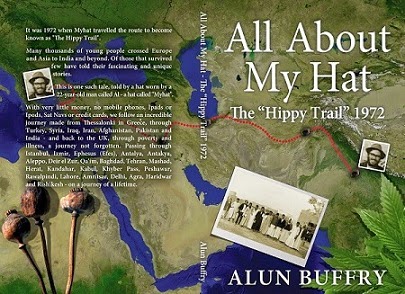
"All About My Hat - The Hippy Trail 1972" by Alun Buffry NOW ON KINDLE AT AMAZON
An incredible journey in 1972, of a young man and his hat, "Myhat", from
Thessalonki in Greece, through Turkey, Syria, Iraq, Iran, Afghanistan,
Pakistan and India - and back to the UK, through poverty and illness, a
journey not forgotten. Passing through Istanbul, Izmir, Ephesus (Efes),
Antalya, Antakya, Aleppo, Deir el Zur, Qa'im, Baghdad, Tehran, Mashad,
Herat, Kandahar, Kabul, Khyber Pass, Peshawar, Rawalpindi, Lahore,
Amritsar, Delhi, Agra, Haridwar and Rishikesh - known now as "The Hippy
Trail".
READERS' COMMENTS
Ann C, Norwich: "This is a fascinatng book packed with stories about adventures on the "Hippy Trail" in all its reality.It was harsh with extreme discomfort.heat and dust and sometimes illness. It took strength and endurance .but then. the rewards were a rich awareness of other cultures and beliefs. I recommend it warmly.and did I mention, it is so funny!"
Roger W E, Swansea: "My Hat is becoming an independent friend, as I read on - he/she/it is competing with you! Roger WE"
Chris P, Essex: "Awesome read fella, most enjoyable."
Ian L, Norfolk: "Read it before Christmas, liked it, very entertaining, definitely a good read, well done Alun."
Frank K, W Sussex: "Loved the book Alun and have shown friends, also travellers with a Hippie hat. Great days to remember for you I bet. I like the way you laid out the text too, great read."
Mark S, Norfolk: "Loving the book."
Melissa D, Italy "I really enjoyed this book..... but I have to admit I skipped some of the travel book descriptions. My favourite part is..... No, I won't spoil it for you!
Simon B, Norwich: "You were lucky to survive. Loved the book."
INTRODUCTION
Let me introduce myself, I am called Myhat.
I am quite an old hat. I was made decades ago. I had been passed many times to a few heads, yet had seldom found one that I felt really comfortable on.
About 40 years ago, everything changed. I found myself upon a head that I had a close affinity with and I found myself seeing, hearing, smelling much through this young man, Al - and even picking up on his emotions and thoughts.
I was lost then for several years, stored in a cupboard until, once again, I found myself on Al's head and now I can tell my tales.
Al and I spent some nine months together on our first trip, visiting many big cities and several small villages, in eight countries, all different, all new to myself and my new head – an adventure of a lifetime.
I had sat on Al's head and witnessed all sorts of strange places and events until we had travelled to India and then to the UK.
When Al arrived back in the UK, he was quite ill, having suffered from a problem called Hepatitis and also dysentery. Al went to his parent's house in Wales and then to hospital. But whilst he was in that hospital, I was never on his head after he had arrived, and ended up in a box in a storage cupboard.
I didn't know what was happening. Why was Al leaving me? How long was I to be here? What would become of me now? Would I get a new head? Would I get more adventures? Would I be treasured or neglected?
Then one day, Al took me out of my box and put me back on his head.
That is how it came that I found myself back on Al's head. I have been on and off Al's head for about forty years and now I can tell my tales. Al had done a lot of travelling over those forty years.
I had always been able to understand any language spoken and understood by whatever head I was placed on - but never been able to utter anything myself – until now! I have discovered that I can help Al remember the places we had experienced together and I somehow I managed to place the idea of writing my tale for me. Anyway, that idea came upon Al and here he is, writing this for me!
As well as understanding the thoughts, memories and feelings of my head – I felt as he felt - I have been able to see through the eyes, hear through the ears and even taste through the mouth and tongue of my head – Al – and over the days developed a strange connection so that so long as Al was nearby, I could watch what was going on around him – even when not on his head!
I watched, I listened and I remembered – and that is how I come to write this story through a head called Al.
A DIP IN THE GANGES
After a pleasant afternoon with Ashok and his family, they drove back to Haridwar and Al was dropped off back near the railway station where, once again, he slept on the wooden bench.
The following morning after a breakfast of fruit, yoghurt and bread, Al took a stroll around the town. It seemed very old. The streets were crowded with people going about their days amidst the cows.
After a while he found a bridge over the river Ganges. It looked greener on the other side, with trees to sit beneath and watch the powerful currents pass. So he crossed the bridge and turned right to follow a rough path running besides the River.
He spotted an orange-robed elderly and bearded man sitting cross-legged beneath a tree, a semi-circle of younger people sitting facing him.
Al knew that they were called Baba’s, as he himself had been called a few times.
“Maybe he’s one of those guru teachers,” Al thought.
Back in England Al had read about the pop group The Beatles who had taken up with a Guru called Maharishi Mahesh Yogi who had taught them how to meditate and himself gained great publicity and popularity – maybe it was something to do with that.
The orange-robbed ‘teacher’ shouted something and motioned to Al to go over and join them and sit down. Al complied. The elderly teacher smiled and asked Al where he was from and why he was in Haridwar, in a broken English with an almost German accent.
Al explained that he had travelled overland from the UK, simply on an adventure and that he was here because he had met a Spanish man in Delhi who had recommended it as a good place to stay for a while. The teacher laughed and from under his robes produced a chillum. The chillum was prepared, wrapped in a safi – a small piece of cloth that served as a sort of filter – the tobacco hash mixture poured in and the lit chillum passed around so that everyone including Al had a good puff.
The teacher-come-chillum-maker – the Baba – asked Al if he had a few rupees for another chillum. Al handed over a small note. A young boy suddenly appeared from amongst the nearby thickness of trees, took the note, ran off into the trees to return seconds later with a small lump of black hash which he passed on and which was instantly made into another chillum and smoked.
Al stayed a short while and as nothing was being said and he was quite high on the hash, he said his goodbyes and left, carrying on in the same direction as before. Within minutes he was sitting with another group under another tree, smoking again.
“This is the good life!” thought Al, so high that he was beginning to feel like he was in a Holy city in India. “By the Ganges!”
He left the second group and walked some hundred yards before he had the idea that immersing oneself in the Ganges was supposed to purify the soul.
“Well,” he mumbled under his breath so only he (and I) could hear, “Why not, it’s hot and I’ll soon dry off.”
Across the river he could see a long walled building complex with steps going down to the River. As he got closer he could see steps going down on this side too. A few steps, “I should be OK."
The water was moving very fast. Al thought maybe he would not immerse himself, just splash himself all over.
“After all, I can’t swim.” So he put down his bag, took me off his head and put me on his bag, took off his sandals, and stepped down and in to the water.
With some hesitation, one step, second step, third step – then his feet were swept from under him. He felt himself falling backwards into the water which he knew would sweep him away. Too high to feel real fear, he envisioned the situation if he was to be swept down the Ganges – he would have to try to float. He had to hope he would be saved, but who would swim in this? How many bodies had ended up like this. Was this really Holy Water?
As he fell he reached out and somehow managed to grab a chain that was attached to the land, maybe for mooring a boat. He grabbed the chain but the force of the water was now tugging at his body like a hungry monster and now splashing his whole body with his head about to go under.
As his head went under he felt a wrenching on his arm but he pulled stronger, now his head was out, now his body, now he was clambering up the steps, drenched and coughing up Holy Water. He made it to the grassy bank and collapsed on the floor.
I felt so many emotions and thoughts and images flooding Al’s brain.
“So fucking stupid! I could have died.”
“Am I cleansed? Am I saved? Don’t feel any different.”
“God I’m stoned! I shouldn’t have done that. What would have happened if that chain wasn’t there?”
“Glad I took Myhat off!"
So was I.
Had I been in that water I would surely have been swept away for ever.
But it wasn’t long before Al was dried out and sitting with yet another group smoking another chillum.
After a while, that particular teacher said that they had seen Al go into the River and now his soul was clean. That was about all he said, except he asked Al if he wanted some chai and said that “Mahatma is coming, he will take you for chai.” Al liked the spicy milky tea drinks.
Al wondered if this was the Maharishi Mahesh Yogi or maybe some local lord or lord’s son, a rich man probably. Everything was so strange that Al did not know what to expect next. I was wondering about who this ‘Mahatma’ was - maybe he made hats?
After a while a man in orange robes accompanied by a small group of Indian-looking people approached. Apparently he was the Mahatma. He exchanged words with the teacher under the tree and said to Al: “OK, you come now for chai and this evening we will do our ‘Arti’ parade through town and then you join us and come to Ashram maybe?” They walked a while, crossed a bridge and entered a small chai shop where the Mahatma said something to the owner or waiter – who did not look too pleased – pointing at Al who, seemingly somewhat disgruntled, delivered to his table with “No charge, Sir” and the Mahatma and his entourage left, saying “Join us for Arti parade.”
There were still a few hours before evening so Al decided to go and wait on his bench back at the railway station.
That was when everything changed.
NOW AVAILABLE ON KINDLE AT AMAZON

READERS' COMMENTS
Ann C, Norwich: "This is a fascinatng book packed with stories about adventures on the "Hippy Trail" in all its reality.It was harsh with extreme discomfort.heat and dust and sometimes illness. It took strength and endurance .but then. the rewards were a rich awareness of other cultures and beliefs. I recommend it warmly.and did I mention, it is so funny!"
Roger W E, Swansea: "My Hat is becoming an independent friend, as I read on - he/she/it is competing with you! Roger WE"
Chris P, Essex: "Awesome read fella, most enjoyable."
Ian L, Norfolk: "Read it before Christmas, liked it, very entertaining, definitely a good read, well done Alun."
Frank K, W Sussex: "Loved the book Alun and have shown friends, also travellers with a Hippie hat. Great days to remember for you I bet. I like the way you laid out the text too, great read."
Mark S, Norfolk: "Loving the book."
Melissa D, Italy "I really enjoyed this book..... but I have to admit I skipped some of the travel book descriptions. My favourite part is..... No, I won't spoil it for you!
Simon B, Norwich: "You were lucky to survive. Loved the book."
TASTERS
INTRODUCTION
Let me introduce myself, I am called Myhat.
I am quite an old hat. I was made decades ago. I had been passed many times to a few heads, yet had seldom found one that I felt really comfortable on.
About 40 years ago, everything changed. I found myself upon a head that I had a close affinity with and I found myself seeing, hearing, smelling much through this young man, Al - and even picking up on his emotions and thoughts.
I was lost then for several years, stored in a cupboard until, once again, I found myself on Al's head and now I can tell my tales.
Al and I spent some nine months together on our first trip, visiting many big cities and several small villages, in eight countries, all different, all new to myself and my new head – an adventure of a lifetime.
I had sat on Al's head and witnessed all sorts of strange places and events until we had travelled to India and then to the UK.
When Al arrived back in the UK, he was quite ill, having suffered from a problem called Hepatitis and also dysentery. Al went to his parent's house in Wales and then to hospital. But whilst he was in that hospital, I was never on his head after he had arrived, and ended up in a box in a storage cupboard.
I didn't know what was happening. Why was Al leaving me? How long was I to be here? What would become of me now? Would I get a new head? Would I get more adventures? Would I be treasured or neglected?
Then one day, Al took me out of my box and put me back on his head.
That is how it came that I found myself back on Al's head. I have been on and off Al's head for about forty years and now I can tell my tales. Al had done a lot of travelling over those forty years.
I had always been able to understand any language spoken and understood by whatever head I was placed on - but never been able to utter anything myself – until now! I have discovered that I can help Al remember the places we had experienced together and I somehow I managed to place the idea of writing my tale for me. Anyway, that idea came upon Al and here he is, writing this for me!
As well as understanding the thoughts, memories and feelings of my head – I felt as he felt - I have been able to see through the eyes, hear through the ears and even taste through the mouth and tongue of my head – Al – and over the days developed a strange connection so that so long as Al was nearby, I could watch what was going on around him – even when not on his head!
I watched, I listened and I remembered – and that is how I come to write this story through a head called Al.
A DIP IN THE GANGES
After a pleasant afternoon with Ashok and his family, they drove back to Haridwar and Al was dropped off back near the railway station where, once again, he slept on the wooden bench.
The following morning after a breakfast of fruit, yoghurt and bread, Al took a stroll around the town. It seemed very old. The streets were crowded with people going about their days amidst the cows.
After a while he found a bridge over the river Ganges. It looked greener on the other side, with trees to sit beneath and watch the powerful currents pass. So he crossed the bridge and turned right to follow a rough path running besides the River.
He spotted an orange-robed elderly and bearded man sitting cross-legged beneath a tree, a semi-circle of younger people sitting facing him.
Al knew that they were called Baba’s, as he himself had been called a few times.
“Maybe he’s one of those guru teachers,” Al thought.
Back in England Al had read about the pop group The Beatles who had taken up with a Guru called Maharishi Mahesh Yogi who had taught them how to meditate and himself gained great publicity and popularity – maybe it was something to do with that.
The orange-robbed ‘teacher’ shouted something and motioned to Al to go over and join them and sit down. Al complied. The elderly teacher smiled and asked Al where he was from and why he was in Haridwar, in a broken English with an almost German accent.
Al explained that he had travelled overland from the UK, simply on an adventure and that he was here because he had met a Spanish man in Delhi who had recommended it as a good place to stay for a while. The teacher laughed and from under his robes produced a chillum. The chillum was prepared, wrapped in a safi – a small piece of cloth that served as a sort of filter – the tobacco hash mixture poured in and the lit chillum passed around so that everyone including Al had a good puff.
The teacher-come-chillum-maker – the Baba – asked Al if he had a few rupees for another chillum. Al handed over a small note. A young boy suddenly appeared from amongst the nearby thickness of trees, took the note, ran off into the trees to return seconds later with a small lump of black hash which he passed on and which was instantly made into another chillum and smoked.
Al stayed a short while and as nothing was being said and he was quite high on the hash, he said his goodbyes and left, carrying on in the same direction as before. Within minutes he was sitting with another group under another tree, smoking again.
“This is the good life!” thought Al, so high that he was beginning to feel like he was in a Holy city in India. “By the Ganges!”
He left the second group and walked some hundred yards before he had the idea that immersing oneself in the Ganges was supposed to purify the soul.
“Well,” he mumbled under his breath so only he (and I) could hear, “Why not, it’s hot and I’ll soon dry off.”
Across the river he could see a long walled building complex with steps going down to the River. As he got closer he could see steps going down on this side too. A few steps, “I should be OK."
The water was moving very fast. Al thought maybe he would not immerse himself, just splash himself all over.
“After all, I can’t swim.” So he put down his bag, took me off his head and put me on his bag, took off his sandals, and stepped down and in to the water.
With some hesitation, one step, second step, third step – then his feet were swept from under him. He felt himself falling backwards into the water which he knew would sweep him away. Too high to feel real fear, he envisioned the situation if he was to be swept down the Ganges – he would have to try to float. He had to hope he would be saved, but who would swim in this? How many bodies had ended up like this. Was this really Holy Water?
As he fell he reached out and somehow managed to grab a chain that was attached to the land, maybe for mooring a boat. He grabbed the chain but the force of the water was now tugging at his body like a hungry monster and now splashing his whole body with his head about to go under.
As his head went under he felt a wrenching on his arm but he pulled stronger, now his head was out, now his body, now he was clambering up the steps, drenched and coughing up Holy Water. He made it to the grassy bank and collapsed on the floor.
I felt so many emotions and thoughts and images flooding Al’s brain.
“So fucking stupid! I could have died.”
“Am I cleansed? Am I saved? Don’t feel any different.”
“God I’m stoned! I shouldn’t have done that. What would have happened if that chain wasn’t there?”
“Glad I took Myhat off!"
So was I.
Had I been in that water I would surely have been swept away for ever.
But it wasn’t long before Al was dried out and sitting with yet another group smoking another chillum.
After a while, that particular teacher said that they had seen Al go into the River and now his soul was clean. That was about all he said, except he asked Al if he wanted some chai and said that “Mahatma is coming, he will take you for chai.” Al liked the spicy milky tea drinks.
Al wondered if this was the Maharishi Mahesh Yogi or maybe some local lord or lord’s son, a rich man probably. Everything was so strange that Al did not know what to expect next. I was wondering about who this ‘Mahatma’ was - maybe he made hats?
After a while a man in orange robes accompanied by a small group of Indian-looking people approached. Apparently he was the Mahatma. He exchanged words with the teacher under the tree and said to Al: “OK, you come now for chai and this evening we will do our ‘Arti’ parade through town and then you join us and come to Ashram maybe?” They walked a while, crossed a bridge and entered a small chai shop where the Mahatma said something to the owner or waiter – who did not look too pleased – pointing at Al who, seemingly somewhat disgruntled, delivered to his table with “No charge, Sir” and the Mahatma and his entourage left, saying “Join us for Arti parade.”
There were still a few hours before evening so Al decided to go and wait on his bench back at the railway station.
That was when everything changed.
AVAILABLE AT http://www.buffry.org.uk/allaboutmyhat.html
NOW AVAILABLE ON KINDLE AT AMAZON
Friday, 10 October 2014
Prohibitionsists seeking medicalisation of plants v No Victim No Crime
Prohibitionists
are campaigning to try to keep a residual prohibition law by working
towards "medicalisation" - allowing a limited number of patients
selected by doctors to obtain cannabis extracts or irradiated and
standardised product to obtain cannabis on prescription at grossly
inflated prices and profits for the pharmaceutical giants thus removing
the possibility of anyone caught growing in ppossession to use medical need in mitigation or defence.
Anyone without a prescription could still be busted if caught growing or in possession - just like many other prescription medications.
Strangely enough there are no health warnings on Sativex or Bedrocan
Prohibitionists stooping low claiming cannabis is as addictive and dangerous as heroin, that it does not increase creativity, causes paranoia, schizophrenia, psychosis, impotence, baldness, loss of memory, loss of motivation, is a gateway to hard drugs and so on
We are argue with them 'til blue cheese in the face.
Point I make is that EVEN IF any of that is true for even one user - all the more reason for consumer protection but no reason to punish that person (those people) that suffer bad effects and certainly NO REASON to punish the rest of us.
In the name of Justice = no victim no crime
Wake up folks!
https://www.facebook.com/pages/NO-Victim-NO-CRIME/257914584389417
Saturday, 27 September 2014
'Scratch and sniff' cannabis plan
Be warned, this is a con and somebody is going to make a small
fortune from selling these cards to authorities when the cards actually
smell nothing like cannabis. They already have dogs much better than
humans at smelling.
It will also risk turning neighbour against neighbour.
But it also sends out the wrong message that cannabis is a dangerous drug.
Firstly, cannabis is a plant - a plant that grew wild until about a century ago - a plant used throughout history since the times of the ancient Chinese and Egyptians right through Culpeper's Herbal time until the present day - and used widely for medicinal benefit.
Today it is used to treat, ease and cure a wide range of ailments and pains, from MS, epilepsy and glaucoma to headaches and back aches and even said to cure and ease cancers and tumours.
The number of users - often young people - that suffer bad consequences is a minute proportion of users - far smaller in number than those that get bad effects from using prescribed drugs. And in fact cannabis is prescribed in the raw but irradiated and standardised form of Bedrocan in many countries, and in the UK and elsewhere as a powerful whole-plant extract in alcohol (a far more dangerous drug itself) called Sativex.
Those youngsters that get cannabis do not grow their own, they buy from the street dealers just like adults - dealers that are untaxed, unknown, uncontrolled and may have few or no scruples about age or quality and may even offer harder drugs.
It makes no sense to punish all growers or users because a few users suffer - no more sense than it would to punish all drinkers because of those that suffer or do harm.
To solve whatever cannabis problems we have it is essential, as they realised in Colorado, Washington and the Netherlands, Uruguay etc, to allow adults to buy cannabis and to allow people their Right to their private lives including the growing of cannabis for their own uses.
http://www.u.tv/News/PSNI-scratch-and-sniff-cannabis-plan/c54a24a5-de7f-40b9-8314-ec5f988047b5
PSNI 'scratch and sniff' cannabis plan: UTV, 27 September 2014
The PSNI is to distribute scratch and sniff cards to the public in order to raise awareness and improve detection of illegal cannabis factories.
The campaign comes after an increase in the number of cannabis factories discovered in the past year rose by 44%.
Since April, police have uncovered 49 factories. In the previous year they broke up 130 facilities compared to 90 in 2012/13 financial year.
The scratch and sniff cards contain an element which replicates the smell of the plant being grown, which is different to the smell of it being smoked.
It's hoped the campaign, launched by the PSNI and independent charity Crimestoppers, will educate the public on how to spot the signs of an illicit operation in their neighbourhoods and encourage them to report their suspicions.
A special presentation will also be made to landlords and others about the signs to look out for and a special DVD has been produced for further guidance.
Assistant Chief Constable Drew Harris said: "More than two cannabis factories are being uncovered every week in Northern Ireland. They are illegal and they are dangerous.
"The money generated by them runs into millions of pounds. That's money going into the pockets of organised criminals - used to fund even more criminal activity.
"From 1 April 2014 until 31 August 2014, police have arrested over 1,110 people for drugs offences and removed an estimated £3.9m of drugs from our streets.
"Over the coming weeks, officers across Northern Ireland will be distributing scratch and sniff cards to the public so that they will be able to recognise the signs and smells of cannabis factories in their local communities.
Justice Minister David Ford described the campaign as a "novel approach to a growing problem in society".
The Alliance minister added: "The distinctive smell is a tell-tale sign which the public should report to the PSNI or to Crimestoppers.
"This initiative is a very innovative example of law enforcement agencies, the voluntary sector and the public coming together to help keep Northern Ireland society safe."
Val Smith, vice chair of Crimestoppers Board Northern Ireland, emphasised the important role which the charity plays in crime detection: "It is really important for people to understand what happens when they ring Crimestoppers.
"There is no caller ID, so the person taking the call can't see the phone number that the call is being made from.
"This means that the caller remains totally anonymous. Similarly, the Crimestoppers 0800 555 111 number does not appear on your telephone bill, a further measure that helps to ensure complete anonymity.
"The caller isn't asked for their name or any personal information; they are simply given an opportunity to share information that they may have about an incident or suspicious behaviour.
"Any information Crimestoppers receives is then submitted to a central point within the Police Service of Northern Ireland and forwarded to the relevant policing area. This information can result in searches being conducted which lead to drugs being seized or cannabis farms being closed down."
It will also risk turning neighbour against neighbour.
But it also sends out the wrong message that cannabis is a dangerous drug.
Firstly, cannabis is a plant - a plant that grew wild until about a century ago - a plant used throughout history since the times of the ancient Chinese and Egyptians right through Culpeper's Herbal time until the present day - and used widely for medicinal benefit.
Today it is used to treat, ease and cure a wide range of ailments and pains, from MS, epilepsy and glaucoma to headaches and back aches and even said to cure and ease cancers and tumours.
The number of users - often young people - that suffer bad consequences is a minute proportion of users - far smaller in number than those that get bad effects from using prescribed drugs. And in fact cannabis is prescribed in the raw but irradiated and standardised form of Bedrocan in many countries, and in the UK and elsewhere as a powerful whole-plant extract in alcohol (a far more dangerous drug itself) called Sativex.
Those youngsters that get cannabis do not grow their own, they buy from the street dealers just like adults - dealers that are untaxed, unknown, uncontrolled and may have few or no scruples about age or quality and may even offer harder drugs.
It makes no sense to punish all growers or users because a few users suffer - no more sense than it would to punish all drinkers because of those that suffer or do harm.
To solve whatever cannabis problems we have it is essential, as they realised in Colorado, Washington and the Netherlands, Uruguay etc, to allow adults to buy cannabis and to allow people their Right to their private lives including the growing of cannabis for their own uses.
http://www.u.tv/News/PSNI-scratch-and-sniff-cannabis-plan/c54a24a5-de7f-40b9-8314-ec5f988047b5
PSNI 'scratch and sniff' cannabis plan: UTV, 27 September 2014
The PSNI is to distribute scratch and sniff cards to the public in order to raise awareness and improve detection of illegal cannabis factories.
The campaign comes after an increase in the number of cannabis factories discovered in the past year rose by 44%.
Since April, police have uncovered 49 factories. In the previous year they broke up 130 facilities compared to 90 in 2012/13 financial year.
The scratch and sniff cards contain an element which replicates the smell of the plant being grown, which is different to the smell of it being smoked.
It's hoped the campaign, launched by the PSNI and independent charity Crimestoppers, will educate the public on how to spot the signs of an illicit operation in their neighbourhoods and encourage them to report their suspicions.
A special presentation will also be made to landlords and others about the signs to look out for and a special DVD has been produced for further guidance.
Assistant Chief Constable Drew Harris said: "More than two cannabis factories are being uncovered every week in Northern Ireland. They are illegal and they are dangerous.
"The money generated by them runs into millions of pounds. That's money going into the pockets of organised criminals - used to fund even more criminal activity.
"From 1 April 2014 until 31 August 2014, police have arrested over 1,110 people for drugs offences and removed an estimated £3.9m of drugs from our streets.
"Over the coming weeks, officers across Northern Ireland will be distributing scratch and sniff cards to the public so that they will be able to recognise the signs and smells of cannabis factories in their local communities.
I have been impressed with this project and hope it will prove to be a successful additional tool to the police in their efforts to thwart cannabis growing in Northern Ireland."We know that people may not realise that the empty, run down house or flat on their street with people coming and going may actually be a cannabis factory. It's not just the stereotype of the remote rural dwelling or disused industrial unit."
Justice Minister David Ford
Justice Minister David Ford described the campaign as a "novel approach to a growing problem in society".
The Alliance minister added: "The distinctive smell is a tell-tale sign which the public should report to the PSNI or to Crimestoppers.
"This initiative is a very innovative example of law enforcement agencies, the voluntary sector and the public coming together to help keep Northern Ireland society safe."
Val Smith, vice chair of Crimestoppers Board Northern Ireland, emphasised the important role which the charity plays in crime detection: "It is really important for people to understand what happens when they ring Crimestoppers.
"There is no caller ID, so the person taking the call can't see the phone number that the call is being made from.
"This means that the caller remains totally anonymous. Similarly, the Crimestoppers 0800 555 111 number does not appear on your telephone bill, a further measure that helps to ensure complete anonymity.
"The caller isn't asked for their name or any personal information; they are simply given an opportunity to share information that they may have about an incident or suspicious behaviour.
"Any information Crimestoppers receives is then submitted to a central point within the Police Service of Northern Ireland and forwarded to the relevant policing area. This information can result in searches being conducted which lead to drugs being seized or cannabis farms being closed down."
Monday, 15 September 2014
Praise over Portsmouth ‘pot picnic’ as users smoke in public
People ought to be concerned about why people that grow or possess
cannabis in their own homes for their own use, whether as a recreation
to relax or to ease pains or treat illnesses, face arrest even though
they have done no harm.
Maybe it is to give the pharmaceutical companies an advantage - after all it is a pharmaceutical business that sells cannabis as a medicinal product (Sativex) at huge profits in the UK?
It is about time that the failed law was corrected and maybe then picnics and information events like this would stop -
Or maybe the cannabis smokers could be allocated somewhere safe and clean to go, away from the public and any children, where they can enjoy their herb in peace.
Let's face it, imagine agroup gathered ina park to drink booze (or take any other drug or medication) - what chaos there could hav ebeen - how many arrests would there have been - but thankfully drinkers have somehwere safe to go - pubs, clubs etc.
Let's give the cannabis smokers the same in the name of health and safety for all.
In the meantime I congratulate these protesters for having the courage to demand what is right and fair for all
http://www.portsmouth.co.uk/news/criticism-over-portsmouth-pot-picnic-as-users-smoke-in-public-1-6298561
Criticism over Portsmouth ‘pot picnic’ as users smoke in public
The News, Portsmouth, September 15, 2014
CANNABIS campaigners have held the first ‘pot picnic’ in Portsmouth for 12 years – but are now facing criticism after some users openly smoked the drug in public.
Dozens went to the event, which organisers said was about awareness of what they say are the illegal drug’s benefits.
Police attended but city council leader, Councillor Donna Jones, was unhappy about the way the event – the first since the final Smokey Bear’s Picnic on Southses Common in 2002 – was policed.
Cllr Jones, a magistrate said: ‘I will be taking this up with the chief inspector for Portsmouth and urgently reviewing the situation.
‘I criticise anybody who is smoking any kind of illegal substance, particularly if they are doing it in public.
‘It’s a deplorable situation when young children are subjected to the smoke and smell from a very strong drug.’
Organiser Simon Dignam said he was not responsible for people smoking.
‘This one is going successfully, I can’t see a reason why we wouldn’t have one next year,’ he said.
‘They are smoking but there’s nothing I can do about that, it’s a personal preference. I personally haven’t had one, because I want to have a level head.’
Simon, from Hampshire Cannabis Community, had attracted campaigners, recreational users, families and people who use the drug medicinally to the day.
Hazel Pannell was diagnosed with bowel cancer in 2012. Doctors discovered it spread and she believes she has around five years to live.
She told The News she takes the drug in oil form in the hope it would cure her.
The 65-year-old from Worthing said: ‘Hopefully it will cure it or stop it spreading. The legality is a worry, a constant concern and the fact that it’s difficult to get hold of, too.’
It comes as Dr Janet Maxwell, director of public health in Portsmouth, last week told The News that the class B drug has real and harmful effects on the human body and mind, including a link to ‘serious, long-term health problems’.
As reported, reform advocates have since criticised Dr Maxwell for her ‘scaremongering’ comments and said they will complain to the city council about her.
At the picnic on Saturday, held at Castle Field, in Southsea, many users of the drug said it brought them benefits.
Stevie Sizer, 33, from Milton, said it had changed his life.
He said: ‘I won’t hide the fact that I do smoke it myself, I have done for 18 years.
‘I started smoking it purely because I had anger management problems and depression at a young age, 13 or 14.
‘It completely changed my life. I still smoke it to this day, as recreational use and for medicinal purposes.’
Hampshire police were unable to confirm to The News if any arrests were made at the picnic but said they would make a comment today.
Business owner selling seeds wants drug to be legal
A COMPANY in the city is thriving selling cannabis seeds – but its owner has said legalising the drug would bring in tax cash.
Martin Bear, who runs the online retailer with 11 people and was at the event on Saturday, said: ‘The war on drugs isn’t working.
‘At the moment it’s a free-for-all. They’re not making any tax or VAT. The government has abandoned it to organised crime.’
But Mr Bear, from Fawcett Road, in Southsea, added selling seeds is legal. He said: ‘Seeds are 100 per cent legal to buy, possess, give away – the problem starts when you water them.’
Friday, 5 September 2014
CENSORED: 1947 Cannabis Study on Epilepsy
It seems to be the pattern for governments that
clearly favour synthetics and pharmaceuticals over plants. From the
times of the ancient Chinese and ancient Egyptians through Romans and
Culpeper's Herbal until 1971 cannabis was used as a medicine. But in
1961 and then in 1971 in the UK, cannabis was suddenly deemed to have
no medical uses and possession, cultivation etc was banned. Nowadays
Bedrocan is grown and sold through pharmacies in Netherlands and
prescribed in other countries, Sativex a whole-plant extract marketted
almost worldwide (both produced by pharmaceutical companies, pharmers,
not farmers), as a medicine is now available in many US States and in
fact USA has been supplying it to a very few patients for decades
whilst all the time burning crops, arresting growers and claiming it
has no medical use in international treaties and many country's
national legislation. That reveals the hypocrisy and corruption of the
governments we have elected.
please see http://weedfinder.com/dash/news/censored-1947-cannabis-study-on-epilepsy/
Wednesday, 23 July 2014
cannabis prohibition - is it actually due to the huge profits
"first a WARNING - to those suffering - posts such as the one below
from balogh - do not send money, chances are they are conmen and in any
case highly illegal.
"and that is the second problem - why is cannabis illegal to grow and possess even in one's own home?
"Why did Mr Cutler have to risk is freedom by using oil illegally produced, when a pahramaceutical company is allowed to grow the plants to extract all the active constitituents and make an expensive alcohol-based spray called Sativex, mainly for pain and MS, but so expensive that many health authorities refuse to supply it?
"one can of spray costing over £100 - one could grow the plants and make oil safely and efficiently at home for just a few pounds.
"the claim that cannabis can halt or cure cancer has been around since the 1970's, ignored by governments and cancer research charities, whilst people take ineffective treatments that save just a few lives and make many people worse, at great cost and great profit to the pharmaceutical giants.
"why?
"is it actually due to the huge profits?
"People need to demand that the oil be produced and prescribed - and it's already being grown and made to make Sativex, which makes a mockery of the Misuse of Drugs Act schedules that say cannabis has no medicinal uses.
"Corruption leading to premature death - somebody has to answer for that!"
http://www.express.co.uk/life-style/health/490381/Cannabis-oil-cured-my-cancer
Cannabis oil cured my terminal cancer
CANCER patient Mike Cutler yesterday hailed cannabis as a miracle cure for the disease after his symptoms vanished when he began taking the drug.
Mike, 63, was diagnosed with liver cancer in 2009 and was given a transplant. But in late 2012 he learned cancer had attacked the replacement organ.
In desperation he began researching online and found a YouTube video advocating the use of cannabis oil for cancer.
He decided to try it – and claims that three days after taking the banned Class B drug his excruciating pain disappeared. Two weeks later he began coughing up blood, which he believes contained the dead cancer cells.
The grandfather-of-nine went for a biopsy at the Royal Free Hospital in London in May and doctors told him the cancer cells had gone.
Retired builder Mike, of Hastings, East Sussex, recalled: “Finding I could die was terrible, so I began searching for something that could help me.
“I couldn’t accept that I was going to die. And when I found I was cured I was completely shocked.
“I’m a normal family man, not a druggie. But I had a serious illness and this helped. I can’t believe cannabis oil isn’t being used regularly as a treatment. It is a miracle cure. The NHS should use it.”
Mike resorted to illegally buying the substance from a dealer and used it to make his own tablets, taking one a day.
He is now campaigning for law changes to allow medicinal use of cannabis.
He spoke at a debate on the subject with Professor David Nutt and Green MP Caroline Lucas in Brighton.
Mike’s claim came as research published last week by the University of East Anglia revealed the main psychoactive ingredient in cannabis, Tetrahydrocannabinol or THC, can help fight cancerous cells.
Saturday, 5 July 2014
Decisions on issuing licenses for safe cultivation of cannabis is a breach of Human Rights law by the UK Home Office
Under Human Rights law it is not legal to differentiate in the way authority treats people due to their property
- so in acting, for example, on whether or not, under the present Misuse of Drugs Act, they issue a license for the safe cultivation of cannabis, the Home Office cannot legally treat people differently simply because they have different property and that would presumably include company directors and employees of say GW Pharmaceuticals.
Yet the owners of GW are given license to cultivate large crops of cannabis and extract the active chemicals into alcohol, for sale as a medication (Sativex) and at high price and profits, yet a person that does not have any ownership in the company will not be issued a license. That seems to me another discrepency between how the Home Office acts and Human Rights law.
All beneficial use is therapeutic - the difference is in urgency of need - the Cannabis Health Service
think that the decision whether or not to prosecute or punish
somebody in possession of or for production of cannabis / drugs should
be based upon whether or not the person has done harm or put at risk
others or their property or Rights or they have threatened public
health - as in fact stipulated in Human Rights law - and not on whether
or not the person is injured or ill.
Campaigning for better medical access for those in urgent need is a different matter, of health and not law, and what is needed is for the Government to RESCHEDULE cannabis bud (plant materials) and not only Sativex as they have done.
Then cannabis will be available on prescription in the form of BEDROCAN, sterilised and standardised, through doctors and pharmacies as in The Netherlands, Italy and other countries and as Sativex but beware - that does not mean that doctors will be willing to prescribe it or that it will be free - in Netherlands one has to pay and a little more expensive than coffeeshops.
That would also not mean that it would become legal to grow cannabis even only for own use.
To enable that the campaign must DEMAND that the law respect Human Rights, specifically to a Private Life, to freedom to choose and practice ones belief and to equity of property between cannabis and, for example, alcohol.
Such a demand cannot be a demand only for one type of person for example those that are ill or injured, it must be applied the same for everyone (that is the acknowledgement of Human Rights not access to prescribed cannabis)
Also as we know cannabis has tremendous value as PREVENTATIVE MEDICINE - and as Clark French and previously Granny Pat Tabram, Chris Baldwin, The Late Biz Ivol, and many others that suffer and have found their suffering eased through consumption of cannabis, have said ALL USE IS MEDICINAL.
I agree with them - at best the line between "medicinal benefit" and "getting high" is vague, to my mind it is false. There is only use - therapeutic use. All else is degree of urgency of need.
So I think this campaign will need to focus on:
1) better access - that is through doctors, pharmacies and clinics
2) stopping prosecutions for possession and cultivation for own use
Then look at supply to adults other than through doctors etc, e.g. CSC's, Coffeeshops, Cannabis Clubs - to make that legal too.
Also Colin Davies has set up an enterprise to raise funds to buy / produce cannabis oil for those that cannot grow their own, many not expecting to live long enough to grow and crop their own.
It is called the CANNABIS HEALTH SERVICE and you can read about his cause and make a donation here
http://www.cannabishealthservice.org/
Tuesday, 27 May 2014
Judge Pugsley described it as a "foul crime" because it led to the risk of addiction to other drugs."
"Judge Pugsley described it as a "foul crime" because it led to the risk of addiction to other drugs."
So is he saying we should punish people that grow or use cannabis because other people that take cannabis later take addictive drugs?
If that is so, then should we not be punishing those that drink coffee (itself quite addictive and certainly a drug) because some coffee drinkers later take more addictive drugs?
Should we not then argue to punish people with toy guns because some of them go on to get real guns and commit terrible crimes - or stop the licensing of guns completely - or punish all drivers because some drive too fast and have terrible accidents?
Or could we not simplify the law and only prosecute and punish those with victims?
http://www.derbytelegraph.co.uk/Derby-judge-s-jail-threat-arthritic-gardener/story-21144213-detail/story.html
Derby judge's jail threat to arthritic gardener who grew cannabis
Derby Telegraph
Monday 26 May 2014
A GARDENER who has smoked cannabis for many years to alleviate pain from arthritis rented a cottage so he could grow the drug. Julian Pinnington started renting the property about a year ago and set up cannabis-growing systems in two of the bedrooms.
The 43-year-old admitted producing cannabis but said that it was primarily for his own use.
However, he accepted that, if there had been a large yield, he would have sold the drug to offset the £350 monthly rent he paid for the cottage.
Derby Crown Court was told that a drugs expert estimated that the potential yield of the operation was 1.5kg to 4kg and could have sold for between £9,720 and £40,500.
Judge David Pugsley handed Pinnington, of Lyndale Drive, Codnor, a 12-month jail sentence, suspended for a year.
And the judge said: "I'm sorry, you don't spend £350 a month on rent, never mind the equipment, if you don't intend to produce a significant amount of cannabis – unless you are a complete buffoon.
"A suspended sentence in your case is not a light sentence as, if you smoke cannabis, you will be sent to prison. My advice is you give it up."
Judge Pugsley described it as a "foul crime" because it led to the risk of addiction to other drugs.
Sarah Allen, prosecuting, said that police found three growing tents and 30 cannabis plants in the property in Oakerthorpe, as well as evidence of a previous crop.
She said that Pinnington's fingerprints were found on the growing equipment.
Miss Allen said: "He was arrested and he admitted he had been a user of cannabis for many years and suffered from arthritis and used it to alleviate the pain from that."
He told police he used about £60 to £70 of cannabis a week.
The court heard that Pinnington, who was self-employed as a gardener, had no previous convictions and was a family and community man.
Nicola Hunter, in mitigation, said Pinnington had started renting the cottage after he received compensation as a result of a car accident.
She said: "He decided to use the money to set up a cannabis grow. "His view at the time was: 'If I grow my own, I can grow a huge supply for myself.'
"He says he has never previously sold any and the previous grow was a catastrophe and produced nothing."
Pinnington will be supervised by the probation service for a year. This supervision includes a drug rehabilitation requirement.
Subscribe to:
Posts (Atom)