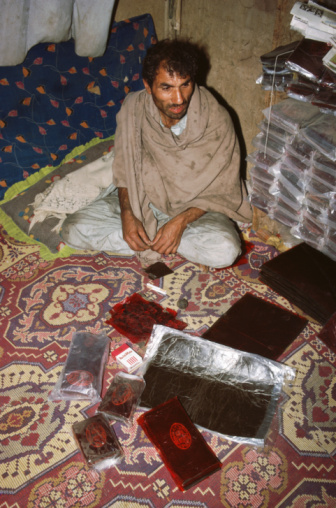
Taken from All About My Hat The Hippy Trail 1972
The
street looked like a chaotic mishmash of tumble-down buildings with
broken or torn flags hanging everywhere. The road was pot-holed. It
was crowded with people. There was a restaurant across the road. Al
took a photograph – not many left.
There
was no toilet in the room. In fact, there did not seem to be one
visible at al. So still with me on his head, he went to the
reception to ask.
“On
roof,” said the small man sitting behind a desk reading a
newspaper. He did not seen interested.
Al
climbed two flights of stairs to find a door that opened onto the
roof.
In
the middle of the roof was a wooden structure with three doors, a
couple of steps up and inside there was a hole in the concrete floor
and a jug of water. The water was to wash instead of the Western
toilet papers we had seen in some cities.
Below
the hole was another level of concrete – piled with human shit. It
was smelling real bad even though the day was cooling fast as the
light was beginning to fade. The whole place was, of course,
swarming with flies.
Later
Al learned that the place was emptied once a day, the shit shovelled
into wicker baskets lines with rushes and leaves, to be carried down
through the hotel and into the street. Al could not imagine what
they did with it after that. Those poor women deserved a reward. But
he had nothing spare to even offer.
A
while after returning to the room, there was a knock on the door.
Keith jumped up and opened it and there stood Hellmut, grinning and
with a smoking joint in his hand.
“Hello
my friends, you want to smoke some hash with me and I buy you
dinner?”
So
they puffed on the joint, their spirits again lifting. Al had been
wondering where he was – absolutely everything was so different to
his home city; in fact it was so different to anything else he had
seen even in the places we had passed through.
Al
was thinking, what is different: well for starters the smells and the
air, the people and their costumes, the language and the script, the
food and the drink, the streets and the buildings, the transport, the
health care, the hygiene and safety rules and protection, life
expectancy and family life, politics and religion, even the ways in
which business was conducted - people argued over prices.
And,
thought Al, what is the same – well I guess I am, he thought – I
guess everyone, well most people, have two arms, two legs and two
eyes; we're all breathing; we probably all want the same thing, We
all want to achieve something and to find fulfilment, peace, love,
freedom.. We probably all wonder at some time what life is all about
– or maybe their religions satisfy all that.
Al
began wondering why he was travelling – what was he looking for.
Religion and science had failed him, now he was feeling like he was
wandering far from home, maybe risking his health and safety, taking
risks in a dangerous part of the world and with very little money.
“Am I nuts?” he thought.
But
so far this adventure had gone well, and in any case there was only
one direction to go and that was India. Al thought that it was said
people could find answers in India – it was where The Beatles had
gone to their Guru called Mahesh Yogi. It was a land of many
beliefs, supposedly with enlightened beings willing to impart the
truth. Or so he'd read. Probably not like that at all. And,
thought Al, I probably don't have enough money to buy enlightenment.
Outside
in the damp street, the women were dressed in black Burkas again, or
colourful cloth wraps, except the Westerners of course. Some of them
were well covered too and many wore head scarves. Almost all the
Western men wore blue jeans, some with hats of varying sorts, and one
even looking quite like myself.
The
local men were of two distinct types. One lot were quite short in
height and slight, dressed in what often looked like dirty pyjamas
with white caps or wrapped in sheets of cloth. The other lot were
massive, thick set giants over 6 feet in height, wearing turban-like
headgear and armed with rifles and long swords.
Bicycles,
three wheeler Rickshaws, and beasts of burden, were the main form of
transport here.
Al
spotted a sign above a doorway. It was a drawing of a set of false
teeth.
There
were three-wheeled street stalls with massive piles of apples,
oranges, lemons and yellow and green melons for sale. Dirty-looking
streets stalls offered strange looking food in huge pans cooking over
charcoal or wood fires.
“You
know, my friends, Peshawar is called the 'City of Thieves' – you
can buy guns here – be careful with your bags,” said Hellmut.
“Fucking
great, man,” said Keith.
The
street was filthy.
“Two
nights here, then I am going to Lahore on the train, if you want, my
friends, I will tell the manager at the hotel and he will buy us
tickets,” said Hellmut.
“How
much do the tickets cost?” asked Keith.
“No
problem my friends I am paying, you are my guests. Now we go to
special place to eat and we can smoke hashish. It is called The
Secret Restaurant and my friend from Berlin, Karl is running it.
And his wife Marianna is from Switzerland. They have good vegetarian
food and good music.
The
Secret Restaurant was actually inside a large second floor apartment
down a poorly lit back street and on to another main road, this time
far busier with trucks, carts, colourful coaches, cars and bicycles –
and men with donkeys carrying either them or their wares. The
roadway and pavements were equally muddy and dirty and it was quite
noisy. Street stalls were still selling fruit and vegetables and
bottles of fizzy drinks – a lot of signs for Pepsi. Other stalls
were issuing clouds of smoke or steam, offering a whole range of
quite unpleasant looking foods. Hygiene was an absentee here.
But
the apartment building itself, behind a large wall separating it from
the road, and guarded at the entrance by a costumed and armed giant
from the hills, was remarkably clean.
The
guard greeted Hellmut and let us pass through the arched gateway.
Hellmut pressed a buzzer near the doorway and soon a pretty young
lady came to let us in. Hellmut greeted Marianna, they hugged like
good old friends. She led the way for us up the stairs and into the
apartment.
The
apartment consisted of at least two bedrooms, kitchen, western toilet
with shower and a massive living room with a balcony looking out on
to what may have been the back garden or a park. There were several
round tables with chairs in the room seating for maybe 16 people.
That still left plenty of room for the many cushions scattered around
by the walls. About half a dozen people sat at tables another half a
dozen or so on the cushions. A young dark-haired girl was playing a
guitar and singing 'The Circle Game”, a Joni Mitchelle song.
For
a second or two Al thought it was Miriam, but no.
Al
could see outside through a double glass door was a balcony – he
could see people were smoking.
The
three of us sat at a table; Al took me off his head and put me next
on the table next to the fourth chair which was empty. I felt as if
I too was a guest at this meal.
The
meal was three courses of vegetarian food – two choices for each
course.
Al
chose dahl with bread, a Madras vegetable curry with rice, and
pancakes with fruit. The dahl was a very hot dish made from lentils
and onions and garlic. It was all delicious, to Al's taste. And
Keith had finished his plates too. Keith had eaten vegetable samosas
– triangle of pastry with spicy potatoes and vegetables inside –
pasta with creamy sauce and cheese, and rice pudding for afters.
They
each drank a beer. It was the first alcohol Al had drank since the
Ouzo in Syria. It was not as strong but still went straight to his
head. He felt giggly.
Afterwards
they smoked chillums on the balcony, looking down on a garden
complete with flowers and a small pool with trickling water.
Al
was lost looking down at that pool. Suddenly he began to wonder
where he was.
One
minute there's a dirty gloomy fearful city at night, with all the
hustle and bustle and smoky fumes. Next, a veggie banquet with beer
and chillums and Hendrix playing ' Foxy Lady' on a balcony above a
heavenly garden. "Maybe in fact", thought Al, "we're
actually all dead! Or just sleeping, dreaming. Or being dreamt?"
Al
was thinking of the nature of reality - or was it illusion? Science
had told him that everything was made of atoms and molecules, forms
of energy, but those very atoms were almost all space, with wisp-like
clouds of negative charge called electrons around a positively
charged nucleus itself made of tiny particles that were sometimes
behaving like particles and sometimes like waves – the
wave-particle duality. And in between it all, 99% was nothing but
space. So we are all mostly space.
Al
thought that just as ridiculous to believe as a religion saying we
were all made out of and by some supreme creator four thousand years
ago in the Garden of Eden.
And
where was the Garden of Eden anyway?
Certainly
not in Peshawar.
With
that he realised he was sitting on a balcony, high as a kite, looking
at a pool of water.
They
drank another beer and Hellmut led them back to the hotel, this time
taking a slightly different, longer but better lit route.
Was
that fireworks or gunshots we could hear? Guns?
The
next day was spent mostly in the Secret Restaurant smoking talking
and eating.
The
morning after that, they took the train to Lahore – direction
India.
In
comparison to the bus rides, the train journey was boring. It was
about three hundred and twenty miles but it took many hours.
When
they reached Lahore, Hellmut took a taxi to a hotel he knew and they
soon booked in. It was another hotel for mostly western travellers.
It
was the Hotel Eden!
A
small hotel with about a dozen room surrounding a small open garden
with small shady trees, potted flowers and a pool in the centre!
Eden!
Was this the Garden of Eden that Al had been thinking about at the
Secret Restaurant in Peshawar?
The
hotel also had a games room and Al looked inside; it had a pool
table, table tennis and darts board.
He
went to their room, small but comfortable, with two beds, dressing
table with mirror and another table with one chair. On the way in he
spotted a machine offering fizzy drinks and bought two for a few
rupee coins.
Inside
the room, Keith said:
“I'll
read you a bit about Lahore,” and opened his travel guide.
“Lahore
is the capital city of the Pakistani province of Punjab and the
second largest metropolitan area in the country.
"It
is the largest native Punjabi-populated city in the world and an
important historical centre in South Asia. With a rich history dating
back over a millennium, Lahore is a main cultural centre of Punjab
region and Pakistan. One of the most densely populated cities in the
world, Lahore remains an economic, political, transportation,
entertainment, and educational hub. It is referred to as the "Mughal
City of Gardens" due to the historic presence of gardens in and
around the city dating back to the Mughal period.
“Lahore
successively served as a regional capital of the empires of the Shahi
kingdoms in the eleventh century, the Ghaznavids in the twelfth
century, the Ghurid State in the twelfth and thirteenth centuries and
the Mughal Empire in the sixteenth century.
"From
1802 to 1849, Lahore served as the capital city of the Sikh Empire.
In the mid-nineteenthth and early twentieth century, Lahore was the
capital of the Punjab region under the British Raj. The traditional
capital
of Punjab for a millennium, Lahore was the cultural centre of the
northern Indian subcontinent which extends from the eastern banks of
the Indus River to New Delhi.
"Mughal
structures such as the Badshahi Mosque, the Lahore Fort, Shalimar
Gardens, the mausolea of Jehangir and Nur Jehan, Chauburji Gate, and
the walled city are some of the major tourist attractions in the
city. Lahore is also home to many British colonial structures built
in the Indo-Saracenic style, such as the Lahore High Court, the
General Post Office, Lahore Museum, Lahore Railway Station, and many
older universities and colleges including the University of the
Punjab, Govt College and King Edward Medical college. The Lahore Zoo,
thought to be the fourth oldest in the world, is also situated here.
“Lahore
was called by different names throughout history. To date there is no
conclusive evidence as to when it was founded. Some historians trace
the history of the city as far back as four thousand years ago.
However, historically, it has been proved that Lahore is at least two
thousand years old. Hieun-tsang, the famous Chinese pilgrim has given
a vivid description of Lahore which he visited in the early parts of
the seventh century. Lahore has been ruled and plundered by a number
of dynasties and hordes.
“Maharaja
Ranjit Singh made Lahore his capital and was able to expand the
kingdom to the Khyber Pass and also included Jammu and Kashmir, while
keeping the British from expanding across the River Sutlej for more
than forty years. After his death in 1839 the internecine fighting
between the Sikhs and several rapid forfeitures of territory by his
sons, along with the intrigues of the Dogras and two Anglo-Sikh wars,
eventually led to British control of the Lahore Darbar ten years
later. For the British, Punjab was a frontier province, because
Lahore had boundaries with Afghanistan and Persia. Therefore, the
Punjabis, unlike the Bengalis and the Sindhis, were not allowed to
use their mother tongue as an official language. The British first
introduced Urdu as an official language in Punjab.
“Lahore
played a special role in the independence movements of India. The
1929 Indian National Congress session was held at Lahore. In this
Congress, the Declaration of the Independence of India was moved by
Jawaharlal Nehru and passed unanimously at midnight on 31 December
1929.
“Upon
the independence of Pakistan, Lahore was made capital of the Punjab
province in the new state of Pakistan. Almost immediately, large
scale riots broke out among Muslims, Sikhs and Hindus, causing many
deaths as well as damage to historic monuments—including the Lahore
Fort, Badshahi mosque and colonial buildings. With United Nations
assistance, the government was able to rebuild Lahore, and most scars
of the communal violence of independence were erased. Less than 20
years later, however, Lahore once again became a battleground in the
War of 1965. The battlefield and trenches can still be observed today
close to the Wagah border area.
“Lahore
has a semi-arid climate.
"The
hottest month is June, when average highs routinely exceed 104°.
“That's
about right, it's damned hot even now in the evening,” said Al.
It
was indeed one of the hottest places Al had ever been to. At night
the choice was between sweating it out and tossing and turning, or
awake with the powerful and noisy ceiling fan blowing at the bed
sheet. In the day it was difficult to move at all.
Hellmut
arrived at their room and they smoked joints.
The
following morning, breakfast was provided by the Hotel Eden. There
were eggs, cheeses, breads, fruits, yoghurt and tea or coffee with
sweet and spicy cakes.
By
the time they had finished eating, Al was thinking it was already far
too hot to move. We sat in the courtyard under the shade of a tree
and Al took me from his head and placed me on a nearby table.
Hellmut
appeared again and invited Keith and Al to share a “Bhang”.
Al
knew that Bhang was a cold drink made from cannabis and spices,
ground together with milk, clarified butter called ghee and water.
The
Bhang in fact did not taste very good this time, so Al drank his
glassful quickly.
About
half an hour or so later and Bhang! The drink lived up to its name!
They didn't even go outside of the hotel grounds that day. They
spent the day reading and chatting and laughing and eating snacks
with tea. Apart from the effects of the Bhang, it was over 100
degrees Fahrenheit by noon.
At
one time Al decided to go to the games room.
When
he entered it was quite dark but he could see what looked like a
light switch on the wall half way along, so he went to switch it on.
Al
put his hand to switch on the light and as he touched it there was a
loud bang and a flash.
Al
seemed to be flying backwards through the air – he had received an
electric shock – first time for him and first time for me. Very
strange feeling.
As
Al went backwards, time seemed to slow down. Al seemed to have
plenty of time to think about what had happened, how stupid he had
been in the dark, whether he was about to hit his head on anything
and how he would cushion his fall and even what would happen and how
people would react back in England if this was going to kill him.
As
he landed backwards on the floor, he realised he had not hit any
tables or anything and thought about how to best protect his head, so
he did his best to keep his head forward and try to take the force of
the fall on his back and shoulders.
He
bent his head forwards – as he hit the ground I flew off his head,
unable to protect him – lucky for him his method worked and the
back of his head hit the ground quite gently.
But
he was pretty much shook up.
He
returned to the garden and told Keith what had happened.
Keith
seemed like he was in a world of his own, very stoned on cannabis –
he did not reply, as if he had not even heard Al, who felt lucky to
be alive.
“Hey
man,” Keith suddenly said, “it's almost four thousand miles
direct back to London, we must have done six or seven thousand the
way we came.”
The
next day after breakfast in the garden, Hellmut asked Al and Keith if
they would like to join him on a flight to India.
“A
few days time, “ said Hellmut; “They have opened the border with
India and there will be flights from here to Amritsar, I will buy you
the tickets, I just need your names and passport numbers. If you
want we can fly in a few days after I have done business.”
So
Hellmut went off in a taxi to buy the tickets. Al and Keith decided
to go out and look about the city.
It
was about as different, as Al thought, from Peshawar as it is
different from Norwich – or maybe less different from Norwich.
The
streets were now dusty, not wet, but with less litter and animal
droppings.
There
were far more cars, taxis, trucks and buses as well as bicycle
rickshaws, and far fewer animals of burden. Quite a few bicycles
too.
Most
of the men were dressed either in one-piece djellabah’s,
loose-fitting cotton in white or grey, or two-piece cotton garments
that looked like pyjamas. A few wore suits, some western-style,
others high-buttoned jackets over trousers.
The
women wore feminised versions of the same, often with lose scarves
draped over their heads, some dressed quite colourfully.
Children
were dressed pretty much like the adults!
Some
men wore the Afghan Jinnah Cap made from sheep's wool, with it's
peaked shape and favoured by Pakistani politicians. Others wore oval
hats that sat in the middle of their heads not covering the eyes at
all. Others wore turbans.
Al
and Keith found along street with stalls on each side, selling just
about everything except the guns we had seen in Peshawar. The
buildings were three story and had decorative balconies, many with
sheets hanging from them.
Most
of the signs were in Arabic writing but some were in English, many
offering Pepsi or Seven Up drinks.
There
were stalls selling 'lassi”, a drink made from crushed ice with
milk and yoghurt, with sugar or salt to taste, or fruit juices. The
ingredients were scooped up from various aluminium bowls; the ice was
piled up behind the vendor who sat cross-legged as he worked. He
would lean over, grab a lump of ice and smash it between what Al
thought looked like rags. But they were thirsty so they bought and
drank some out of aluminium mugs.
That
evening they met with Hellmut again at the Hotel Eden, smoked some
joints and drank some tea. Hellmut had bought the air tickets for
the next day.
“Then
tonight I invite you to film studio,” said Hellmut. “I am giving
some money to make a film. We will have dinner there, it is gut.
Also you may meet the top singer in Pakistan and a famous actor.. We
leave in half an hour when the taxi is coming.”
It
was a modern-looking building with a couple of guards outside and
they just waved us in.
Inside
the big doors, Hellmut told a receptionist who we were and we were
shown through some corridors to a large room decorated with glitter
and lights, with pictures of people around the walls, presumably film
stars and sponsors.
After
a while two young men approached us – they were dressed
immaculately in suits and ties.
They
shook hands with Hellmut who introduced us simply as “Keith and
Al”. Obviously in such a place, Al had removed me from his head
and I had been placed on a table, so nobody mentioned me. I simply
watched, listened and learned.
A
waiter came and asked us if we wanted to drink; beer was available,
so everyone ordered that. It was American beer.
The
conversation was mainly between Hellmut and the two Lahore lads.
Sure
enough he was going to give them hundreds of thousands of rupees to
make a film. They were saying that the industry had suffered. They
said they had a top actor and one of the best known pop singers.
There was some talk about what the film was about – it sounded that
it was mostly about a man and a woman that met and wanted to be
together but circumstances always interfered.
After
about half an hour, several waiters came in carrying plates and trays
of food: bowls of dahl, flat bread, a spicy lamb dish and more pieces
of lamb and of chicken, a dish made with chick peas and spice,
vegetable curries and rice, yoghurt – and fruits. And a massive
cherry tart! And creamy rice pudding There were five of them eating
with enough food for twenty.
Whilst
they were eating, suddenly a group of about ten people entered and
headed towards them. They were all men except the two women they
were surrounding. Apparently one of the ladies was the pop singer.
As
they approached the others stopped eating and stood up. Al and Keith
did the same. One of the Pakistani hosts at our table spoke,
introducing only Hellmut. Smiles were exchanged, but no words and as
rapidly as they had arrived, the group left.
“So
much for pop stars, man, “said Keith quietly.
After
the dinner, we headed back out into a wide corridor.
As
Al, Keith and Hellmut headed down the corridor, Al noticed something
in another wide corridor off to the left.
There
was a group of about ten young men that seemed to be surrounding a
girl that Al thought was European. Al thought that did not look like
a good situation so decided to look closer.
She
was certainly not Pakistani. She wore a headscarf. She looked
familiar. She looked a bit like Miriam.
Al
started to push his way through the small crowd.
It
was
Miriam!
“Miriam,
hi"!”, he shouted.
“Al!”
she answered and stepped towards him and they gave each other a hug.
All
felt good about that hug.
“You
OK, what's happening?” asked Al.
Miriam
replied: “I'm OK, great, it's just this lot, they think I'm a rock
star!”
“Well
I guess you are!”, said Al, “Shall I get rid of them?”
Al
turned to the crowd of youths and said “OK, that's enough, now fuck
off!”
And,
somewhat to Al's surprise, they did!
Al
told Miriam that he had better go the the exit to tell his friends
what he was doing, so they went down the stairs and back towards the
long wide corridor that led to the exit.
Suddenly
a group of about twenty men were approaching us, all huddled together
but still filling the corridor so all Al and Miriam could do was to
stand close to the wall as the large group passed by.
Al
could see that in the very middle of the group crammed so much that
he had to go with the flow, was Zulfikar
Ali Bhutto,
the President of Pakistan.. Al had the idea he was not entirely
popular with people. “Apparently,” Miriam said later, “he is
on his way to do a TV broadcast, in English as that was the language
shared by most of the people rich enough to have a TV.”
Miriam
told Al that,Bhutto had managed to get the release of thousands of
prisoners and some territory from India, after signing an agreement
with Indira Ghandi, the Prime Minister of India.
When
Al and Miriam reached Keith and Hellmut, Al told them he was going to
stay a while and drink some beer with Miriam and he would make his
own way back to the hotel later. Hellmut passed Al a small paper
bag. “It is blues, speed,” he said quietly, “Take a few and
they will keep you awake and give good buzz”.
Al
swallowed three tablets and went back to Miriam. They drank coffee
instead of beer and chatted for a while. I learned that Miriam had
been invited to the studios for dinner by an American but he had not
turned up. He also discovered that Miriam had a ticket for the same
flight as he for the next day and that she too planned to stay at the
Golden Temple in Amritsar.
After
a while Al started to feel the effects of the pills. He was talking
a lot! Miriam did not seem to mind, she seemed like a good
listener. But Al felt it was time for him to get back to his hotel.
Miriam would get a taxi but it was in the opposite direction to Eden.
Al saw her into the taxi and was about to order one for himself when
one of the young men that had met Hellmut appeared and he offered Al
a lift on the back of his moped.
Quite
a ride – the “speed” in the blues had kicked in and they seemed
to be speeding ever so fast in and out of the busy traffic along
poorly lit roads. I thought that I was going to blow off Al's head
several times and land in the road and get crushed by a car. Gladly
I was OK and we soon reached the Hotel Eden, Keith sitting in the
garden smoking a joint.
So
this “speed” drug seemed to make everything go faster whereas the
electric shock in the hotel games room and the backwards fall had
seemed to make time go more slowly.
“I
didn't expect you back tonight – thought you'd be with Miriam,
What happened man?” said Keith.
“No
I thought I'd better come back and get ready for tomorrow,” said
Al, “and anyway I don't like those pills, I wanted a smoke.”
Several
smokes later, his rucksack mostly packed, Al lay on his bed for hours
tossing and turning. He just could not get to sleep. Keith was
snoring. Al was thinking about Miriam and the flight to Amritsar.